
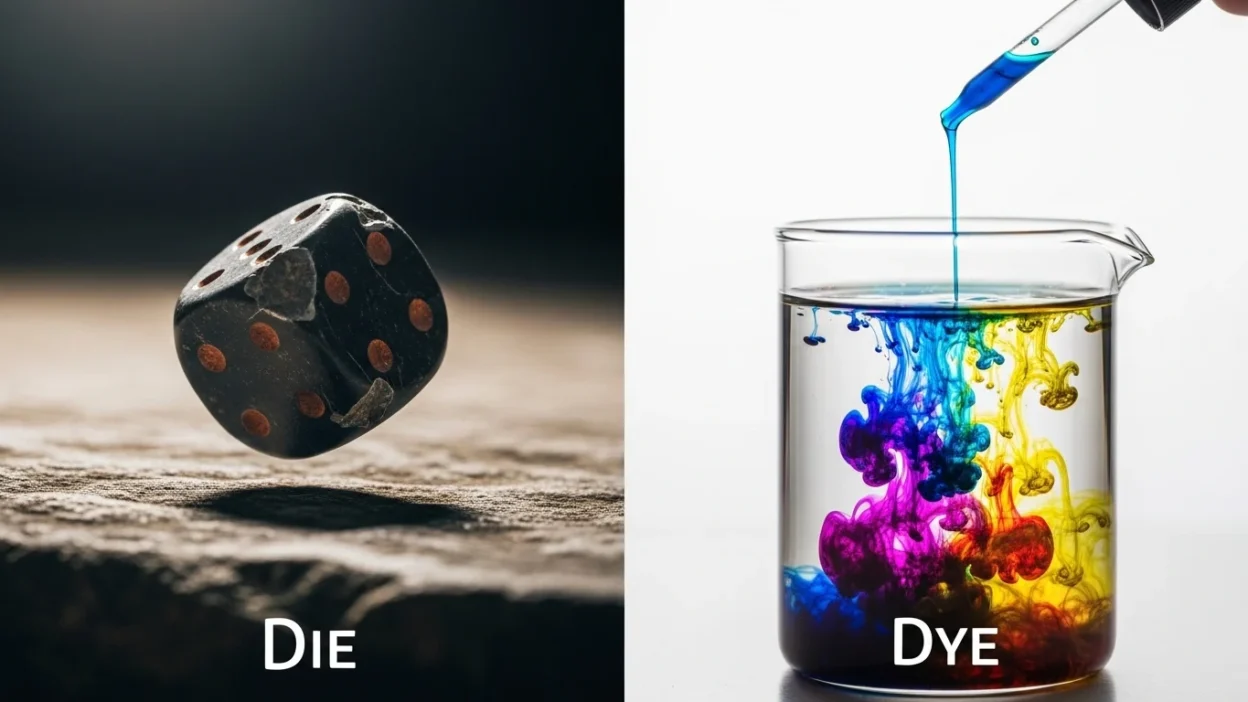
Many English learners get confused between die and dye. The reason is simple: these two words sound exactly the same when we say them. Words that sound the same but have different meanings and spellings are called homophones.
Because they sound alike, people often mix them up in writing. For example, someone may write:
- My hair will die tomorrow.
- The flowers will dye without water.
Both sentences are incorrect, but the mistake happens because the words sound identical.
The good news is that once you learn the meaning and use of each word, the confusion disappears quickly. This guide explains everything in very simple English, so you can understand the difference easily.
Quick Answer: Die vs Dye
Here is the quick and simple difference.
Die
- Means to stop living
- Used for people, animals, plants, or sometimes machines
- Related to death or stopping life
Example:
- The plant will die without water.
Dye
- Means to change the color of something
- Usually used for hair, clothes, fabric, or materials
Example:
- She will dye her hair red.
Simple memory trick
- Die = Death
- Dye = Color
Simple Origin and Background
Understanding where words come from can sometimes make them easier to remember.
Die
The word die has been used in English for hundreds of years. It comes from very old European languages that had similar words meaning to stop living or to pass away.
Over time, the meaning stayed almost exactly the same. Today, die still means to stop being alive.
Example:
- Many plants die in winter.
Dye
The word dye comes from an old word that means coloring material. In the past, people used plants, flowers, and minerals to add color to clothes or fabrics.
For example, people used berries or leaves to make colors for cloth.
Today, dye still means to change or add color to something.
Example:
- They dye fabric in a factory.
Clear Explanation of the Difference
Let’s explain the difference in the simplest way possible.
Meaning of Die
Die is a verb that means to stop living.
It can be used for:
- People
- Animals
- Plants
- Sometimes machines or batteries (informal use)
Examples:
- The fish will die without clean water.
- My phone battery may die soon.
- Many trees die during very cold winters.
In daily English, the word can also be used in expressions like:
- The engine died.
- The excitement died quickly.
In these cases, it means to stop working or stop happening.
Meaning of Dye
Dye is a verb that means to change the color of something.
It is usually used for:
- Hair
- Clothes
- Fabric
- Materials
Examples:
- She wants to dye her hair black.
- They dye clothes in the factory.
- He dyed the shirt blue.
You can also use dye as a noun, meaning the coloring substance itself.
Example:
- The red dye stained the cloth.
Comparison Table
| Feature | Die | Dye |
| Meaning | To stop living | To change color |
| Type of word | Verb | Verb and noun |
| Related to | Life and death | Colors |
| Used for | People, animals, plants, batteries | Hair, clothes, fabrics |
| Example | The plant will die. | She will dye her hair. |
Which One to Use and When
Here is a simple guide to help you choose the correct word.
Use die when talking about life ending
Examples:
- The old dog may die soon.
- Flowers die without water.
- My phone battery will die if I don’t charge it.
Use dye when talking about color
Examples:
- I want to dye my hair brown.
- She dyed her dress green.
- The company dyes fabric for clothing.
Quick thinking tip
Ask yourself one question:
Are we talking about life or color?
- Life → die
- Color → dye
Common Mistakes People Make
Many learners make similar mistakes when writing these words.
Mistake 1: Using “die” when talking about color
Incorrect:
- She will die her hair.
Correct:
- She will dye her hair.
Mistake 2: Using “dye” when talking about death
Incorrect:
- The plant will dye without water.
Correct:
- The plant will die without water.
Mistake 3: Confusing past forms
Past forms are also different.
| Word | Past Form |
| Die | Died |
| Dye | Dyed |
Examples:
- The battery died last night.
- She dyed her hair yesterday.
Everyday Real-Life Examples
Here are examples from daily life situations.
In Emails
Correct:
- My laptop battery died, so I couldn’t finish the work.
- I plan to dye my hair this weekend.
On Social Media
Examples people might write:
- “My phone almost died during the concert!”
- “Just dyed my hair purple!”
In News
Examples:
- Many fish died because of polluted water.
- The company dyes thousands of fabrics every day.
In Daily Conversations
Examples:
- The flowers died because we forgot to water them.
- She dyed her hair blonde last month.
Short Learning Section for Students
If you are learning English, here are simple tips to remember the difference.
Tip 1: Think about the letter Y
The word dye has the letter Y, and Y looks colorful and different.
So remember:
Y → Color → Dye
Tip 2: Think about the word death
Both die and death start with D and have similar sounds.
So remember:
Die → Death
Tip 3: Practice with sentences
Try these simple practice sentences.
Fill the blank with die or dye.
- The plant will ___ without water.
- She wants to ___ her hair blue.
- My phone battery might ___.
- He will ___ the shirt red.
Answers:
- die
- dye
- die
- dye
FAQs
1. Are die and dye pronounced the same?
Yes. They sound exactly the same in English. That is why many people confuse them in writing.
2. What does “die” mean?
Die means to stop living. It is used for people, animals, plants, or sometimes machines.
Example:
The fish will die without water.
3. What does “dye” mean?
Dye means to change the color of something.
Example:
She will dye her hair red.
4. What is the past tense of die?
The past tense of die is died.
Example:
The battery died yesterday.
5. What is the past tense of dye?
The past tense of dye is dyed.
Example:
She dyed her hair last week.
6. Can dye be a noun?
Yes. Dye can be a noun that means a coloring substance.
Example:
The blue dye stained the cloth.
7. Is “die your hair” correct?
No. That is incorrect.
Correct sentence:
- Dye your hair
8. Is “my phone dyed” correct?
No. Phones do not change color in that way.
Correct sentence:
- My phone died.
Conclusion
The difference between die and dye is actually very simple once you understand their meanings.
- Die means to stop living.
- Dye means to change color.
Even though the words sound exactly the same, their meanings are completely different.
Remember this simple rule:
- Life ending → Die
- Changing color → Dye
With a little practice and attention, you will never confuse these two words again. Understanding small differences like this helps students, English learners, and everyday writers communicate more clearly and confidently.

Justin Larry is a talented language writer and content creator at WordHuts.com. She specializes in explaining word differences, grammar tips, and common English mistakes in a clear, practical style. Her engaging content helps readers improve vocabulary, writing skills, and everyday communication, making language learning simple and effective.