Many English learners and even native speakers feel confused about “drier” and “dryer.” These two words look almost the same. They sound the same when spoken, and they both come from the word “dry.”
Because of this, people often wonder:
- Which spelling is correct?
- Are they different words?
- When should I use each one?
The truth is simple: both words are correct, but they are used in different situations. Understanding the difference will help you write clearly and avoid mistakes.
This guide explains everything in very simple English, so students, beginners, and general readers can understand the difference easily.
Quick Answer: Drier vs Dryer
Here is the short answer first.
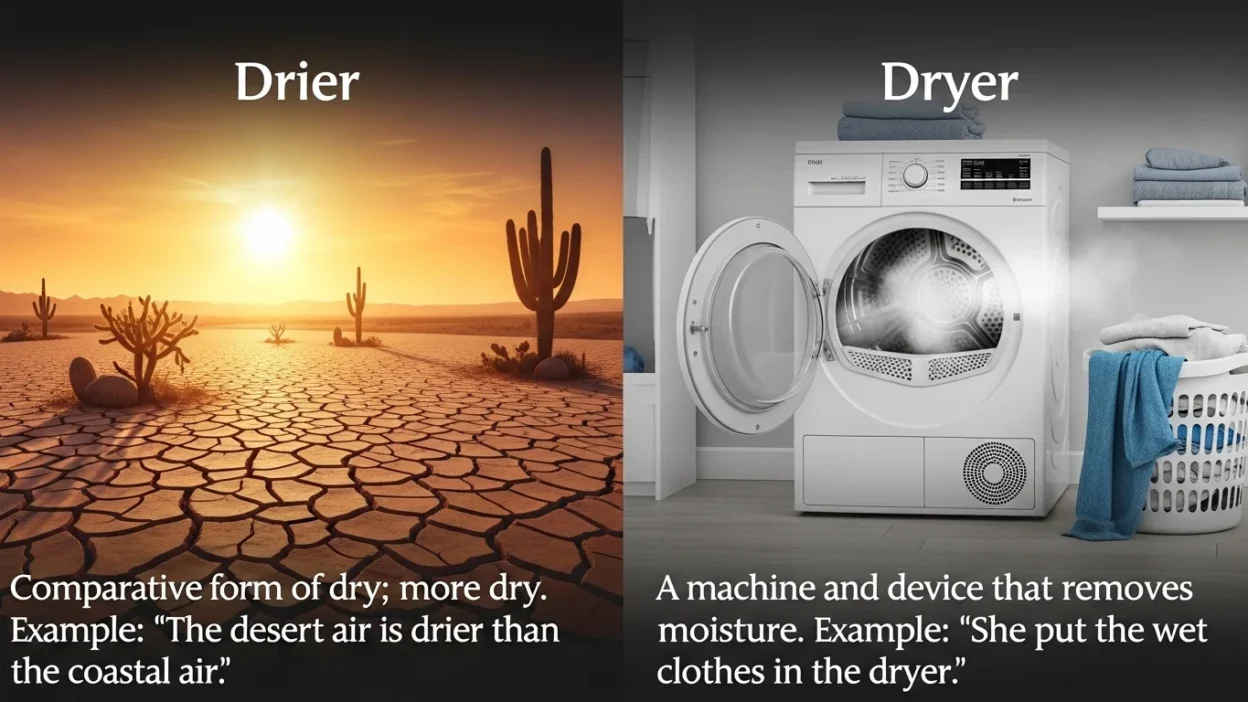
- Drier
- Used when comparing how dry something is.
- It is the comparative form of “dry.”
- Example: Today is drier than yesterday.
- Dryer
- Usually refers to a machine or device that dries things.
- Example: Put the clothes in the dryer.
Easy trick to remember:
- Drier = more dry
- Dryer = machine that dries
Simple Background: Where These Words Come From
Both drier and dryer come from the base word “dry.”
Dry means something has little or no water or moisture.
Examples:
- Dry clothes
- Dry weather
- Dry skin
- Dry land
When we want to compare dryness, English often adds “-er.”
Example:
- Tall → taller
- Cold → colder
- Dry → drier
But English spelling sometimes changes slightly to make words easier to read.
Over time, two forms appeared:
- Drier – used for comparison
- Dryer – used mainly as a noun for machines
This is why the two spellings exist today.
The Main Difference Between Drier and Dryer
Let’s explain the difference in the simplest way possible.
1. Drier: Used for Comparison
Drier means “more dry.”
It is used when you compare two things.
Examples:
- This towel is drier than the other one.
- The desert air is drier than the air near the ocean.
- My skin feels drier in winter.
In these sentences, we are comparing levels of dryness.
So remember:
Drier = comparative form of dry
2. Dryer: Used for Machines
Dryer usually refers to a device that removes water or moisture.
Common examples include:
- Clothes dryer
- Hair dryer
- Food dryer
Examples:
- Put the clothes in the dryer.
- She used a hair dryer after washing her hair.
- The hotel laundry room has two dryers.
Here, dryer is a noun, not a comparison.
So remember:
Dryer = machine that dries something
Quick Comparison Table
| Feature | Drier | Dryer |
| Main meaning | More dry | Machine that dries |
| Type of word | Comparative adjective | Noun |
| Used for comparison? | Yes | No |
| Used for devices? | No | Yes |
| Example | This place is drier than before. | The clothes are in the dryer. |
This table helps you quickly see the difference.
Which One Should You Use?
Use drier when you talk about how dry something is compared to something else.
Examples:
- This year is drier than last year.
- My throat feels drier today.
- The north side of the country is drier.
Use dryer when you talk about machines or tools that dry things.
Examples:
- Turn off the dryer after the clothes are dry.
- I bought a new hair dryer.
- The laundry room has three dryers.
Simple memory trick
Think like this:
- Drier = more dry
- Dryer = device
Common Mistakes People Make
Many learners mix these words because they look similar. Here are some common mistakes.
Mistake 1: Using dryer for comparison
❌ Today is dryer than yesterday.
✔ Today is drier than yesterday.
Why? Because you are comparing weather, not talking about a machine.
Mistake 2: Using drier for machines
❌ Put the clothes in the drier.
✔ Put the clothes in the dryer.
Why? Because it is a machine.
Mistake 3: Thinking only one spelling is correct
Some people believe only dryer is correct. This is not true.
Both spellings are correct, but they have different uses.
Mistake 4: Confusion in fast writing
When people write quickly in messages or social media, they sometimes mix them up.
Example:
❌ My hair is still wet. I need the drier.
Correct:
✔ My hair is still wet. I need the dryer.
Everyday Real-Life Examples
Let’s look at how these words appear in daily life.
In Emails
Example 1:
The weather here is much drier than in my hometown.
Example 2:
Please remove the clothes from the dryer after 40 minutes.
In Weather Reports
This summer is expected to be drier than normal.
Here we compare this summer with other summers.
In Social Media
Example posts:
- “My skin gets drier during winter.”
- “My hair dryer stopped working today.”
At Home
Common sentences people say:
- “The towel is drier now.”
- “The dryer is running.”
- “Hang the clothes if the dryer is full.”
In School or Study
Teachers might say:
- “The desert climate is drier than the forest climate.”
This is a comparison of environments.
Learning Tip for Students and Beginners
If you are learning English, here is a simple way to remember the difference.
Step 1: Ask yourself a question
Ask:
Am I comparing dryness?
If the answer is yes, use drier.
Example:
- The air is drier today.
Step 2: Ask another question
Ask:
Am I talking about a machine?
If yes, use dryer.
Example:
- The dryer is broken.
Step 3: Use a memory trick
Remember this small sentence:
“The dryer makes clothes drier.”
This sentence shows both words clearly.
Frequently Asked Questions
1. Are drier and dryer pronounced the same?
Yes. They usually sound the same in speech. This is why people get confused when writing.
2. Is “dryer” always a machine?
Most of the time, yes. It usually means a device that dries something, such as a clothes dryer or hair dryer.
3. Is “drier” always used for comparison?
Yes. Drier is the comparative form of dry. It means more dry.
Example:
- The climate here is drier.
4. Can dryer ever mean “more dry”?
In very rare cases, some writers use dryer as the comparative form. However, drier is the clearer and more common choice for comparison.
5. Which spelling should students use?
Students should usually follow this rule:
- Drier = comparison
- Dryer = machine
This keeps your writing clear.
6. What is the superlative form?
The superlative form of dry is driest.
Examples:
- This desert is the driest place in the country.
- Winter is the driest season here.
7. Is “hair drier” correct?
It is usually written as hair dryer.
Example:
✔ hair dryer
✔ clothes dryer
8. Why does English have two spellings?
English spelling developed over many years. Some words gained different spellings for different meanings, even if they sound the same.
Conclusion
The difference between drier and dryer is actually very simple once you understand it.
Remember these key points:
- Drier means more dry and is used for comparisons.
- Dryer usually means a machine that dries things.
- Both words come from the base word dry.
- They sound the same, but their meanings are different.
A helpful sentence to remember is:
“The dryer makes clothes drier.”
If you keep this rule in mind, you will rarely make mistakes with these words again.
With practice, the difference becomes clear, and using the correct word will feel natural in everyday English.

Gregory Alexander is a skilled writer and language researcher at WordHuts.com. He focuses on clarifying confusing word pairs, grammar rules, and common usage mistakes. With a passion for precise communication, Gregory creates simple, easy-to-understand content that helps readers strengthen vocabulary, writing accuracy, and everyday English skills.