Many English learners get confused between envelope and envelop because the two words look almost identical.
The only visible difference is the extra “e” at the end of envelope. Because the spelling is so similar, people often mix them up while writing.
Another reason for the confusion is that both words come from the same root idea of wrapping or covering something. However, in modern English they are used in different ways.
One word is a thing, and the other is an action. Once you understand this simple difference, it becomes very easy to remember which word to use.
Quick Answer
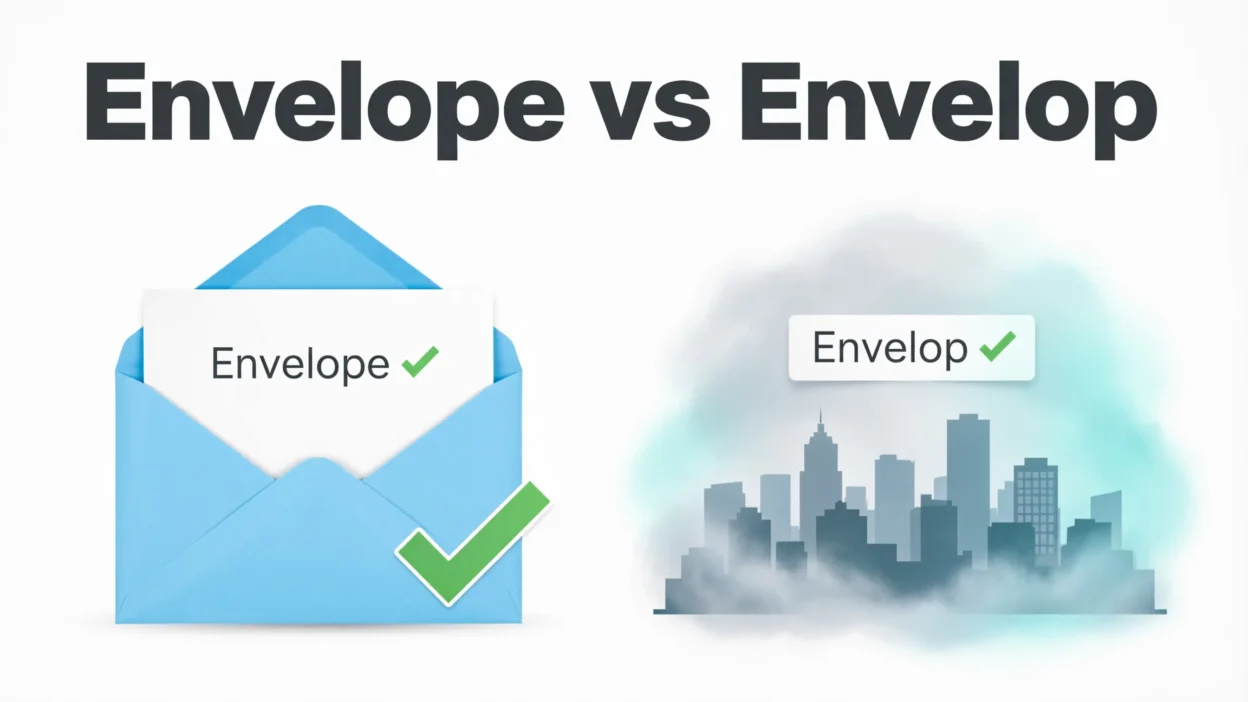
- Envelope → A noun that means a paper cover used to send letters.
- Envelop → A verb that means to surround or cover something completely.
Examples:
- She placed the letter inside the envelope.
- Thick fog began to envelop the city.
Simple Origin or Background Explanation
Both envelope and envelop come from older words that meant to wrap or cover something.
Over time, English created two forms:
- Envelope became the word for the paper cover used to send letters.
- Envelop kept the original meaning of wrapping or surrounding something completely.
Even though they share a similar origin, their meanings and uses are now different in modern English.
Clear Explanation of the Difference
The key difference between envelope and envelop is their part of speech and meaning.
Envelope
Envelope is a noun, which means it is a thing or object.
It refers to the paper container used to hold letters, cards, or documents before sending them through the mail.
Examples:
- She wrote the address on the envelope.
- The invitation arrived in a beautiful envelope.
- Please put the document inside the envelope.
Envelop
Envelop is a verb, which means it describes an action.
It means to cover, wrap, or surround something completely.
Examples:
- A thick fog began to envelop the town.
- Smoke enveloped the building after the fire.
- A feeling of happiness enveloped the room.
Comparison Table
Feature | Envelope | Envelop
Meaning | A paper cover used for letters | To surround or wrap something completely
Part of speech | Noun | Verb
Usage | Mail, letters, documents | Describing something covering or surrounding
Example | She opened the envelope. | Darkness began to envelop the forest.
Which One to Use and When
Use envelope when you are talking about mail or paper covers for letters and documents.
Examples:
- Please write the address on the envelope.
- The card came in a red envelope.
Use envelop when describing something covering or surrounding something else.
Examples:
- Smoke started to envelop the room.
- The smell of flowers enveloped the garden.
A simple way to remember:
Envelope = object
Envelop = action
Common Mistakes People Make
1. Using “envelop” when they mean “envelope”
Incorrect:
I placed the letter in the envelop.
Correct:
I placed the letter in the envelope.
2. Forgetting the final “e”
Some people accidentally remove the final e when writing envelope, which changes the word into envelop.
3. Not knowing the difference between noun and verb
Many learners do not realize that envelope is a noun and envelop is a verb.
Everyday Real-Life Examples
Here are examples showing how these words appear in daily life.
At home
She opened the birthday card from the envelope.
In offices
Please seal the envelope before sending it.
In storytelling
Darkness slowly enveloped the village.
In news reports
Thick smoke enveloped the area after the fire.
On social media
I finally received the acceptance letter in the envelope today!
Learning Section for Students and Beginners
Here is an easy trick to remember the difference.
Memory Trick
Think of this rule:
Envelope ends with “e” like “letter.”
Both relate to mail.
For envelop, imagine something wrapping around another object.
Practice Sentences
Fill in the blank with the correct word.
- She sealed the ______ before mailing it.
- A thick cloud began to ______ the sky.
- The invitation arrived in a blue ______.
Answers:
- envelope
- envelop
- envelope
Frequently Asked Questions (FAQ)
1. What does “envelope” mean?
It means a paper cover used to hold letters or documents.
2. What does “envelop” mean?
It means to surround or wrap something completely.
3. Which word is more common?
Envelope is much more common in everyday English.
4. Is “envelop” used in writing?
Yes, but it is mostly used in descriptive or formal writing.
5. Can “envelop” describe emotions?
Yes.
Example:
A feeling of calm enveloped her.
6. Are the words pronounced the same?
They sound similar, but envelope usually has three syllables, while envelop has two.
7. Can these words be used interchangeably?
No. They have different meanings and grammar roles.
8. Is “envelope” used in everyday situations?
Yes. It is commonly used when sending letters, invitations, or documents.
Conclusion
The difference between envelope and envelop is simple once you understand their meanings.
- Envelope is a noun that refers to a paper cover used for letters.
- Envelop is a verb that means to surround or wrap something completely.
Remember this simple rule:
Envelope = object (mail cover)
Envelop = action (to cover or surround)
Learning this difference will help you avoid common mistakes and write more clearly.

Justin Larry is a talented language writer and content creator at WordHuts.com. She specializes in explaining word differences, grammar tips, and common English mistakes in a clear, practical style. Her engaging content helps readers improve vocabulary, writing skills, and everyday communication, making language learning simple and effective.