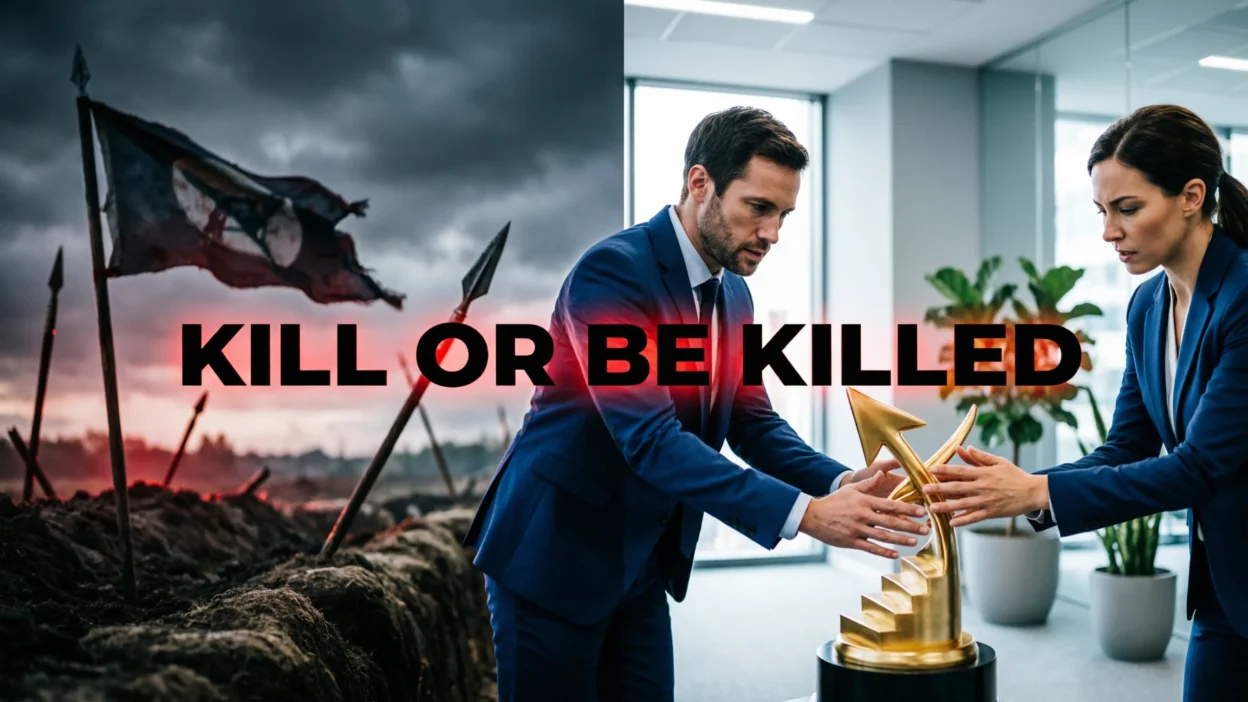
The phrase “kill or be killed” sounds very strong.
When students or English learners hear it for the first time, they often feel confused.
They may ask:
- Does this always mean real death?
- Is it only used in war?
- Can I use it in normal conversation?
- Is it rude or dramatic?
The problem is that this phrase has both a literal meaning and a figurative meaning. If you do not understand the difference, it can be confusing.
In this article, everything will be explained in very simple English so that you can understand it clearly on the first read.
Quick Answer: What Does “Kill or Be Killed” Mean?
“Kill or be killed” means:
- You must defeat or destroy someone
- If you do not, they will defeat or destroy you
- There are only two choices
- The situation is very serious or extreme
It can be used:
- In real life dangerous situations
- In movies and video games
- In sports or business (as strong language)
The key idea is: there is no middle choice.
Origin and Background of the Phrase
The phrase “kill or be killed” comes from real survival situations.
In history, soldiers in war sometimes faced moments where:
- They had to fight to stay alive
- If they did not fight, they would die
In those situations, it was truly “kill or be killed.”
Over time, people began using the phrase in other situations that are not about real death.
Today, it is often used:
- In action movies
- In competitive sports
- In business discussions
- In video games
The meaning has expanded, but the core idea is still the same: only two strong outcomes.
Clear Explanation of the Meaning
Let’s understand the phrase step by step.
“Kill”
This means:
- To defeat completely
- To destroy
- To remove someone as a threat
“Be killed”
This means:
- To be defeated
- To be destroyed
- To lose completely
So when someone says:
“It’s kill or be killed.”
They mean:
- If you do not win, you will lose badly.
- There are only two strong results.
- The situation is intense.
Now let’s understand the most important difference.
Literal vs Figurative Meaning
This is where most confusion happens.
Literal Meaning (Real Danger)
This is used when there is real physical danger.
For example:
In war, soldiers sometimes face kill or be killed situations.
In this case:
- Death is real.
- It is not an expression.
- It is serious survival.
Figurative Meaning (Not Real Death)
This is used when there is strong competition or pressure.
For example:
In the business world, it’s kill or be killed.
In this case:
- No one is dying.
- It simply means strong competition.
- If you do not succeed, you may fail badly.
The context decides the meaning.
Comparison Table
Below is a clear and properly structured comparison table.
| Situation Type | Meaning | Is Death Real? | Example Sentence |
|---|---|---|---|
| War | Fight to survive | Yes | The battlefield was truly kill or be killed. |
| Self-defense | Protect your life | Yes | It was a kill or be killed moment. |
| Business | Intense competition | No | The market feels like kill or be killed. |
| Sports Final | Must win or be eliminated | No | Tonight’s match is kill or be killed. |
| Video Game | Character survival in the game | Fictional | This level is kill or be killed. |
| School Exams | High pressure to succeed | No | Some students feel exams are kill or be killed. |
This table shows how the same phrase changes meaning depending on the situation.
Which One Should You Use and When?
You should use “kill or be killed” when:
- The situation is extreme
- There are only two strong outcomes
- You want to show serious pressure
Do NOT use it:
- In polite business emails
- In calm or peaceful situations
- In small problems
This is a strong phrase. It should not be used casually.
Common Mistakes People Make
Here are common errors learners make.
Mistake 1: Using It for Small Problems
Wrong:
I forgot my pen. It’s kill or be killed.
This is too dramatic.
Better:
I’m in trouble.
Mistake 2: Thinking It Always Means Real Death
Not true.
In many cases, it just means strong competition.
Example:
The fashion industry is kill or be killed.
No one is actually killing anyone.
Mistake 3: Using It in Formal Emails
Avoid writing:
This deal is kill or be killed.
It sounds aggressive and unprofessional.
Mistake 4: Changing the Structure
The correct fixed phrase is:
✔ kill or be killed
❌ kill and be killed
❌ kill or get killed
It is a set expression.
Everyday Real-Life Examples
Let’s look at simple real-life situations.
News Report
Soldiers described the area as kill or be killed.
This is literal.
Business Meeting
Start-ups often feel it’s kill or be killed in the first year.
This is figurative.
Sports Commentary
The final game is kill or be killed — the loser goes home.
No one dies. It means must win.
Social Media Post
In Hollywood, it’s kill or be killed.
This means very competitive.
Video Game Chat
Be careful! This round is kill or be killed!
This refers to in-game survival.
Learning Section for Students and Beginners
If you are learning English, follow these simple tips.
Tip 1: Remember It Is Strong Language
The word “kill” is powerful. Use it carefully.
Tip 2: Always Check Context
Ask yourself:
- Is this about real danger?
- Or is it just about competition?
Context gives you the answer.
Tip 3: Use It for Extreme Situations Only
Do not use it for normal daily problems.
Practice Exercise
Decide if the sentence is Literal or Figurative.
| Sentence | Literal or Figurative? |
|---|---|
| The soldiers faced a kill or be killed decision. | Literal |
| The job market is kill or be killed. | Figurative |
| In this survival game, it’s kill or be killed. | Figurative (fictional) |
| The animal acted in a kill or be killed moment. | Literal |
This practice helps you understand the difference clearly.
Frequently Asked Questions (FAQ)
1. Does “kill or be killed” always mean death?
No. Often it just means strong competition.
2. Is this phrase negative?
Yes, it sounds aggressive and serious.
3. Can I use it in formal writing?
It is usually too dramatic for formal writing.
4. Is it common in movies?
Yes. Action and war movies often use it.
5. Can it be used in sports?
Yes. It describes must-win situations.
6. Is it rude?
It can sound harsh. Use it carefully.
7. Is it a fixed expression?
Yes. The structure does not change.
8. Should beginners use it often?
No. It is better to use it only when necessary.
Conclusion:
The phrase “kill or be killed” describes a situation where:
- You must defeat someone
- Or you will be defeated
- There is no middle choice
Sometimes it means real physical danger.
Sometimes it simply means strong competition.
The most important thing is context.
If you remember that this phrase shows an extreme situation with only two strong outcomes, you will never feel confused again.
Use it carefully, and you will sound confident and natural in English.

Brandon Samuel is a dedicated writer and language enthusiast, serving as the lead author at WordHuts.com. He specializes in explaining word differences, grammar rules, and common language mistakes in simple terms. Brandon’s clear, practical writing style helps readers improve vocabulary, writing confidence, and everyday communication skills.