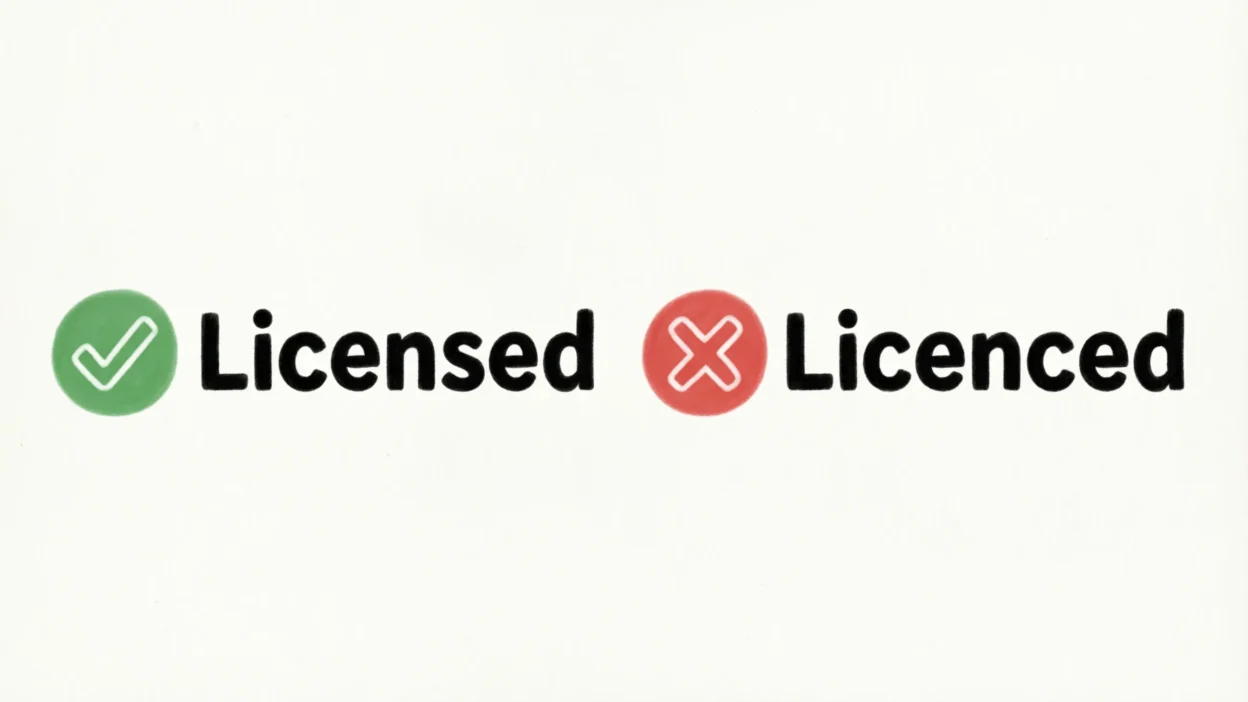
Many English learners feel confused when they see the words licensed and licenced. Both words look almost the same, and many people think they are simply two spelling styles like color and colour.
However, the truth is a little different. In most cases, licensed is the correct spelling, while licenced is usually considered a spelling mistake. Because of this confusion, students and writers often wonder which word they should use.
This article explains the difference in very simple English, so you can clearly understand when and how to use the correct spelling.
Quick Answer
- Licensed is the correct and standard spelling.
- Licenced is usually considered incorrect in modern English.
- The correct word comes from license / licence.
- Licensed is used as a verb and adjective.
- Most dictionaries and style guides prefer licensed.
Example:
- She is a licensed doctor.
- The shop is licensed to sell medicines.
Simple Background of the Word
The word license comes from an old Latin word that means permission or freedom to do something.
Over time, English developed two related forms:
- License – the verb (mainly used in American English)
- Licence – the noun in British English
Examples:
- The government will license the new company.
- He applied for a driving licence.
When we change the word into past tense or adjective form, we add –d, which creates licensed.
Understanding the Main Difference
The important thing to know is this:
Licensed is the correct spelling.
Licenced is normally treated as a spelling error.
Why does this happen?
Because the correct base form for the verb is license, not licence. When we add –d, we get:
license → licensed
Some people mistakenly add –d to the noun licence, which creates licenced, but that spelling is usually not accepted.
Comparison Table
| Feature | Licensed | Licenced |
|---|---|---|
| Correct spelling | Yes | No (usually considered incorrect) |
| Common usage | Very common | Rare |
| Accepted in formal writing | Yes | No |
| Meaning | Having official permission | Same intended meaning but wrong spelling |
| Recommended for students | Yes | No |
Which One Should You Use?
You should always use “licensed.”
It is the correct spelling used in:
- books
- newspapers
- official documents
- education
- professional writing
Examples:
- She is a licensed pharmacist.
- The restaurant is licensed to serve food late at night.
- He became a licensed driver last year.
Using licensed will always be safe and correct.
Common Mistakes People Make
Many learners make small mistakes with this word. Let’s look at the most common ones.
1. Writing “licenced” instead of “licensed”
Incorrect:
- The shop is licenced to sell medicine.
Correct:
- The shop is licensed to sell medicine.
2. Mixing British and American forms
People sometimes mix licence and license incorrectly.
British English:
- noun → licence
- verb → license
American English:
- noun → license
- verb → license
But in both styles, the correct past form is:
licensed
3. Thinking both spellings are equal
Unlike words such as organizing / organising, these two spellings are not equally accepted.
Licensed is the proper spelling.
Everyday Real-Life Examples
You will see the word licensed in many everyday situations.
In emails
Example:
Please make sure the technician is licensed before starting the repair.
In news reports
Example:
The city requires all taxi drivers to be licensed.
In job descriptions
Example:
We are hiring a licensed electrician.
On social media
Example:
Always hire a licensed plumber for home repairs.
In daily conversations
Example:
Is the doctor licensed to practice here?
Learning Tips for Students and Beginners
If you are learning English, remembering the correct spelling can be easy with a small trick.
Simple Memory Trick
Think of the word license.
Add –d:
license → licensed
That’s it.
Practice Sentences
Try reading these sentences:
- He is a licensed pilot.
- The company is licensed by the government.
- She became a licensed nurse last year.
The more you read and write the word, the easier it becomes to remember.
Frequently Asked Questions (FAQ)
1. Is “licenced” a correct word?
Usually no. Most dictionaries and style guides consider it a misspelling.
2. Is “licensed” correct?
Yes. Licensed is the correct and standard spelling.
3. Why do some people write “licenced”?
They mistakenly add –d to licence, which creates the incorrect spelling.
4. Is “licensed” used in both American and British English?
Yes. Both forms use licensed as the past tense and adjective.
5. What does “licensed” mean?
It means having official permission to do something.
Example:
- a licensed doctor
- a licensed driver
6. Can I use “licensed” in formal writing?
Yes. It is the correct choice for formal and professional writing.
7. Is “licensed” a verb or an adjective?
It can be both.
Verb example:
- The government licensed the company.
Adjective example:
- He is a licensed engineer.
8. Is “licensed” commonly used?
Yes. It is very common in education, law, healthcare, and business.
Conclusion
The difference between licensed and licenced is simple once you understand it.
- Licensed is the correct and accepted spelling.
- Licenced is usually considered incorrect.
Whenever you write about someone who has official permission to do something, always use licensed. This spelling is clear, correct, and accepted everywhere.
Learning small spelling differences like this can help you write clearer and more confident English.

Gregory Alexander is a skilled writer and language researcher at WordHuts.com. He focuses on clarifying confusing word pairs, grammar rules, and common usage mistakes. With a passion for precise communication, Gregory creates simple, easy-to-understand content that helps readers strengthen vocabulary, writing accuracy, and everyday English skills.