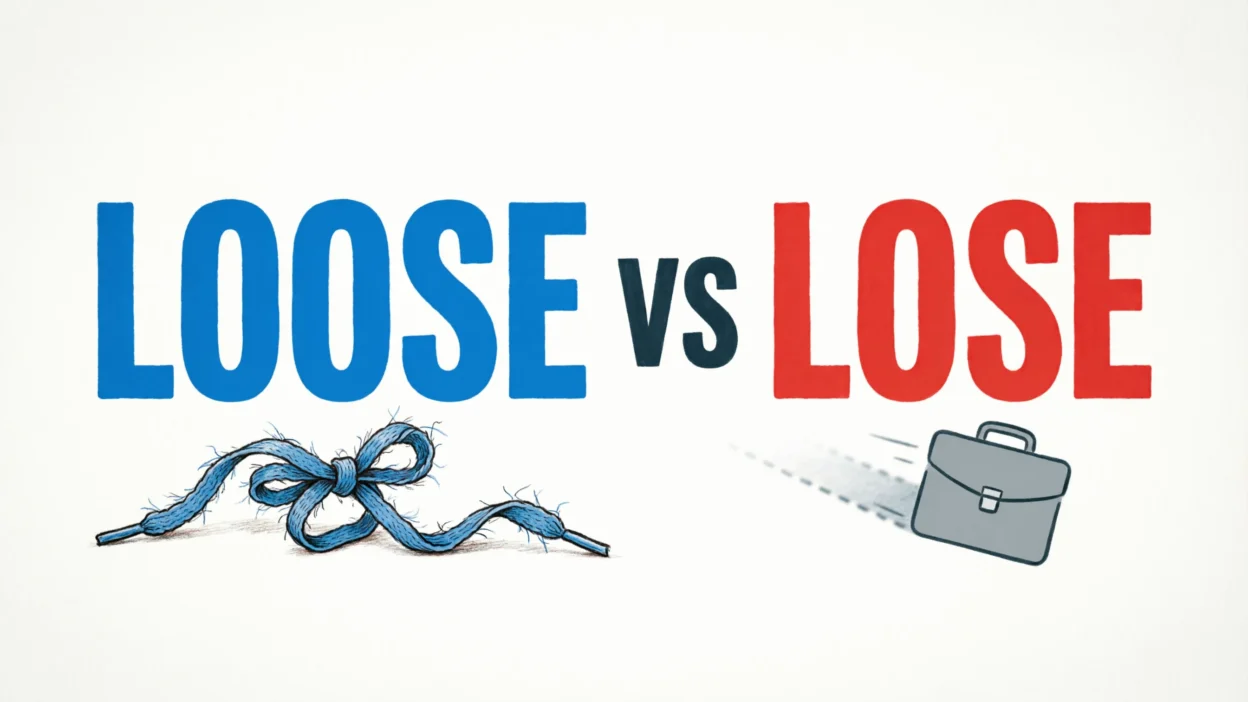
Many English learners mix up loose and lose because the words look very similar. The only difference is one extra letter “o.”
However, their meanings are completely different. One word is an adjective, and the other is a verb. Because of this small spelling difference, people often write the wrong word in messages, essays, and emails.
Understanding the difference will help you write correct and clear English.
Quick Answer
- Loose → means not tight or not firmly fixed
- Lose → means to fail to keep something or not win
Examples:
- The shirt is loose.
- I don’t want to lose my keys.
Simple Background Explanation
Both words come from old English words, but they developed different meanings over time.
Loose originally described something not tight or free.
Lose developed from a verb meaning to fail to keep something or to be defeated.
Even though the words look similar, their grammar and meanings are different.
Clear Explanation of the Difference
The key difference is how the words are used.
Loose is an adjective. It describes a noun.
Examples:
- The bolt is loose.
- Her dress is loose.
Lose is a verb. It describes an action.
Examples:
- I might lose my phone.
- Our team could lose the match.
Remember:
- Loose = describes something
- Lose = action
Comparison Table
| Feature | Loose | Lose |
|---|---|---|
| Part of Speech | Adjective | Verb |
| Meaning | Not tight or free | Fail to keep something |
| Usage | Describes a noun | Describes an action |
| Example | The screw is loose. | Don’t lose the screw. |
Which One Should You Use and When?
Use loose when you are describing something that is not tight.
Examples:
- My shoe is loose.
- The door handle feels loose.
Use lose when talking about losing something or not winning.
Examples:
- I don’t want to lose my wallet.
- The team may lose the game.
Common Mistakes People Make
1. Writing “loose” instead of “lose”
Incorrect:
I don’t want to loose my phone.
Correct:
I don’t want to lose my phone.
2. Writing “lose” instead of “loose”
Incorrect:
My shirt is lose.
Correct:
My shirt is loose.
3. Confusing pronunciation
Some learners pronounce both words the same way, which causes spelling mistakes in writing.
Everyday Real-Life Examples
Here are examples from daily situations.
In emails
Be careful not to lose the documents.
At home
The handle on the door is loose.
At school
If you don’t study, you may lose marks.
In sports
Our team doesn’t want to lose the match.
In clothing
I prefer loose clothes in summer.
Learning Section for Students and Beginners
Here are simple tricks to remember the difference.
Trick 1: Look at the Letters
Loose has two “o” letters, like something wide or relaxed.
Lose has one “o”, like something disappearing.
Trick 2: Remember the Action
If the word describes an action, use lose.
Example:
Don’t lose your keys.
Trick 3: Remember the Description
If the word describes something not tight, use loose.
Example:
The rope is loose.
Practice Exercise
Fill in the blank:
- My shoelace is ______.
- I don’t want to ______ my phone.
- The screw is ______.
Answers:
- loose
- lose
- loose
Frequently Asked Questions (FAQ)
1. What does “loose” mean?
It means not tight or not firmly fixed.
2. What does “lose” mean?
It means to fail to keep something or not win.
3. Is “loose” a verb?
No. It is usually an adjective.
4. Is “lose” an adjective?
No. It is a verb.
5. Why do people confuse these words?
Because they look similar and differ by only one letter.
6. Which word is used for losing a game?
The correct word is lose.
Example:
They might lose the game.
7. Which word describes clothing?
The correct word is loose.
Example:
She likes loose dresses.
Conclusion
The difference between loose and lose is simple but important.
- Loose describes something not tight.
- Lose means to fail to keep something or not win.
Remember this rule:
Loose describes. Lose acts.
Once you remember this small rule, you will never confuse these two words again.

Justin Larry is a talented language writer and content creator at WordHuts.com. She specializes in explaining word differences, grammar tips, and common English mistakes in a clear, practical style. Her engaging content helps readers improve vocabulary, writing skills, and everyday communication, making language learning simple and effective.