Many English learners feel confused between minuscule and miniscule. The two words look almost identical, and the only difference is one letter: “u” in minuscule and “i” in miniscule. Because the pronunciation sounds very similar, people often spell the word incorrectly.
This confusion is very common, even among native English speakers. Many people naturally assume the spelling should be miniscule, but in standard English, the correct spelling is minuscule.
Understanding the correct word will help you avoid spelling mistakes in writing, school assignments, and everyday communication.
Quick Answer
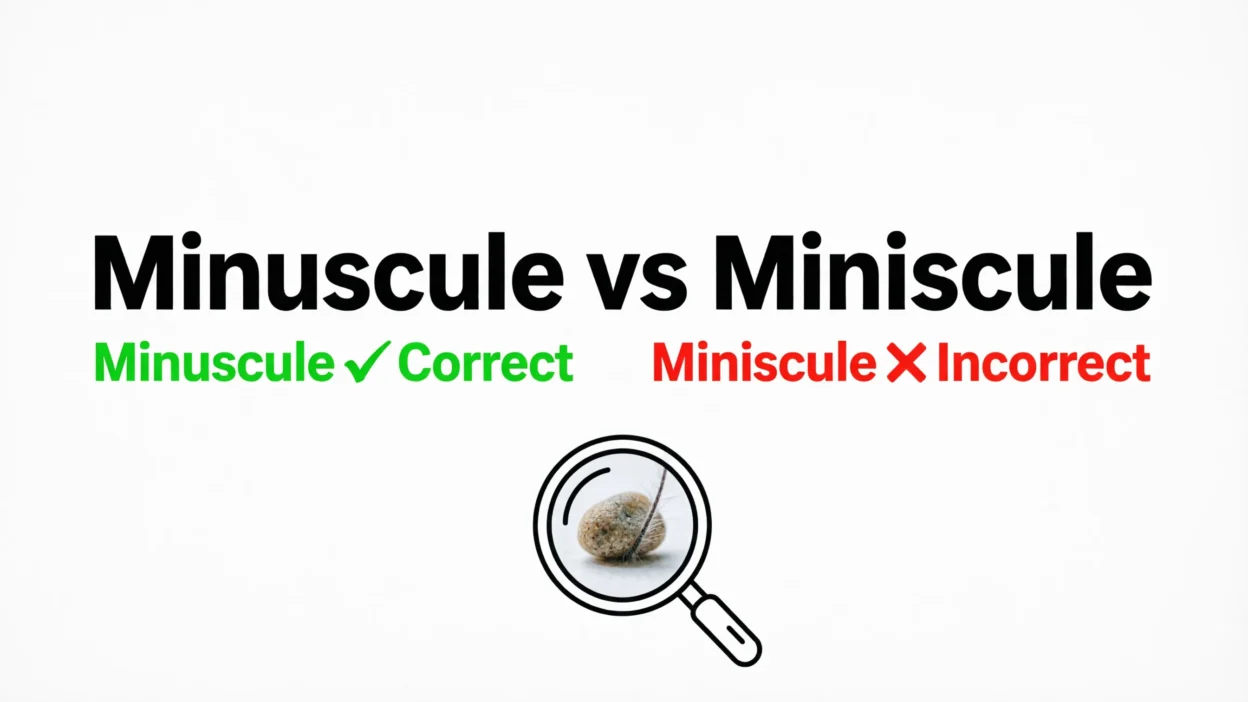
- Minuscule → Correct spelling
- Miniscule → Incorrect spelling
- Minuscule means extremely small or tiny.
Examples:
- The chances of success are minuscule.
- The insect was minuscule, almost impossible to see.
Simple Origin or Background Explanation
The word minuscule comes from a Latin word meaning somewhat small. It was later used in English to describe things that are very tiny or extremely small.
Historically, the word was also used to describe small letters in handwriting or printing, especially in contrast to large capital letters.
The spelling miniscule developed later as a common mistake because people think the word comes from mini, which also means small. However, the correct historical spelling is minuscule.
Clear Explanation of the Difference
The difference between minuscule and miniscule is simple.
Minuscule
Minuscule is the correct adjective used to describe something that is extremely small or tiny.
Examples:
- The difference between the two numbers is minuscule.
- The insect was minuscule.
- The chances of winning are minuscule.
This word is often used in science, writing, and everyday descriptions.
Miniscule
Miniscule is a common spelling mistake. It appears frequently in informal writing, but it is not the standard or accepted spelling in English dictionaries.
Incorrect example:
- The difference was miniscule. ✗
Correct example:
- The difference was minuscule. ✓
Which One to Use and When
You should always use “minuscule.”
Use it when describing something that is very tiny, extremely small, or almost unnoticeable.
Examples:
In everyday conversation
- The difference between the prices is minuscule.
In science or mathematics
- The particle is minuscule in size.
In writing
- The error was minuscule, but it still mattered.
In descriptions
- The crack in the wall was minuscule.
Because miniscule is incorrect, it should not be used in formal or professional writing.
Common Mistakes People Make
1. Spelling it with “mini”
Many people assume the word comes from mini, which leads them to write:
✗ miniscule
Correct form:
✓ minuscule
2. Pronunciation confusion
When spoken, minuscule often sounds like miniscule, which leads to spelling errors.
3. Typing mistakes
Because the word is long, it is easy to mistype one letter when writing quickly.
Everyday Real-Life Examples
Here are examples showing how minuscule is used in daily situations.
In conversations
The difference between the two colors is minuscule.
In science discussions
The organism is minuscule and can only be seen with a microscope.
In news or reports
The change in temperature was minuscule.
On social media
The chances of my favorite team winning are minuscule today!
In everyday descriptions
The crack in the phone screen is minuscule but still noticeable.
Learning Section for Students and Beginners
Here is an easy trick to remember the correct spelling.
Memory Trick
Think of the word:
MINU + SCULE
Notice the letter “u” in the middle.
Remember:
Minuscule → has “u”
This will help you avoid the common mistake miniscule.
Practice Sentences
Fill in the blank with the correct word.
- The insect was ______ and difficult to see.
- The difference between the numbers is ______.
- The scratch on the car was ______.
Answers:
- minuscule
- minuscule
- minuscule
Frequently Asked Questions (FAQ)
1. What does “minuscule” mean?
It means extremely small or tiny.
2. Is “miniscule” correct?
No. Miniscule is considered a spelling mistake.
3. Why do people write “miniscule”?
People often confuse the word with mini, which also means small.
4. Is “minuscule” used in everyday English?
Yes. It is used in conversations, writing, and scientific descriptions.
5. Can “minuscule” describe numbers or differences?
Yes.
Example:
The difference between the two results was minuscule.
6. Can it describe physical objects?
Yes.
Example:
The insect was minuscule.
7. Is “minuscule” used in formal writing?
Yes. It is commonly used in academic and professional writing.
8. How can I remember the correct spelling?
Remember the letter “u” in the middle:
minuscule = correct spelling
Conclusion
The difference between minuscule and miniscule is mainly about spelling.
- Minuscule is the correct word meaning extremely small or tiny.
- Miniscule is a common spelling mistake and should be avoided.
Remember this simple rule:
Minuscule → correct spelling with “u.”
Learning this small detail will help your English writing look clearer and more accurate.

Justin Larry is a talented language writer and content creator at WordHuts.com. She specializes in explaining word differences, grammar tips, and common English mistakes in a clear, practical style. Her engaging content helps readers improve vocabulary, writing skills, and everyday communication, making language learning simple and effective.