
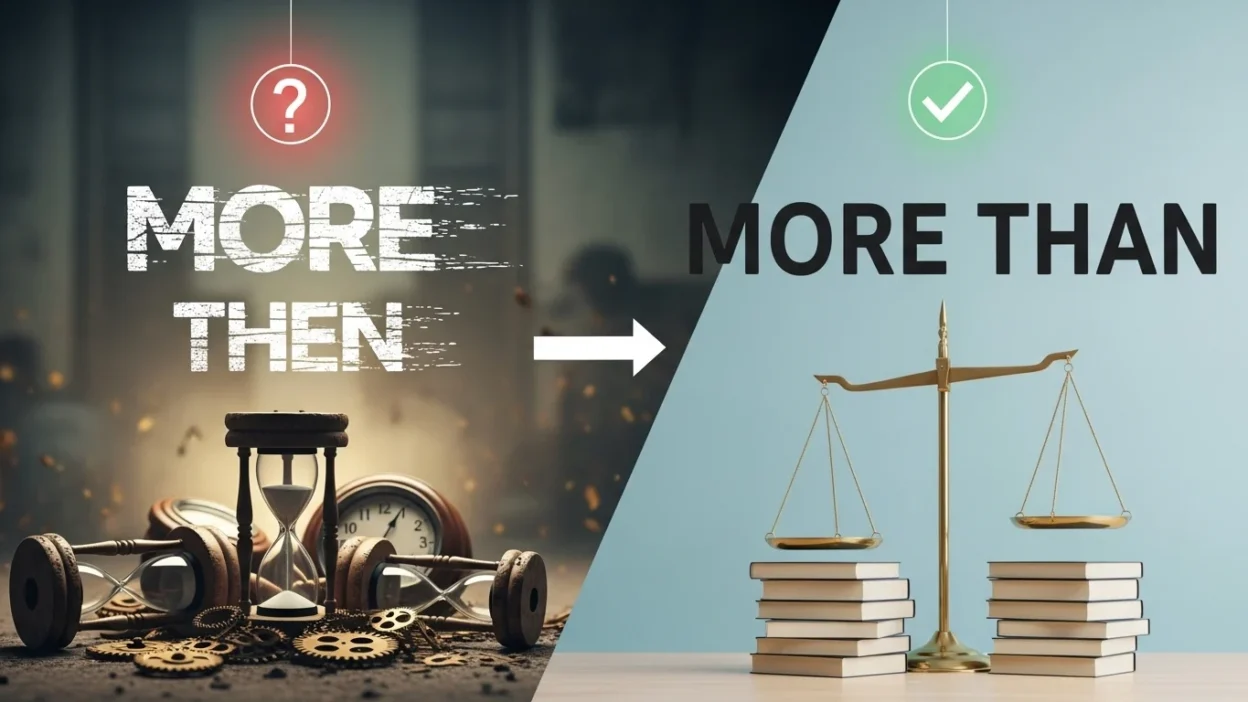
Many students and English learners feel confused when they see “more then” and “more than.” At first glance, the two phrases look almost the same. They only differ by one letter — “e” and “a.”
Because they look so similar, people often type the wrong one, especially when writing quickly in messages, emails, or school assignments.
The truth is simple:
- One phrase is correct in most situations
- The other phrase is usually a mistake
Understanding the difference is easier than many people think. Once you learn a small rule, you will probably never confuse them again.
This guide explains everything in very simple English, with clear examples so beginners can understand it immediately.
Quick Answer
Here is the short and simple answer:
- More than → Correct phrase used to compare numbers, amounts, or levels
- More then → Usually a grammar mistake
- Than is used for comparison
- Then is used for time or sequence
Examples:
Correct:
- She has more than 100 books.
- This phone costs more than the old one.
Incorrect:
- She has more then 100 books.
If you remember just one thing, remember this:
Use “more than” when comparing things.
A Simple Background Explanation
To understand the difference, it helps to know what “than” and “then” mean.
The word “than”
“Than” is used when we compare two things.
Examples:
- taller than
- faster than
- bigger than
- more than
Example sentence:
- My brother is taller than me.
The word “then”
“Then” is related to time or order.
It shows what happens next.
Examples:
- First we ate dinner, then we watched a movie.
- Finish your homework, then you can play.
Because these two words have different meanings, “more then” normally does not make sense in English.
The Clear Difference Between “More Then” and “More Than”
Let’s break it down simply.
More Than
“More than” means a larger number, amount, or level.
It is used when comparing quantities.
Examples:
- More than 10 students came.
- The movie lasted more than two hours.
- I drank more than three cups of tea.
In all these examples, we are talking about numbers or amounts.
More Then
“More then” is not correct in standard English when used this way.
People usually write it by accident because then and than sound similar when spoken quickly.
Example mistake:
- ❌ There were more then 50 people.
Correct version:
- ✅ There were more than 50 people.
Simple Comparison Table
| Phrase | Correct or Incorrect | Meaning | Example |
| More than | Correct | A larger amount or number | She has more than 200 followers |
| More then | Usually incorrect | Does not fit comparison meaning | ❌ more then 200 people |
| Than | Used for comparison | Bigger than, faster than | He runs faster than me |
| Then | Used for time/order | After that | Eat first, then rest |
This table shows the key idea:
Than = comparison
Then = time
Which One Should You Use?
In almost every situation, the correct phrase is:
More than
Use it when talking about:
Numbers
- more than 20 students
- more than 5 hours
- more than 1,000 views
Example:
- The video received more than 10,000 likes.
Amounts
- more than enough
- more than expected
Example:
- We have more than enough food.
Comparisons
Example:
- This book is more interesting than the last one.
Time or measurements
Example:
- The meeting lasted more than two hours.
Remember This Easy Rule
If you are comparing numbers, sizes, or amounts, always use:
more than
Common Mistakes People Make
Many learners repeat the same mistakes. Here are some common ones.
Mistake 1: Mixing Up Than and Then
Incorrect:
- She earns more then her brother.
Correct:
- She earns more than her brother.
Mistake 2: Typing Quickly
Sometimes people know the correct rule but type fast and write then instead of than.
Example:
- ❌ more then 100 people
Correct:
- ✅ more than 100 people
Mistake 3: Pronunciation Confusion
In casual speech, than and then can sound similar. This makes learners think they are interchangeable.
But in writing, they must be used correctly.
Mistake 4: Copying Informal Online Writing
On social media, people sometimes write quickly and ignore grammar rules.
Example:
- “There were more then 500 comments!”
This is common online, but it is not correct English.
Everyday Real-Life Examples
Here are examples from daily life so you can see how the phrase works naturally.
Emails
- We received more than 300 responses to the survey.
- The meeting will take more than an hour.
News
- The event attracted more than 10,000 visitors.
- The storm affected more than five cities.
Social Media
- The video reached more than 1 million views.
- She gained more than 5,000 followers overnight.
Daily Conversation
- I slept more than eight hours last night.
- This bag weighs more than I expected.
- The line had more than 50 people.
School Examples
- The class read more than three chapters today.
- The library has more than 20,000 books.
These examples show that “more than” is used everywhere in English.
A Short Learning Section for Students
If you are learning English, here is an easy way to remember the rule.
Step 1: Ask Yourself a Question
Are you comparing numbers or amounts?
If yes → use more than
Example:
- more than 5 apples
- more than 10 minutes
Step 2: Think About Time
If you are talking about what happens next, use then.
Example:
- Finish your work, then relax.
Step 3: Practice With Simple Sentences
Fill in the blank:
- There are more ___ 100 students.
- Eat your dinner, ___ watch TV.
- She has more ___ her sister.
Answers:
- than
- then
- than
Practicing like this helps you remember the difference quickly.
FAQ Section
1. Is “more then” ever correct?
In normal grammar, no. It is usually a mistake. The correct phrase is more than.
2. Why do people write “more then”?
Because then and than sound similar when spoken quickly.
Many people type the wrong one without noticing.
3. What does “more than” mean?
It means a larger number, amount, or degree.
Example:
- The project took more than three weeks.
4. When should I use “then”?
Use then when talking about time or order.
Example:
- First finish your homework, then go outside.
5. Is “more than” used with numbers only?
No. It can also describe amounts, levels, or comparisons.
Example:
- The story is more than interesting.
6. Is it a big grammar mistake?
It is a small but noticeable mistake, especially in formal writing.
Teachers and editors usually correct it.
7. How can I remember the rule easily?
Use this simple idea:
Than = comparison
Then = time
8. Do native speakers make this mistake?
Yes, sometimes. It often happens in fast typing or casual online writing.
Conclusion
The difference between “more then” and “more than” is actually very simple once you understand the rule.
Remember these key points:
- More than is the correct phrase used for comparisons.
- Than is the word used when comparing numbers, amounts, or levels.
- Then is related to time and sequence.
- “More then” is usually just a typing or grammar mistake.
A good way to remember the rule is:
If you are comparing → use “than.”
With this simple idea in mind, you can confidently write sentences like:
- more than 50 people
- more than two hours
- more than expected

Justin Larry is a talented language writer and content creator at WordHuts.com. She specializes in explaining word differences, grammar tips, and common English mistakes in a clear, practical style. Her engaging content helps readers improve vocabulary, writing skills, and everyday communication, making language learning simple and effective.