
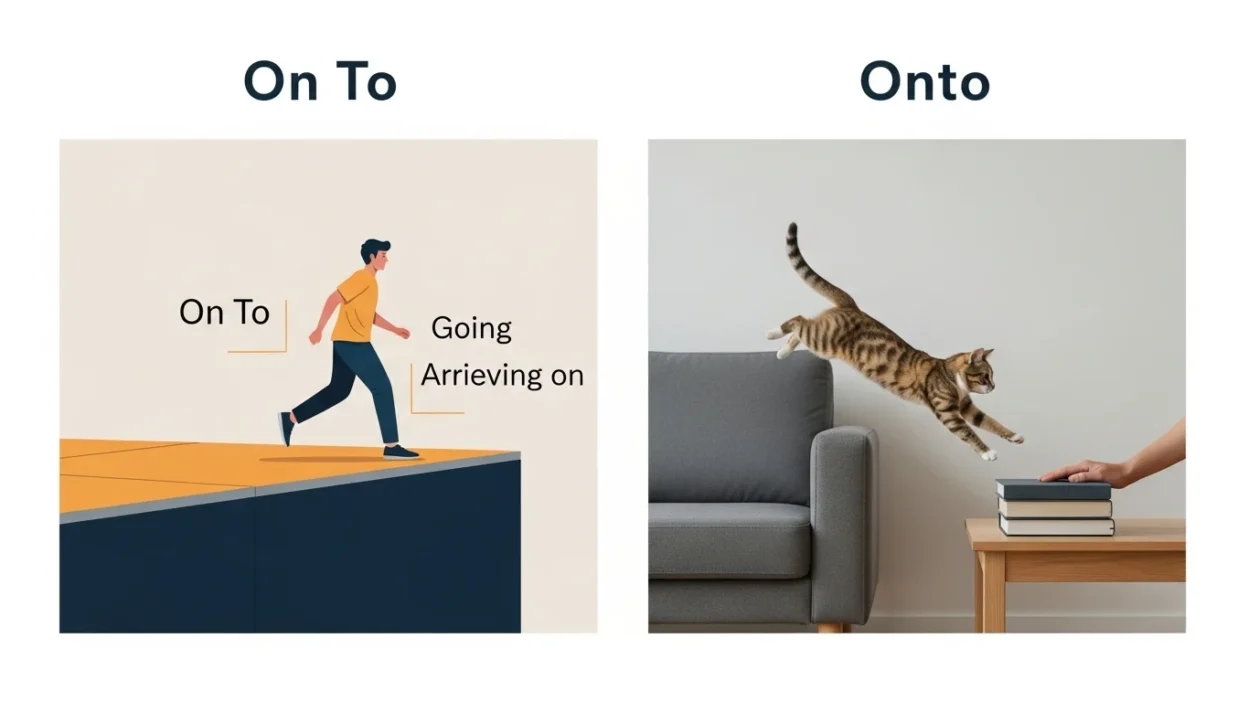
Many English learners feel confused about “on to” and “onto.”
At first look, they seem almost the same. The only difference is a space. Because of this, people often think they mean exactly the same thing.
But in English, small changes can create different meanings. Sometimes “onto” is the correct word, and sometimes “on to” is the correct choice.
The good news is that the difference is actually very simple once you understand the idea behind each one. In this guide, you will learn the meaning in clear and easy English with many examples.
By the end, you will feel confident using both “on to” and “onto.”
Quick Answer
Here is the simple rule most learners remember:
- Onto = movement to a surface
- On to = continuing to the next thing
Examples:
- The cat jumped onto the table.
- After math class, we moved on to science.
Quick summary:
- Use “onto” when something moves to a place or surface
- Use “on to” when something continues to the next step, topic, or stage
Simple Background
The words “on” and “to” have existed in English for many centuries.
Originally:
- “On” described a position on a surface
- “To” showed direction or movement
Over time, English speakers sometimes joined the two words together, forming “onto.”
This new word helped show movement to a surface more clearly.
However, the two words did not always combine. In many situations, “on” still belongs to a verb, while “to” belongs to the next action.
That is why both forms still exist today.
The Difference Between “On To” and “Onto”
Let’s explain the difference in the simplest way possible.
Meaning of “Onto”
Onto means movement toward a surface.
Something moves from one place to a position on top of something else.
Examples:
- She climbed onto the roof.
- The child jumped onto the bed.
- The dog ran onto the road.
In each example:
- There is movement
- The movement ends on a surface
Meaning of “On To”
On to means continuing to the next thing.
It often appears with verbs like:
- move
- go
- continue
- pass
- carry
Examples:
- Let’s move on to the next chapter.
- The meeting moved on to another topic.
- She went on to become a teacher.
Here, nothing is moving onto a surface. Instead, something continues to the next stage or idea.
Comparison Table
| Feature | Onto | On To |
| Form | One word | Two words |
| Main meaning | Movement to a surface | Continue to the next thing |
| Common use | Physical movement | Progress or transition |
| Example | The cat jumped onto the chair. | Let’s move on to the next topic. |
| Easy reminder | Think position | Think progress |
Which One Should You Use?
A simple way to decide is to ask two questions.
Question 1: Is something moving to a surface?
If yes, use ONTO.
Examples:
- He stepped onto the stage.
- The bird flew onto the fence.
- She climbed onto the bus.
Question 2: Are we continuing to the next step or idea?
If yes, use ON TO.
Examples:
- The teacher moved on to a new lesson.
- We will go on to the next slide.
- After lunch, we went on to the museum.
Common Mistakes People Make
Many learners mix these two forms. Here are the most common mistakes.
Mistake 1: Using “onto” for topics
Incorrect:
- Let’s move onto the next topic.
Correct:
- Let’s move on to the next topic.
Why?
Because the sentence talks about continuing, not movement to a surface.
Mistake 2: Using “on to” for physical movement
Incorrect:
- The cat jumped on to the table.
Correct:
- The cat jumped onto the table.
Why?
Because the cat moves to a surface.
Mistake 3: Thinking they are always interchangeable
Sometimes people believe both forms are always acceptable.
But in many sentences, only one form makes sense.
Understanding the meaning helps you choose correctly.
Everyday Real-Life Examples
Let’s look at examples from daily communication.
Emails
- Let’s move on to the next project.
- Please step onto the platform before scanning your ticket.
News Sentences
- The athlete jumped onto the podium after winning the race.
- The discussion moved on to economic issues.
Social Media
- My cat just climbed onto my laptop again.
- After finishing one series, I moved on to another show.
Daily Conversations
- He stepped onto the train quickly.
- The teacher went on to explain the next idea.
- The child climbed onto the sofa.
- After breakfast, we moved on to our work.
These examples show how naturally both forms appear in daily English.
Learning Tips for Students and Beginners
If you want to remember the difference easily, try these tips.
Tip 1: Think about movement
If you imagine something physically landing on something, the word is probably ONTO.
Example:
- jump onto
- climb onto
- step onto
Tip 2: Think about progress
If the sentence shows progress or continuation, the correct form is ON TO.
Example:
- move on to
- go on to
- continue on to
Tip 3: Use the “surface test”
Ask yourself:
Is there a surface like a table, floor, stage, or roof?
If yes → ONTO
Example:
- The dog jumped onto the couch.
Tip 4: Practice with simple sentences
Practice helps memory.
Example practice:
- She climbed ___ the ladder.
- Let’s move ___ the next chapter.
Answers:
- onto
- on to
FAQs
1. Are “on to” and “onto” the same?
No.
They look similar but have different meanings.
- Onto shows movement to a surface.
- On to shows continuation to the next thing.
2. Is “onto” always about movement?
Usually, yes.
It often describes physical movement ending on a surface.
Example:
- The frog jumped onto the rock.
3. When should I use “on to”?
Use on to when something continues to the next step, stage, or idea.
Example:
- Let’s move on to the next question.
4. Can both forms ever work in the same sentence?
Sometimes the sentence meaning changes depending on the form.
Example:
- He climbed onto the horse. (movement to a surface)
- He held on to the horse. (holding tightly)
5. Is “onto” more modern?
Both forms have been used for a long time.
English keeps both forms because they serve different purposes.
6. Do native speakers make mistakes?
Yes, sometimes.
Because the words look very similar, even native speakers occasionally mix them up.
7. Is there an easy trick to remember?
Yes.
Remember:
Onto → Object or surface
On to → Next step
8. Is “on to” used in phrases like “go on to”?
Yes.
Example:
- She went on to win the competition.
- He went on to become a doctor.
Conclusion
The difference between “on to” and “onto” becomes simple when you focus on the meaning.
Remember these two ideas:
- Onto → movement to a surface
- On to → moving forward to the next step or idea
Examples:
- The cat jumped onto the table.
- The teacher moved on to the next lesson.
By practicing with everyday sentences and paying attention to the meaning, you will quickly learn to choose the correct form.

Justin Larry is a talented language writer and content creator at WordHuts.com. She specializes in explaining word differences, grammar tips, and common English mistakes in a clear, practical style. Her engaging content helps readers improve vocabulary, writing skills, and everyday communication, making language learning simple and effective.