English spelling can sometimes be confusing, especially when words change their form. A common example is “partier” vs “partyer.” Many students and English learners are unsure which spelling is correct.
The confusion happens because the base word “party” ends with the letter “y.” When we add endings to words that end in “y,” the spelling sometimes changes
. Some people assume the spelling should stay the same and write “partyer,” while others write “partier.”
In reality, only one of these spellings is correct in standard English.
This article will clearly explain the difference between partier and partyer using very simple language. By the end, you will easily know which spelling to use and why.
Quick Answer
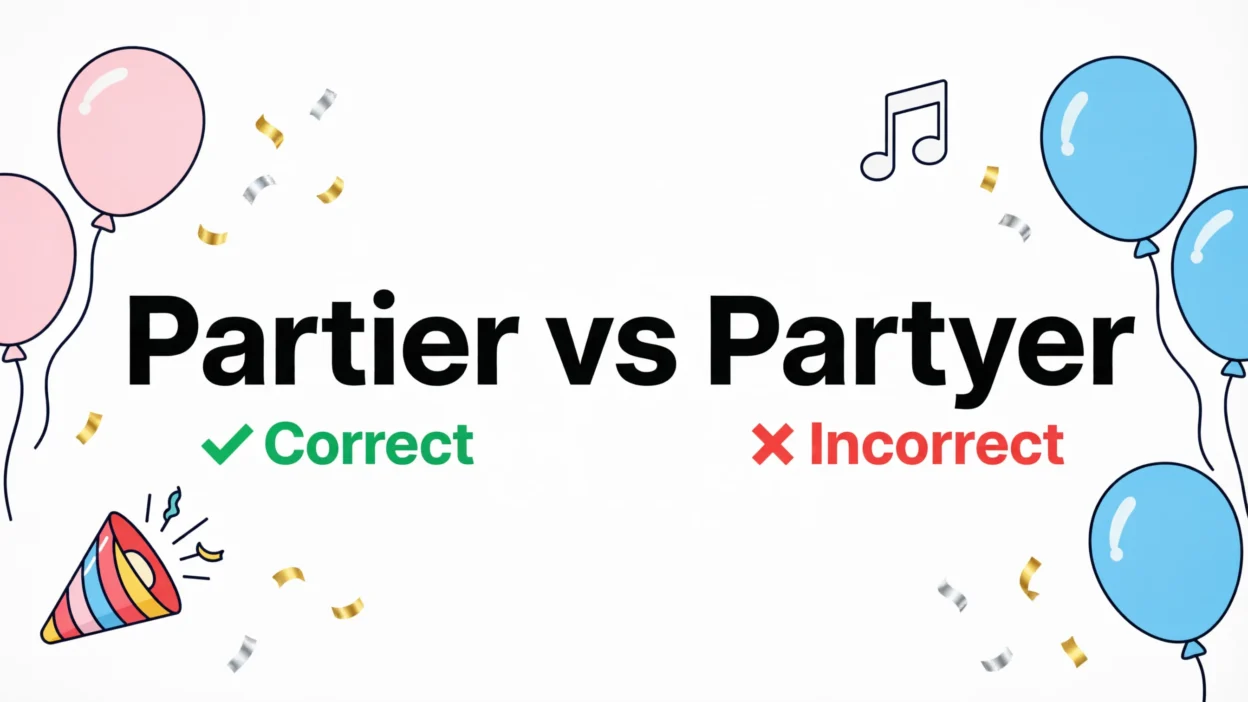
- Partier is the correct spelling in standard English.
- Partyer is incorrect and should not be used.
- The spelling partier follows the normal English rule for words ending in y.
- A partier is a person who enjoys going to parties.
Example:
- She is a big partier.
- My friend is not much of a partier.
Simple Origin or Background
The word partier comes from the base word “party.”
A party is a social event where people meet, talk, eat, dance, or celebrate.
When we want to describe a person who enjoys parties, we add “-er” to the word.
However, English spelling rules say that when a word ends in consonant + y, the y usually changes to i before adding endings like -er or -est.
For example:
- happy → happier
- funny → funnier
- lazy → lazier
The same rule applies to party.
So:
party → partier
That is why partier is correct.
Clear Explanation of the Difference
The difference between partier and partyer is very simple.
Partier follows the correct spelling rule in English.
The letter y changes to i before adding -er.
On the other hand, partyer keeps the letter y, which breaks the normal spelling rule.
Because of this, partyer is not accepted in standard English writing.
You may sometimes see partyer in informal writing or mistakes online, but it is considered incorrect.
Comparison Table
| Word | Correct or Incorrect | Meaning | Example |
|---|---|---|---|
| Partier | Correct | A person who enjoys going to parties | She is a big partier on weekends. |
| Partyer | Incorrect | Not standard English | ✗ He is a partyer. |
Which One to Use and When
You should always use partier in both formal and informal English.
Use partier when talking about someone who enjoys social events or celebrations.
Examples:
In conversation
- My brother is a real partier.
In writing
- He was known as a big partier during college.
In social media
- I’m not a big partier, but I love small gatherings.
In stories or descriptions
- The city attracts young partiers every weekend.
Avoid using partyer, because it is considered a spelling mistake.
Common Mistakes People Make
Many learners make small mistakes when writing this word. Here are the most common ones.
1. Keeping the letter “y”
Some people write:
✗ partyer
They think adding -er means keeping the base word exactly the same. But English spelling rules often change y to i.
Correct:
✓ partier
2. Thinking both spellings are correct
Some learners believe both forms are acceptable. However, only “partier” is correct in standard English.
3. Confusing it with other similar words
Some words do not follow the same spelling change. This can make learners unsure.
But for party, the correct form is always:
party → partier
4. Copying mistakes from social media
Online posts sometimes include spelling mistakes. If you see partyer on social media, remember that it is not the correct spelling.
Everyday Real-Life Examples
Here are examples of how partier appears in daily life.
Email Example
Hi Alex,
Thanks for inviting me to the celebration. You know I’m not a big partier, but I’ll try to come for a while.
Best,
Sam
Social Media Example
“I’m not really a partier, but last night was fun!”
News Style Example
The beach city attracts thousands of young partiers every summer.
Conversation Example
Friend 1: Do you like nightclubs?
Friend 2: Not really. I’m not much of a partier.
School or College Example
During university, he was known as the biggest partier in his group.
Learning Section for Students and Beginners
Here is a simple trick to remember the correct spelling.
Step 1: Start with the base word.
party
Step 2: Look at the ending.
The word ends with consonant + y
Step 3: Change y → i
Step 4: Add -er
Result:
party → partier
Practice with these examples:
- happy → happier
- funny → funnier
- pretty → prettier
The pattern is the same.
If you remember this rule, you will easily spell partier correctly.
Frequently Asked Questions (FAQ)
1. Is “partyer” a real word?
No. Partyer is not considered correct in standard English.
2. What does “partier” mean?
A partier is someone who enjoys parties, celebrations, or social events.
3. Why does “party” change to “partier”?
Because English spelling rules change y to i before adding -er.
4. Can I use “partier” in formal writing?
Yes. Partier is the correct spelling and can be used in any type of writing.
5. What is the plural of “partier”?
The plural form is partiers.
Example:
The club was full of young partiers.
6. Is “partier” common in everyday English?
Yes. It is often used when describing someone who enjoys nightlife or celebrations.
7. Does British English use “partyer”?
No. Both American and British English use partier.
8. Is “partier” only used for young people?
Not always. Anyone who enjoys parties can be called a partier.
Conclusion
The difference between partier and partyer is simple once you understand the spelling rule.
The word partier is the correct and accepted form in English. It follows the common rule where y changes to i before adding -er.
The spelling partyer does not follow this rule and is considered incorrect.
To remember this easily:
party → partier
Whenever you write about someone who enjoys parties, always use partier.
Learning small spelling rules like this can make your English writing clearer and more confident.

Brandon Samuel is a dedicated writer and language enthusiast, serving as the lead author at WordHuts.com. He specializes in explaining word differences, grammar rules, and common language mistakes in simple terms. Brandon’s clear, practical writing style helps readers improve vocabulary, writing confidence, and everyday communication skills.