
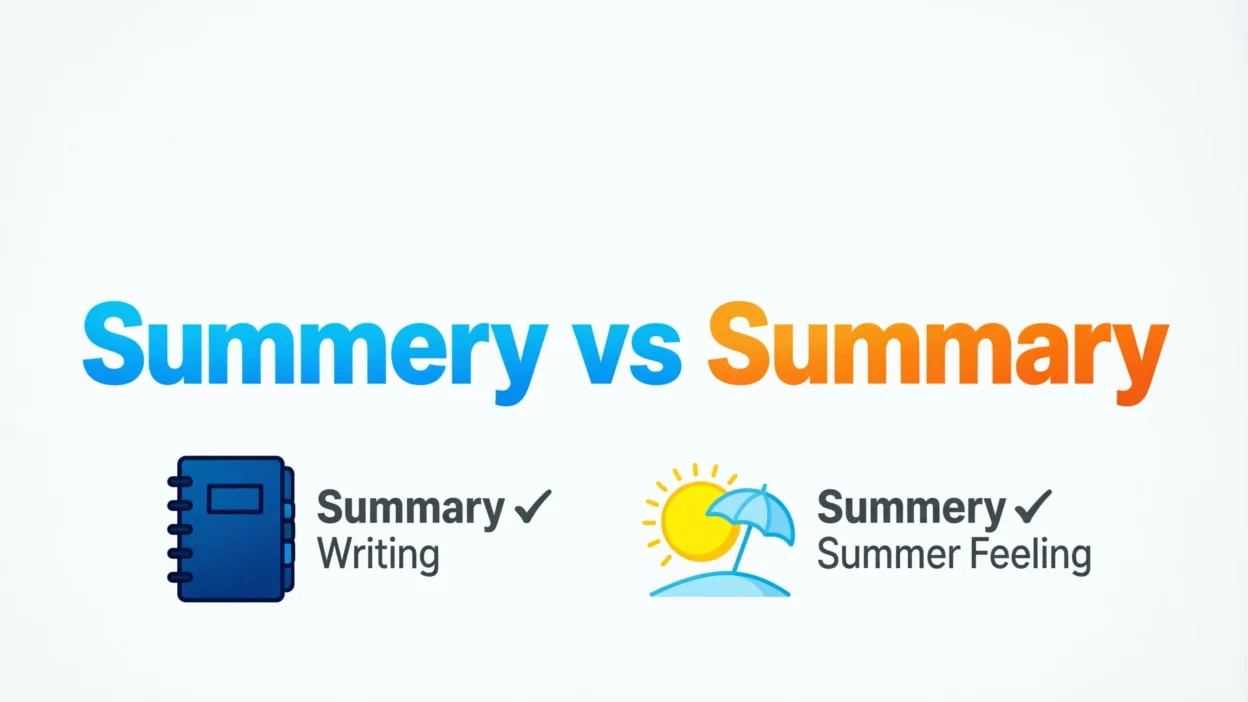
Many English learners often confuse summery and summary because the words look almost the same. The difference is only one letter, but the meanings are completely different.
Some people also mix them up because summary is a very common word used in writing and school work, while summery is related to the word summer.
When people type quickly or are unsure about spelling, they sometimes choose the wrong word.
Understanding the difference between these two words will help you write clearer and more accurate English.
Quick Answer
- Summary → A short explanation of the main points of something.
- Summery → Something that feels like or reminds you of summer.
Examples:
- Please write a summary of the article.
- The weather today feels very summery.
Simple Origin or Background Explanation
Both words come from different base words.
Summary comes from an old Latin word that means main points or main idea. This word is often used when talking about books, reports, or articles.
Summery comes from the word summer, which refers to the warm season of the year. The ending -y means “having the quality of.”
So the words developed from completely different ideas:
- summary → main points
- summery → like summer
Clear Explanation of the Difference
The difference between summary and summery is mainly about meaning and usage.
Summary is a noun. It means a short version of something that includes the most important points.
Examples:
- The teacher asked for a summary of the story.
- At the end of the report, there is a short summary.
Summery is an adjective. It describes something that feels like summer.
Examples:
- She wore a light, summery dress.
- The air felt warm and summery.
So the meanings are completely different.
Comparison Table
| Feature | Summary | Summery |
|---|---|---|
| Meaning | Short explanation of main points | Something that feels like summer |
| Part of speech | Noun | Adjective |
| Common usage | Writing, reports, books | Weather, clothing, atmosphere |
| Example | Write a summary of the story. | It’s a bright and summery day. |
Which One to Use and When
Use summary when you are talking about a short explanation of something.
Examples:
- The student wrote a summary of the chapter.
- The report ends with a summary of the findings.
Use summery when describing something that feels like summer.
Examples:
- She bought a summery hat for vacation.
- The room had a bright, summery decoration style.
Common Mistakes People Make
1. Using “summery” instead of “summary”
Incorrect:
Please write a summery of the book.
Correct:
Please write a summary of the book.
2. Thinking both words mean the same thing
Some learners assume the words are just spelling variations, but they actually have different meanings.
3. Confusing spelling while typing
Because the words look very similar, typing quickly can lead to mistakes.
Always check whether you are talking about main points or summer-like feeling.
Everyday Real-Life Examples
Here are examples showing how the words appear in daily situations.
In school
The teacher asked students to write a summary of the lesson.
In business reports
The report includes a short summary at the beginning.
In fashion
She chose a summery dress for the beach trip.
On social media
Loving this warm and summery weather today!
In conversations
Friend 1: Did you read the article?
Friend 2: Yes, I read the summary.
Learning Section for Students and Beginners
Here is an easy trick to remember the difference.
Memory Trick
Look at the middle of the word:
SumMARY → contains “MARY”
Think of summary as a message or explanation.
SummERy → contains “ER” from “summER”
Think of summery as related to summer.
Practice Sentences
Fill in the blanks:
- Please write a ______ of the article.
- The beach had a bright ______ feeling.
- The book includes a short ______ at the end.
Answers:
- summary
- summery
- summary
Frequently Asked Questions (FAQ)
1. What does “summary” mean?
A summary is a short explanation of the main points of something.
2. What does “summery” mean?
It means having the feeling or qualities of summer.
3. Is “summery” a common word?
It is less common than summary, but it is used when describing weather, clothes, or atmosphere.
4. Which word is used in school assignments?
Students usually write a summary of texts or lessons.
5. Can “summery” describe clothing?
Yes. For example:
She wore a light, summery dress.
6. Are the words interchangeable?
No. They have completely different meanings.
7. Which word is more common?
Summary is used more often, especially in writing and education.
8. Is “summary” used in professional writing?
Yes. It is very common in reports, research, and business documents.
Conclusion
The difference between summery and summary is easy once you know their meanings.
- Summary means a short explanation of the main points of something.
- Summery describes something that feels like summer.
Remember this simple idea:
Summary → main points
Summery → summer feeling
Understanding this difference will help you avoid spelling mistakes and write clearer English.

Justin Larry is a talented language writer and content creator at WordHuts.com. She specializes in explaining word differences, grammar tips, and common English mistakes in a clear, practical style. Her engaging content helps readers improve vocabulary, writing skills, and everyday communication, making language learning simple and effective.