Many English learners feel confused when they see “take effect” and “take affect.”
They look almost the same.
They sound the same.
But only one is correct.
This confusion happens because:
- “Effect” and “affect” are often mixed up.
- Both words are common in English.
- The spelling difference is small.
In this article, you will learn the difference in very simple English. By the end, you will clearly understand which one to use and why.
Quick Answer
Here is the simple truth:
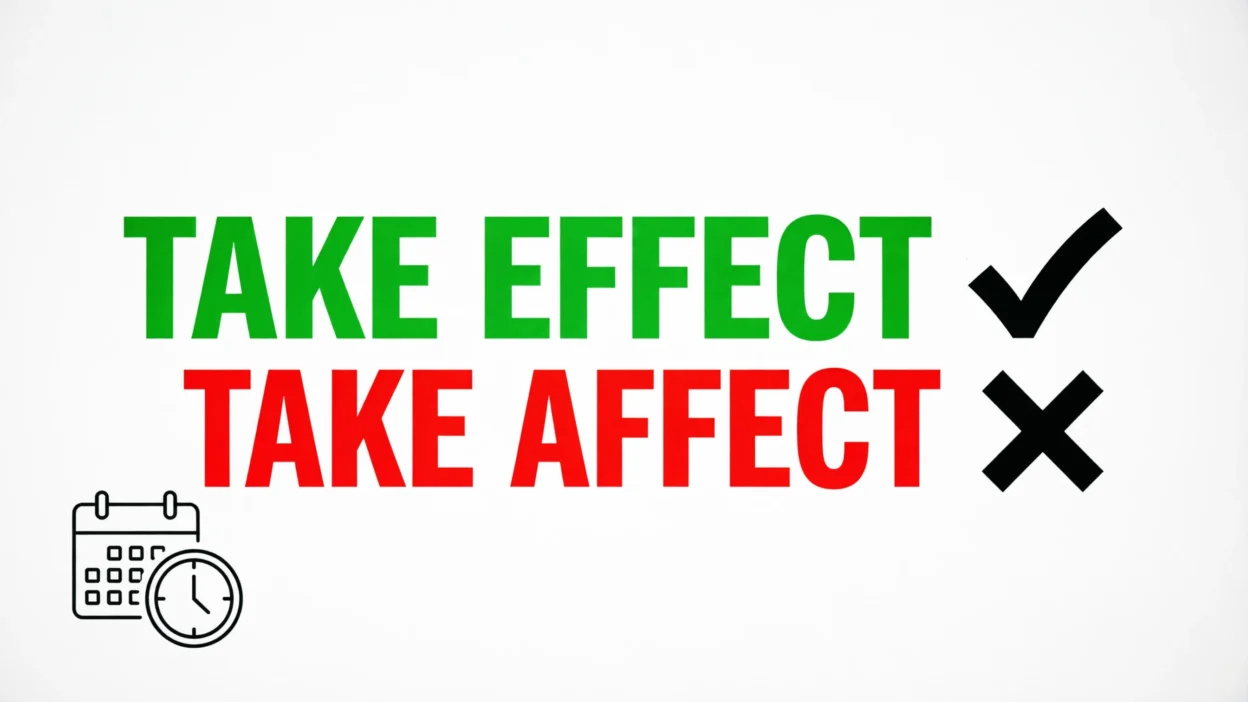
- Take effect = correct expression
- Take affect = incorrect
Use:
✔ take effect
✘ take affect
Example:
The new law will take effect next month.
That is correct.
Simple Background Explanation
To understand this clearly, we need to understand the words “effect” and “affect.”
What Does “Effect” Mean?
“Effect” is usually a noun.
It means:
- Result
- Change
- Outcome
Example:
The medicine had a strong effect.
This means the medicine caused a result or change.
What Does “Affect” Mean?
“Affect” is usually a verb.
It means:
- To influence
- To change something
Example:
The weather can affect your mood.
This means the weather can influence your mood.
What Does “Take Effect” Mean?
“Take effect” is a fixed expression.
It means:
- To start working
- To begin to produce a result
- To become active
Example:
The new rules will take effect tomorrow.
This means:
- The rules will start working tomorrow.
- The rules will become active tomorrow.
Another example:
The medicine will take effect in 30 minutes.
This means:
- The medicine will start working in 30 minutes.
“Take effect” is about something beginning to work or become active.
Why “Take Affect” Is Wrong
“Take affect” is not a correct expression in English.
Why?
Because:
- “Affect” is a verb.
- “Take effect” needs a noun.
- The correct noun is “effect.”
So if you write:
The new policy will take affect.
This is incorrect.
Correct version:
The new policy will take effect.
Clear Explanation of the Difference
The main difference is simple:
- “Take effect” = correct phrase meaning “start working.”
- “Take affect” = spelling mistake.
Remember:
Effect = noun (result)
Affect = verb (influence)
In this expression, we need the noun.
Comparison Table
| Point of Difference | Take Effect | Take Affect |
|---|---|---|
| Correct Expression | Yes | No |
| Meaning | To begin working | No correct meaning |
| Word Type Used | Effect (noun) | Affect (verb) |
| Example | The rule takes effect today. | The rule takes affect today. (wrong) |
| Used in Formal Writing | Yes | No |
This table clearly shows that only “take effect” is correct.
Which One Should You Use and When?
Always use take effect when you mean:
- Something starts working
- Something becomes active
- Something begins to produce results
Examples:
The contract will take effect next week.
The changes take effect immediately.
The medicine took effect quickly.
Never use “take affect.”
Common Mistakes People Make
Mistake 1: Confusing Affect and Effect
Many learners mix them up because they sound the same.
Remember:
- Affect = action
- Effect = result
“Take effect” uses the result word.
Mistake 2: Writing It Incorrectly in Formal Documents
This mistake often appears in:
- School essays
- Business emails
- Legal documents
Wrong:
The new law will take affect next year.
Correct:
The new law will take effect next year.
Mistake 3: Thinking “Take Affect” Means Something Different
It does not. It is simply incorrect.
Everyday Real-Life Examples
Here are simple examples from daily life.
Law Example
The new traffic rules will take effect on Monday.
This means the rules will start being used on Monday.
Medicine Example
The painkiller should take effect in 20 minutes.
This means it will start working soon.
School Example
The new grading system takes effect next semester.
This means it starts next semester.
Workplace Example
Salary changes will take effect in July.
This means they begin in July.
Weather Example
The storm warning takes effect tonight.
This means it becomes active tonight.
Learning Section for Students and Beginners
Here are easy tips to help you remember.
Tip 1: Think “Start Working”
If something begins working, write:
✔ take effect
Tip 2: Remember the Simple Rule
Take + noun
“Effect” is a noun.
“Affect” is a verb.
So we use “effect.”
Tip 3: Use the Memory Trick
Affect = Action
Effect = End result
When something “takes effect,” it starts creating results.
Practice Exercise
Choose the correct word.
- The new policy will take ______ next month.
- The medicine took ______ quickly.
- The weather can ______ your mood.
- The changes take ______ immediately.
Answers:
- effect
- effect
- affect
- effect
This helps you see the difference clearly.
Frequently Asked Questions (FAQ)
1. Is “take affect” ever correct?
No. It is considered a mistake.
2. What does “take effect” mean?
It means to start working or become active.
3. Is this phrase formal?
Yes. It is common in formal writing and official documents.
4. Can I use it in daily conversation?
Yes. It is used in both formal and informal situations.
5. Why do people confuse these words?
Because “affect” and “effect” sound the same.
6. Is “effect” always a noun?
Most of the time, yes. For beginners, treat it as a noun.
7. What is the easiest way to remember?
Take effect = start working.
Simple and Clear Conclusion
“Take effect” and “take affect” may look similar, but only one is correct.
- “Take effect” means to begin working or become active.
- “Take affect” is a spelling mistake.
If something starts working, always write take effect.
Remember: effect is the correct word in this expression.

Gregory Alexander is a skilled writer and language researcher at WordHuts.com. He focuses on clarifying confusing word pairs, grammar rules, and common usage mistakes. With a passion for precise communication, Gregory creates simple, easy-to-understand content that helps readers strengthen vocabulary, writing accuracy, and everyday English skills.