Many students and English learners get confused about “thumb in” and “thumb out.”
They may ask:
- Is this about direction?
- Is this about body language?
- Is this about hitchhiking?
- Do they mean the same thing?
The confusion happens because these phrases can be used in different situations:
- Hand gestures
- Hitchhiking
- Informal speech
In this article, we will explain everything in very simple English so you understand the difference clearly.
Quick Answer
Here is the simple difference:
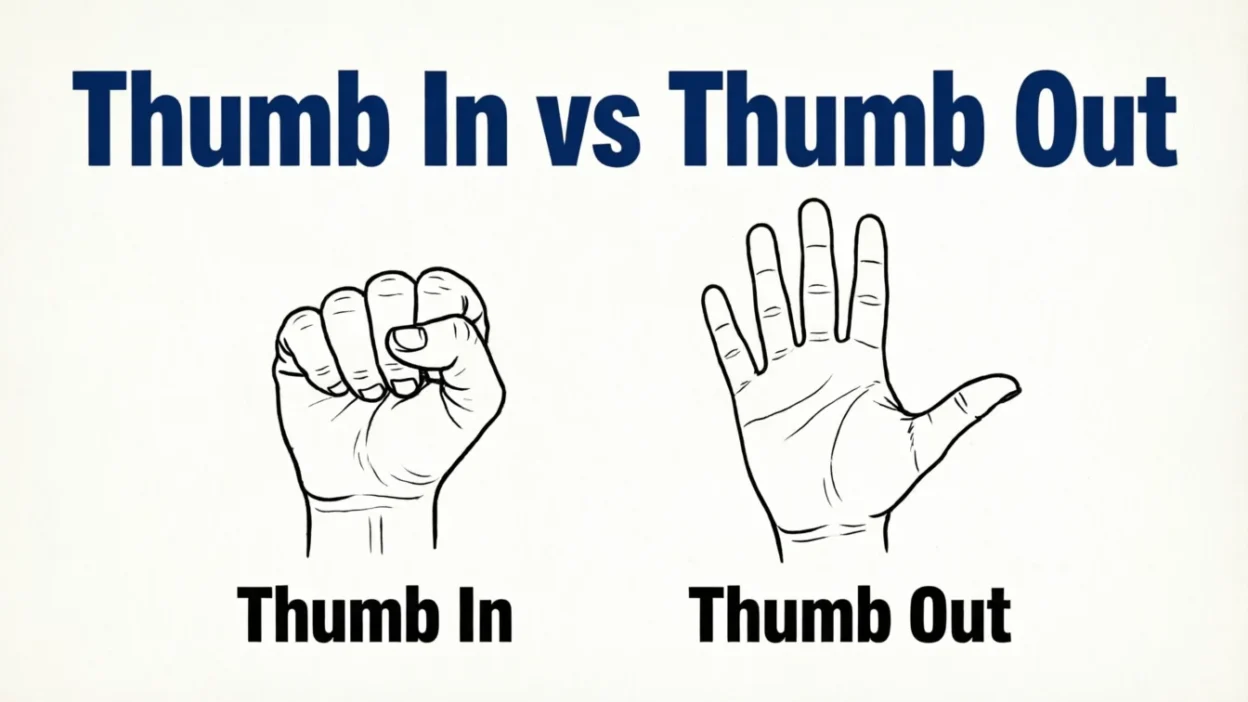
- Thumb in usually means your thumb is inside your hand or close to your body.
- Thumb out usually means your thumb is pointing outward or extended away from your hand.
In some situations:
- Thumb out can mean hitchhiking.
- Thumb in can show a closed or tight position.
The meaning depends on context.
Simple Background Explanation
Your thumb is the short, strong finger on the side of your hand.
When people say “thumb in” or “thumb out,” they are usually talking about:
- The position of the thumb
- A hand gesture
- A body language signal
These are not fixed grammar phrases like idioms. They simply describe physical position.
But sometimes they are used in informal ways.
Clear Explanation of the Difference
Let’s break it down.
What Does “Thumb In” Mean?
“Thumb in” means:
- Your thumb is inside your fingers.
- Your thumb is tucked in.
- Your thumb is not pointing outward.
For example:
He stood with his thumb in his pocket.
This means his thumb was inside the pocket, not outside.
Another example:
She made a fist with her thumb in.
This means her thumb was inside her fingers.
This position can sometimes show:
- Nervousness
- Protection
- Closed body language
But it depends on the situation.
What Does “Thumb Out” Mean?
“Thumb out” means:
- Your thumb is extended outward.
- Your thumb is pointing away from your hand.
- Your thumb is visible and open.
Example:
He stood with his thumb out of his pocket.
This means his thumb was outside the pocket.
Another example:
She gave a thumbs-out gesture.
(Though “thumbs up” is more common.)
Most commonly, “thumb out” is connected with hitchhiking.
Example:
He stood by the road with his thumb out.
This means he was asking for a ride.
In many countries, putting your thumb out toward the road means you want a car to stop and give you a ride.
Comparison Table
| Point of Difference | Thumb In | Thumb Out |
|---|---|---|
| Basic Meaning | Thumb inside or tucked | Thumb extended outward |
| Hand Position | Closed or inward | Open or outward |
| Body Language Feeling | Can look protective or nervous | Can look confident or open |
| Hitchhiking Meaning | Not used | Commonly used |
| Example | He stood with his thumb in his pocket. | He stood with his thumb out by the road. |
This table shows that the difference is mainly about position and sometimes meaning.
Which One Should You Use and When?
Use thumb in when:
- The thumb is inside the hand.
- The thumb is inside a pocket.
- The thumb is tucked in.
Example:
He crossed his arms with his thumbs in.
Use thumb out when:
- The thumb is extended.
- The thumb is outside the pocket.
- Someone is hitchhiking.
Example:
She waited with her thumb out for a ride.
Always think about physical position.
Common Mistakes People Make
Mistake 1: Thinking They Are Idioms
These are usually not fixed idioms. They describe position.
So do not treat them like special grammar expressions.
Mistake 2: Confusing with “Thumbs Up”
“Thumb out” is not the same as “thumbs up.”
- Thumbs up = sign of approval
- Thumb out = thumb extended (often hitchhiking)
Mistake 3: Using the Wrong Preposition
Correct:
Thumb in his pocket.
Thumb out of his pocket.
Wrong:
Thumb in of his pocket.
Keep the prepositions clear.
Everyday Real-Life Examples
Here are simple examples you may hear.
Example 1: On the Road
A traveler stood with his thumb out.
This means he wanted someone to stop and give him a ride.
Example 2: Body Language
She stood quietly with her thumbs in her pockets.
This may show she felt shy.
Example 3: Sports Coaching
Keep your thumb in when making a fist.
This describes correct hand position.
Example 4: Social Media
He posted a photo with his thumb out on the highway.
This probably means hitchhiking.
Example 5: Daily Conversation
He always stands with his thumbs out of his pockets.
This describes posture.
Learning Section for Students and Beginners
Here are easy tips.
Tip 1: Think of Direction
In = inside
Out = outside
This works almost every time.
Tip 2: Picture the Hand
Imagine the hand:
- Thumb hidden → thumb in
- Thumb visible and extended → thumb out
Tip 3: Remember Hitchhiking
If someone is by the road asking for a ride:
✔ thumb out
Practice Exercise
Choose the correct phrase.
- He stood by the road with his thumb ______.
- She made a fist with her thumb ______.
- He kept his thumb ______ of his pocket.
- She walked with her thumbs ______ her pockets.
Answers:
- out
- in
- out
- in
Frequently Asked Questions (FAQ)
1. Are “thumb in” and “thumb out” idioms?
No. They usually describe physical position.
2. Does “thumb out” always mean hitchhiking?
No. But it often does when someone is near a road.
3. Does “thumb in” have a special meaning?
Usually no. It simply describes position.
4. Is “thumbs out” correct?
It can be correct if talking about both hands, but it is less common.
5. What is more common: thumb in or thumb out?
“Thumb out” is more common because of hitchhiking.
6. Is this formal English?
It is neutral and can be used in normal conversation.
7. Can body language experts talk about thumb positions?
Yes. Thumb position can sometimes show confidence or nervousness.
Simple and Clear Conclusion
“Thumb in” and “thumb out” are simple phrases about position.
- Thumb in = thumb inside or tucked.
- Thumb out = thumb extended or outside.
The most common special meaning is:
- Thumb out = hitchhiking.
If you remember that “in” means inside and “out” means outside, you will never be confused again.

Gregory Alexander is a skilled writer and language researcher at WordHuts.com. He focuses on clarifying confusing word pairs, grammar rules, and common usage mistakes. With a passion for precise communication, Gregory creates simple, easy-to-understand content that helps readers strengthen vocabulary, writing accuracy, and everyday English skills.