
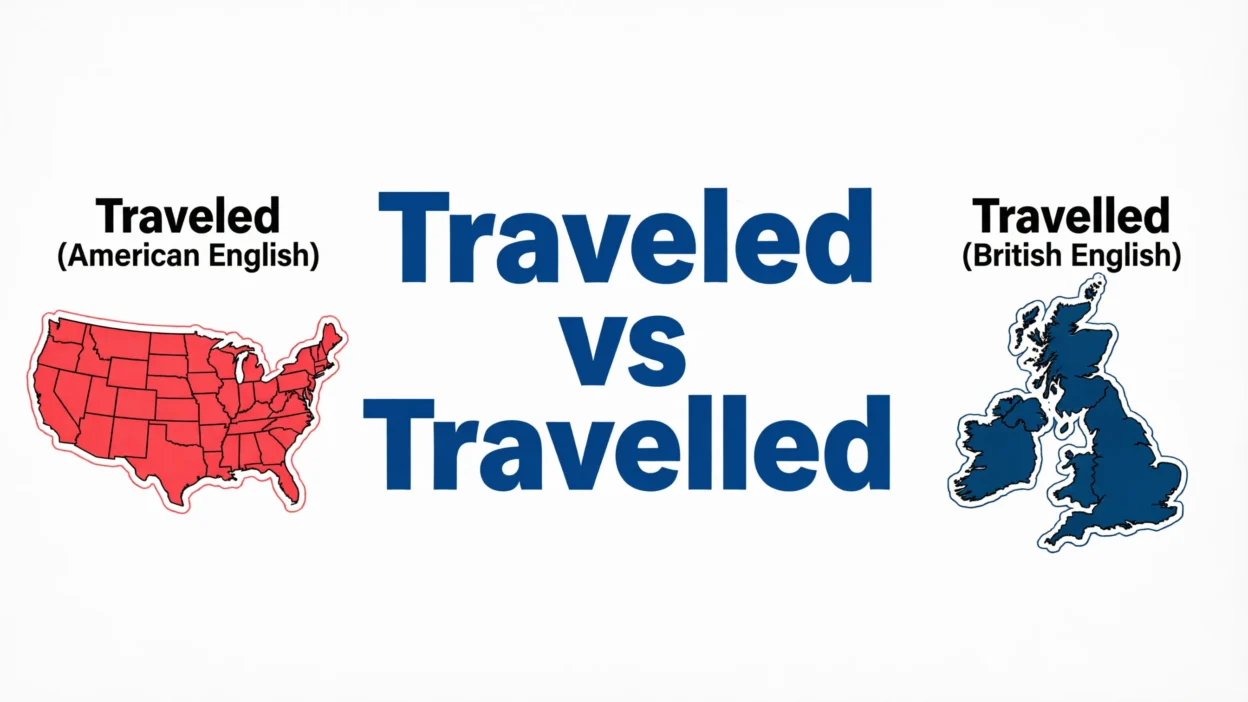
Many English learners feel confused between traveled and travelled. Both words look almost the same, and both appear in books, articles, and online writing. Because of this, people often wonder which spelling is correct.
The confusion usually happens because English has two main spelling styles: American English and British English. Some words are spelled differently depending on which style of English is being used.
The good news is that both “traveled” and “travelled” are correct, but they are used in different regions. Once you understand this simple rule, the confusion disappears.
Quick Answer
- Traveled → American English spelling
- Travelled → British English spelling
Both words mean the past form of “travel,” meaning to go from one place to another.
Examples:
- She traveled across the United States last year.
- He travelled around Europe during summer.
Simple Origin or Background Explanation
The word travel comes from older European languages and has been used in English for many centuries. Over time, English developed different spelling styles in different regions.
When American English spelling rules were simplified, many words dropped the double “l.”
Examples:
- traveled (American English)
- travelled (British English)
Both forms are still widely used today depending on the country or writing style.
Clear Explanation of the Difference
The difference between traveled and travelled is mainly about regional spelling.
Traveled
Traveled is the American English spelling. It is commonly used in the United States and often appears in American books, websites, and newspapers.
Examples:
- She traveled to New York last month.
- They traveled across the country by car.
- He traveled alone during his vacation.
Travelled
Travelled is the British English spelling. It is commonly used in countries that follow British spelling, such as the United Kingdom, Australia, and Canada.
Examples:
- She travelled to London last year.
- They travelled through several countries.
- He travelled by train across Europe.
Comparison Table
| Feature | Traveled | Travelled |
|---|---|---|
| Meaning | Past form of travel | Past form of travel |
| Spelling style | American English | British English |
| Letter pattern | Single “l” | Double “ll” |
| Common usage regions | United States | UK, Australia, Canada |
| Example | She traveled to Texas. | She travelled to London. |
Which One to Use and When
You should choose the spelling based on the type of English you are using.
Use traveled when writing in American English.
Examples:
- I traveled to California last year.
- We traveled by plane.
Use travelled when writing in British English.
Examples:
- She travelled across Asia.
- They travelled during the holidays.
The most important rule is consistency. If you choose one style, try to use it throughout your writing.
Common Mistakes People Make
1. Thinking one spelling is wrong
Some learners think travelled or traveled is incorrect. In reality, both are correct depending on the spelling style.
2. Mixing spelling styles
Sometimes writers mix American and British spellings in the same text.
Example mistake:
- She travelled to France and later traveled to Spain.
It is better to stay consistent with one style.
3. Forgetting the spelling rule
Many American spellings simplify double letters, which leads to:
- traveled
- canceled
- modeled
British English often keeps the double letter.
Everyday Real-Life Examples
Here are examples showing how these words appear in daily situations.
In conversations
I traveled to another city for work.
In travel blogs
We travelled through beautiful villages in Europe.
In school writing
The explorer traveled across the desert.
On social media
I travelled to five countries this year!
In news stories
The athlete traveled internationally for competitions.
Learning Section for Students and Beginners
Here is an easy trick to remember the difference.
Memory Trick
Think about the number of “L” letters.
American English → traveled (one L)
British English → travelled (two LL)
This simple rule helps you remember the spelling quickly.
Practice Sentences
Fill in the blank with the correct word.
- She ______ across Europe last summer.
- They ______ to another city for the event.
- The family ______ by train during their vacation.
Possible answers:
- traveled (American English)
- travelled (British English)
Both can be correct depending on the spelling style used.
Frequently Asked Questions (FAQ)
1. Are “traveled” and “travelled” both correct?
Yes. Both spellings are correct but belong to different English styles.
2. Which spelling is used in the United States?
The United States usually uses traveled.
3. Which spelling is used in the United Kingdom?
The United Kingdom usually uses travelled.
4. Do both words have the same meaning?
Yes. Both are the past tense of the verb “travel.”
5. Is it wrong to use “travelled” in American writing?
It is not technically wrong, but “traveled” is preferred in American English.
6. Why does British English use double “l”?
British spelling often keeps the original double-letter form of some verbs.
7. Should I use one spelling consistently?
Yes. Try to use the same spelling style throughout your writing.
8. Are there other words like this?
Yes.
Examples include:
- canceled / cancelled
- modeled / modelled
- labeled / labelled
Conclusion
The difference between traveled and travelled is simply about spelling style.
- Traveled is the American English spelling.
- Travelled is the British English spelling.
Both words mean the same thing: the past form of “travel.”
The key is to choose the spelling style that fits your writing and stay consistent.

Justin Larry is a talented language writer and content creator at WordHuts.com. She specializes in explaining word differences, grammar tips, and common English mistakes in a clear, practical style. Her engaging content helps readers improve vocabulary, writing skills, and everyday communication, making language learning simple and effective.