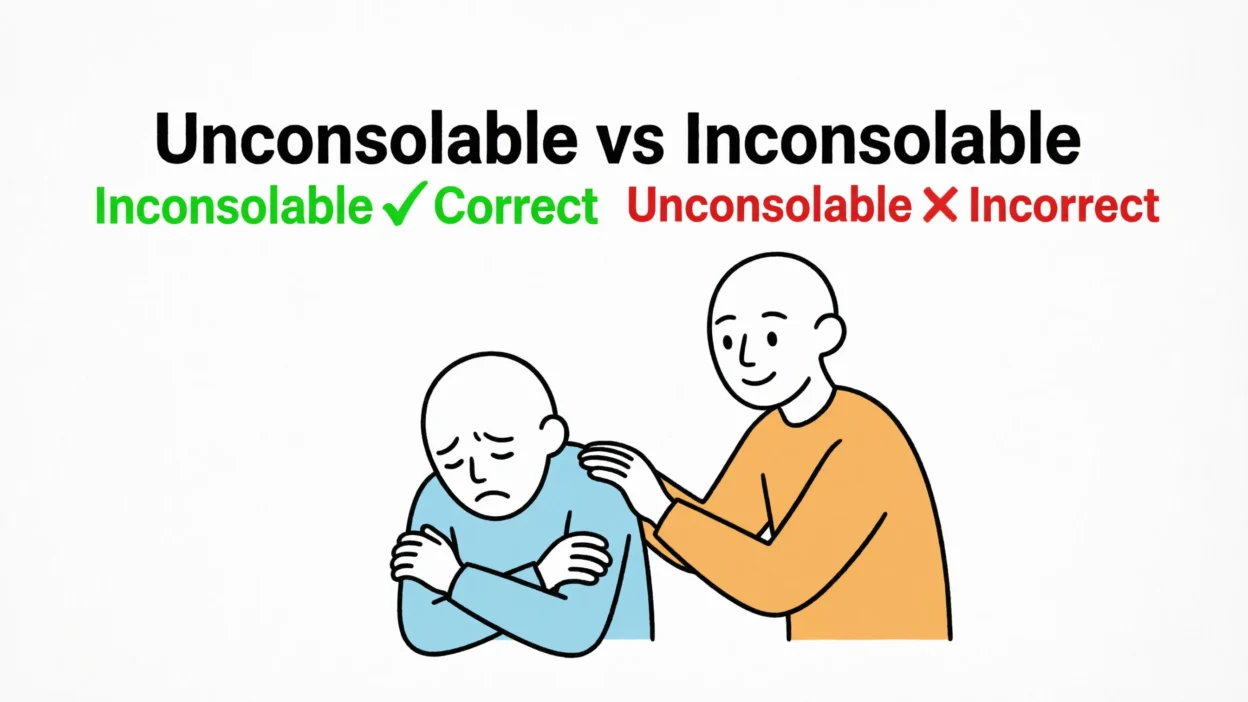
Many English learners feel confused between unconsolable and inconsolable because both words look very similar and seem to express the same idea. The only visible difference is the prefix “un-” and “in-”, which both often mean “not.”
Because of this, people sometimes assume both words are correct or interchangeable. However, in standard English, only one of these words is commonly accepted and widely used.
Understanding the correct word will help you write more clearly and avoid spelling mistakes in essays, conversations, and daily communication.
Quick Answer
- Inconsolable → Correct and widely accepted word
- Unconsolable → Very rare and generally considered incorrect or outdated
- Inconsolable means so sad that no one can comfort you.
Examples:
- She was inconsolable after hearing the bad news.
- The child became inconsolable when he lost his favorite toy.
Simple Origin or Background Explanation
The word inconsolable comes from the word console, which means to comfort someone who is sad.
When the prefix “in-” is added, the meaning becomes “not able to be comforted.”
So the word developed like this:
console → comfort someone
in + console → inconsolable (not able to be comforted)
The spelling unconsolable sometimes appears because English often uses “un-” to create negative words. However, the standard and accepted form in dictionaries is inconsolable.
Clear Explanation of the Difference
The difference between unconsolable and inconsolable is mainly about correct usage.
Inconsolable
Inconsolable is the correct adjective used to describe someone who is extremely sad and cannot be comforted.
Examples:
- She felt inconsolable after losing her pet.
- The family was inconsolable after the tragedy.
- The child became inconsolable when his toy broke.
This word is commonly used in stories, news reports, and emotional descriptions.
Unconsolable
Unconsolable is rarely used in modern English and is generally considered incorrect or nonstandard. Most writers and speakers prefer inconsolable.
Incorrect or uncommon example:
- She was unconsolable after the loss. ✗
Preferred form:
- She was inconsolable after the loss. ✓
Comparison Table
Feature | Inconsolable | Unconsolable
Meaning | Too sad to be comforted | Same idea but rarely used
Correct usage | Yes | Generally not accepted
Frequency | Common | Very rare
Example | The child was inconsolable. | ✗ The child was unconsolable.
Which One to Use and When
You should always use “inconsolable.”
Use it when describing someone who is extremely sad or upset and cannot be comforted.
Examples:
- In daily conversation
- The baby was inconsolable after waking up.
2. In news reports
- The family was inconsolable after the accident.
3. In storytelling
- She became inconsolable when she heard the news.
Because unconsolable is rarely accepted, it is better to avoid using it.
Common Mistakes People Make
1. Using “un-” instead of “in-”
Many learners think the word should follow a common pattern like:
- happy → unhappy
So they write:
✗ unconsolable
Correct form:
✓ inconsolable
2. Assuming both words are correct
Because both prefixes mean “not,” some people think both spellings are acceptable.
However, standard English uses inconsolable.
3. Spelling confusion
The long spelling makes it easy to write the word incorrectly if someone is not familiar with it.
Everyday Real-Life Examples
Here are examples showing how inconsolable appears in real-life situations.
conversations:
The child was inconsolable after losing his toy.
news:
The family was inconsolable after the tragic accident.
stories:
She was inconsolable when she heard the sad news.
social media:
My dog ran away and I feel inconsolable today.
emotional descriptions:
He was inconsolable after saying goodbye to his best friend.
Learning Section for Students and Beginners
Here is an easy trick to remember the correct word.
Memory Trick
Think of the phrase:
Impossible → starts with “in”
Many emotional or descriptive words also use “in-”.
So remember:
Inconsolable = correct
Practice Sentences
Fill in the blank with the correct word.
- The baby became ______ after dropping the toy.
- She felt ______ after losing her pet.
- The family was ______ after the sad news.
Answers:
- inconsolable
- inconsolable
- inconsolable
Frequently Asked Questions (FAQ)
1. What does “inconsolable” mean?
It means extremely sad and unable to be comforted.
2. Is “unconsolable” correct?
It is rarely used and generally considered incorrect in modern English.
3. Which word should I use?
You should use inconsolable.
4. Is “inconsolable” a common word?
Yes. It is often used in emotional situations and storytelling.
5. Can “inconsolable” describe children?
Yes.
Example:
The child was inconsolable after falling down.
6. Can adults be described as inconsolable?
Yes. Anyone can feel inconsolable after a major loss or tragedy.
7. What is the root word?
The root word is console, which means to comfort someone.
8. Is this word used in news reports?
Yes. It is often used when describing grief after serious events.
Conclusion
The difference between unconsolable and inconsolable is mainly about correct usage.
- Inconsolable is the correct and widely accepted word meaning someone who cannot be comforted.
- Unconsolable is rarely used and generally avoided in standard English.
Remember this simple rule:
Inconsolable = correct word
Using the correct spelling will help your writing look clearer and more accurate.

Gregory Alexander is a skilled writer and language researcher at WordHuts.com. He focuses on clarifying confusing word pairs, grammar rules, and common usage mistakes. With a passion for precise communication, Gregory creates simple, easy-to-understand content that helps readers strengthen vocabulary, writing accuracy, and everyday English skills.