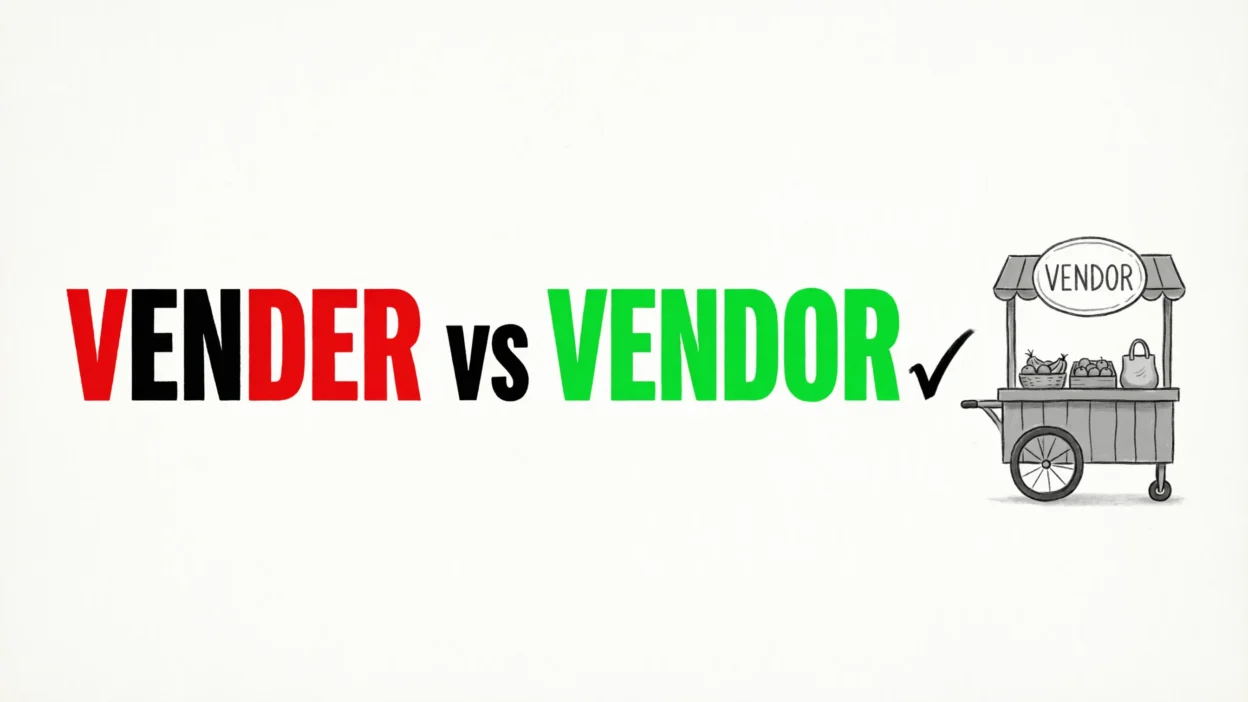
Many English learners get confused between “vender” and “vendor.”
They look almost the same.
They sound almost the same.
But one spelling is much more common than the other.
Students often ask:
- Is “vender” wrong?
- Which spelling should I use?
- Are they different words?
In this article, you will learn the difference in very simple English. By the end, you will clearly understand which one to use and when.
Quick Answer
Here is the simple truth:
- Vendor is the correct and standard spelling in modern English.
- Vender is a rare spelling and is usually considered incorrect today.
In most cases, you should use:
✔ vendor
✘ vender (not recommended)
Example:
The vendor sold fresh fruit at the market.
Simple Origin and Background
The word comes from Latin and Old French. Long ago, both spellings appeared in English writing.
But over time, one spelling became more common.
Today:
- “Vendor” is standard in American English.
- “Vendor” is also preferred in British English.
- “Vender” is rarely used and often seen as an old or incorrect spelling.
So even though both spellings existed in history, modern English strongly prefers vendor.
What Does “Vendor” Mean?
A vendor is:
- A person who sells something
- A company that sells products or services
It simply means seller.
Examples:
The street vendor sells snacks.
The software vendor provides technical support.
We contacted the vendor for more information.
A vendor can sell:
- Food
- Clothes
- Technology
- Services
- Almost anything
What About “Vender”?
“Vender” is an older spelling of “vendor.”
In modern English:
- It is rarely used.
- It may be seen as a spelling mistake.
- Most dictionaries recommend “vendor.”
If you write “vender” in school or business, it may be marked as incorrect.
So it is safer and better to always use vendor.
Clear Explanation of the Difference
Here is the most important point:
The meaning is the same.
The difference is spelling and usage.
- Vendor = correct and modern spelling
- Vender = old or uncommon spelling
There is no difference in meaning.
The difference is which one is accepted today.
Comparison Table
| Feature | Vendor | Vender |
|---|---|---|
| Meaning | Person or company that sells something | Same meaning |
| Modern Usage | Very common and correct | Rare and outdated |
| Accepted in School Writing | Yes | Usually no |
| Accepted in Business Writing | Yes | Not recommended |
| Spelling Preference Today | Standard | Not standard |
This table shows clearly that “vendor” is the correct choice in modern English.
Which One Should You Use and When?
You should always use vendor in:
- School essays
- Business emails
- Contracts
- Reports
- Online writing
Example:
The vendor delivered the products on time.
Do not use “vender” unless you are reading very old texts or historical documents.
Simple rule:
If you are writing today, choose vendor.
Common Mistakes People Make
Mistake 1: Thinking They Have Different Meanings
Some learners think:
- Vendor = company
- Vender = person
This is not true. They mean the same thing.
Mistake 2: Using “Vender” in Formal Writing
Writing this in a business email:
We contacted the vender.
This may look like a spelling mistake.
Correct version:
We contacted the vendor.
Mistake 3: Mixing Up with Similar Words
Do not confuse “vendor” with:
- Vending (as in vending machine)
- Vendor’s (showing possession)
Example:
The vendor’s products are popular.
Everyday Real-Life Examples
Let’s look at simple examples.
At a Market
The fruit vendor sells fresh apples.
This means the person sells fruit.
In Business
We signed a contract with a new vendor.
This means a company that provides goods or services.
In Technology
The software vendor released an update.
This means the company that created the software.
In School
Students met different vendors at the career fair.
This means different companies or sellers.
In all these examples, the correct word is vendor.
Learning Section for Students and Beginners
Here are easy tips to remember.
Tip 1: Remember the “O”
Think of “vendor” like:
- Vendor
- Order
- Office
The “O” spelling is the modern one.
Tip 2: If Spell Check Changes It, That’s a Clue
If you type “vender” and your computer underlines it, that means it is not the preferred spelling.
Tip 3: Keep It Simple
Always write:
✔ vendor
This is safe in every situation.
Practice Exercise
Choose the correct word.
- The street ______ sells hot dogs.
- We emailed the software ______.
- The company works with many different ______.
Answers:
- vendor
- vendor
- vendors
Never “vender.”
Frequently Asked Questions (FAQ)
1. Is “vender” completely wrong?
It is not historically wrong, but it is outdated and not recommended today.
2. Do British and American English use different spellings?
No. Both prefer “vendor.”
3. Do they have different meanings?
No. They mean the same thing.
4. Can I use “vender” in academic writing?
It is better not to. Use “vendor.”
5. Why do some people still write “vender”?
It may be a spelling mistake or influence from older texts.
6. Is “vendor” a noun or verb?
It is a noun. It names a person or company that sells something.
7. What is a vending machine?
It is a machine that sells items automatically. The word “vending” comes from the same root.
Simple and Clear Conclusion
“Vendor” and “vender” have the same meaning, but only one spelling is correct in modern English.
- Vendor = correct and standard
- Vender = rare and outdated
If you want to avoid mistakes, always choose vendor.
It is simple, safe, and correct in all modern writing.

Brandon Samuel is a dedicated writer and language enthusiast, serving as the lead author at WordHuts.com. He specializes in explaining word differences, grammar rules, and common language mistakes in simple terms. Brandon’s clear, practical writing style helps readers improve vocabulary, writing confidence, and everyday communication skills.