Many English learners feel confused between woman and women. The words look almost the same, and the pronunciation is also very similar. Because of this, students sometimes use the wrong word in writing or speaking.
However, the difference is actually very simple. One word is used for one person, and the other is used for more than one person.
Once you understand this basic rule, you will easily know when to use each word.
Quick Answer
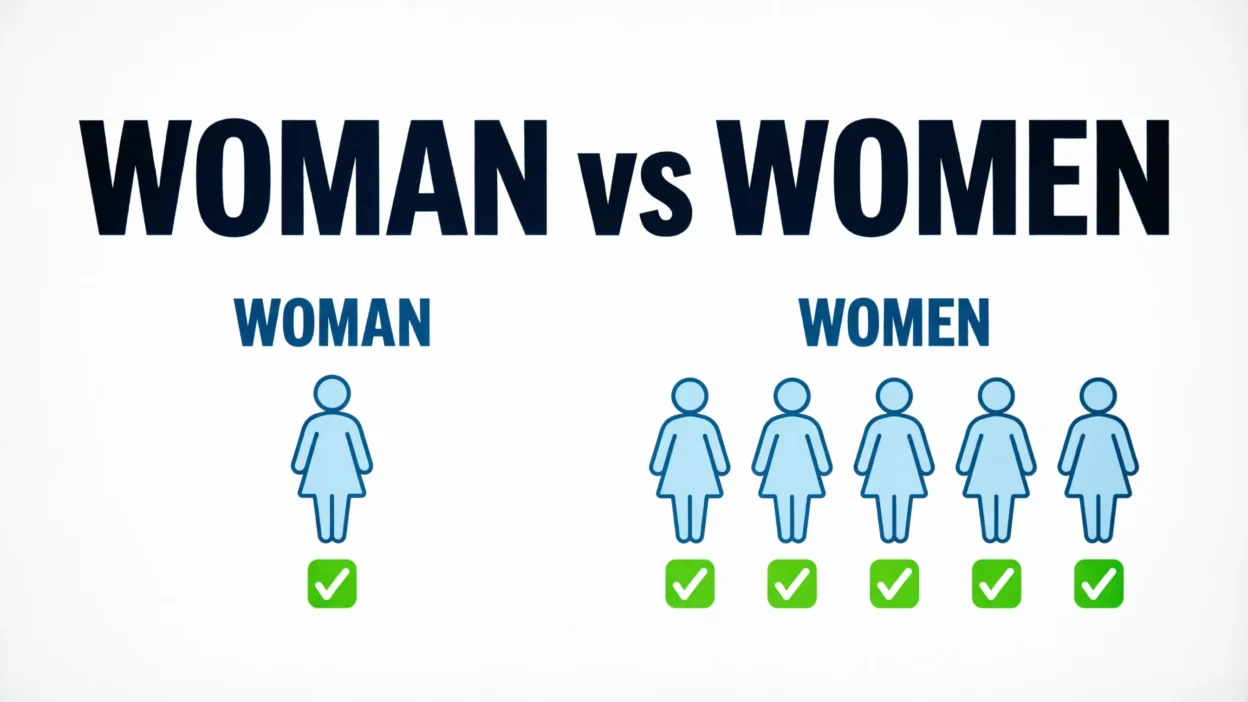
- Woman → One adult female (singular)
- Women → More than one adult female (plural)
Examples:
- She is a woman.
- There are many women in the room.
Simple Background Explanation
The word woman has been used in English for hundreds of years to refer to an adult female person.
When English forms the plural (more than one), some words change their spelling. Instead of simply adding -s, the word changes slightly.
For example:
- man → men
- woman → women
This type of change is common in older English words.
Clear Explanation of the Difference
The main difference between woman and women is the number of people.
Woman refers to one adult female.
Examples:
- That woman is my teacher.
- The woman is speaking on the phone.
Women refers to more than one adult female.
Examples:
- The women are talking in the meeting.
- Many women work in this company.
So the rule is simple:
- One person → woman
- More than one person → women
Comparison Table
| Feature | Woman | Women |
|---|---|---|
| Number | Singular (one) | Plural (more than one) |
| Meaning | One adult female | More than one adult female |
| Example | The woman is smiling. | The women are smiling. |
| Verb agreement | Uses singular verbs | Uses plural verbs |
Which One Should You Use and When?
Use woman when you talk about one person.
Examples:
- The woman is waiting outside.
- She is a strong woman.
Use women when you talk about two or more people.
Examples:
- The women are discussing the project.
- Many women enjoy reading.
Remember:
Woman = one
Women = many
Common Mistakes People Make
1. Using “women” for one person
Incorrect:
The women is my doctor.
Correct:
The woman is my doctor.
2. Using “woman” for multiple people
Incorrect:
The woman are sitting in the room.
Correct:
The women are sitting in the room.
3. Pronunciation confusion
Many learners pronounce both words the same way.
Correct pronunciation:
- Woman → /woo-muhn/
- Women → /wi-min/
Everyday Real-Life Examples
Here are examples of how the words appear in daily situations.
In news
The woman won an important award.
Several women participated in the conference.
At work
The woman is the manager of the office.
Many women work in the technology field.
In daily conversations
That woman helped me find the store.
The women are planning a trip.
On social media
She is an inspiring woman.
These women are amazing leaders.
Learning Section for Students and Beginners
Here are simple tricks to remember the difference.
Trick 1: Compare with “man” and “men”
English follows the same pattern.
- man → men
- woman → women
Trick 2: Look at the first vowel
- Woman → one person
- Women → many people
Trick 3: Check the verb
Singular verb:
The woman is talking.
Plural verb:
The women are talking.
Practice Exercise
Fill in the blank:
- The ______ is my teacher.
- Two ______ are standing outside.
- The ______ is reading a book.
Answers:
- woman
- women
- woman
Frequently Asked Questions (FAQ)
1. What is the difference between woman and women?
Woman is singular. Women is plural.
2. When should I use “woman”?
Use it when talking about one adult female.
3. When should I use “women”?
Use it when talking about two or more adult females.
4. Why does the spelling change?
Some older English words change their vowels when forming plurals.
5. Is “women” pronounced the same as “woman”?
No. The pronunciation is slightly different.
6. Is “woman” used for girls?
No. It refers to adult females. For young people, we usually say girl.
7. Can “women” be used in professional contexts?
Yes. It is commonly used in workplaces, news, and academic writing.
Conclusion
The difference between woman and women is simple but important.
- Woman refers to one adult female.
- Women refers to more than one adult female.
Remember this rule:
Woman = one person
Women = many people
Once you remember this basic idea, you will use these words correctly in speaking and writing.

Justin Larry is a talented language writer and content creator at WordHuts.com. She specializes in explaining word differences, grammar tips, and common English mistakes in a clear, practical style. Her engaging content helps readers improve vocabulary, writing skills, and everyday communication, making language learning simple and effective.