
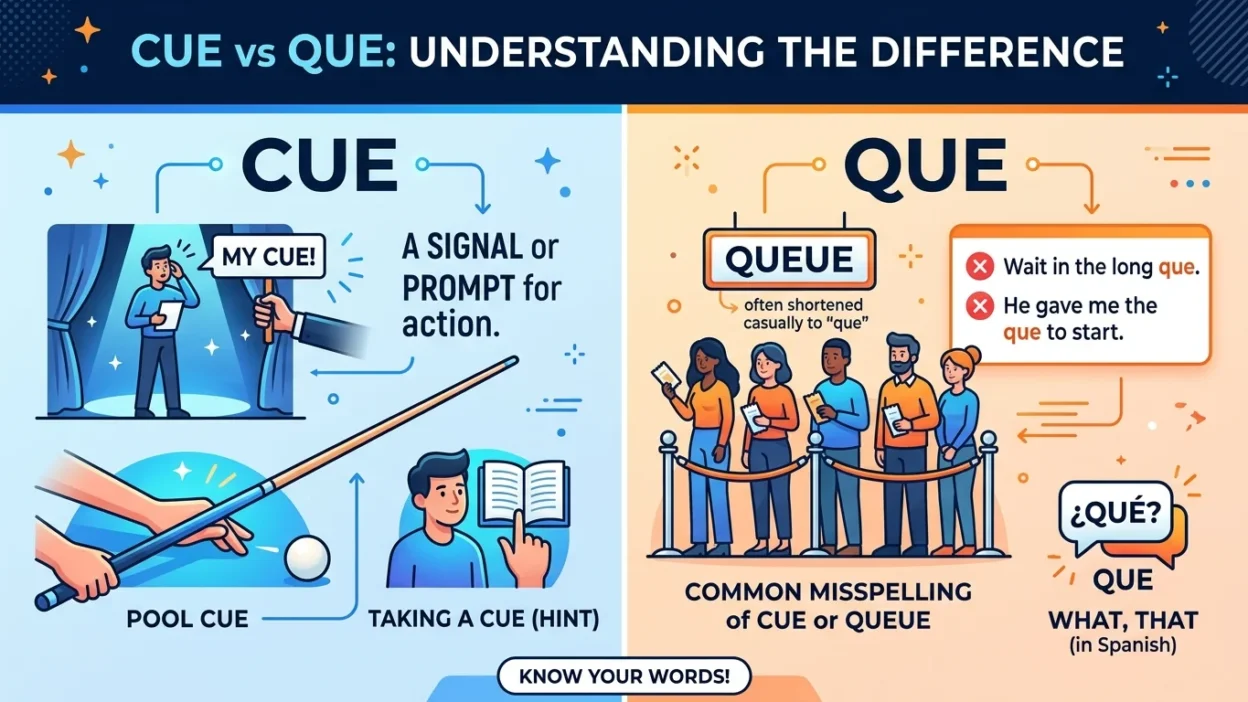
Many people get confused between cue and que because the two words look and sound similar. You may see them in text messages, social media posts, emails, or even school writing. Some people accidentally write que when they really mean cue.
The good news is that the difference is actually very simple once you understand how each word is used.
This guide will explain everything in clear and easy English so students, ESL learners, and beginners can understand it quickly.
Quick Answer
Here is the simple difference:
- Cue is a real English word.
- Cue usually means:
- a signal
- a reminder
- a sign to begin something
- Que is usually not an English word.
- Que comes from Spanish, Portuguese, and some other languages.
- In English writing, people often type que by mistake when they mean cue or queue.
Easy Example
- “That was my cue to leave.”
- “The actor waited for his cue.”
Incorrect in English:
- “That was my que to leave.”
Simple Background of the Words
Where “Cue” Comes From
The word cue has been used in English for hundreds of years. It became common in theater and acting.
Actors needed a signal to know when to speak or move. That signal was called a cue.
Later, the word started being used in everyday life too.
Today, cue can mean:
- a hint
- a signal
- a reminder
- something that causes an action
Where “Que” Comes From
The word que is mainly used in:
- Spanish
- Portuguese
- French (in some cases)
In Spanish, que often means:
- “that”
- “what”
- “which”
Example in Spanish:
- “¿Que pasa?” meaning “What’s happening?”
So, que is not usually an English vocabulary word.
The Main Difference Between Cue and Que
Cue = Signal or Sign
Use cue when talking about:
- signals
- hints
- reminders
- starting an action
Examples
- The music was my cue to walk on stage.
- She gave me a cue to start talking.
- His smile was a cue that everything was okay.
In all these examples, cue means a sign or signal.
Que = Usually From Another Language
Use que only when:
- writing in Spanish or another language
- using a foreign phrase
- quoting something from another language
Examples
- “Que bonito!” (Spanish expression)
- “Que sera, sera.”
In normal English sentences, que is usually incorrect.
Comparison Table
| Word | Meaning | Used in English? | Common Use |
| Cue | A signal, sign, or reminder | Yes | Theater, conversation, daily life |
| Que | Word from Spanish or other languages | Usually no | Foreign phrases or language learning |
Which One Should You Use?
Use “Cue” When Talking About Signals
Choose cue if you mean:
- a hint
- a sign
- a signal to act
Examples
- The teacher’s nod was my cue.
- Rain clouds were the cue to go inside.
- The music gave dancers their cue.
Use “Que” Only in Foreign Language Situations
Choose que only when:
- writing Spanish
- quoting another language
- using a known foreign phrase
Examples
- “Que pasa?”
- “No hay de que.”
Why People Mix Them Up
There are several reasons people confuse these words.
1. They Sound Similar
When spoken quickly, cue and que can sound alike.
2. Fast Typing and Autocorrect
Phones and keyboards sometimes change words automatically.
Someone may type:
- “that was my que”
when they really mean:
- “that was my cue”
3. Social Media Habits
Online writing is often casual. Many people copy incorrect spelling without noticing.
Over time, the mistake spreads.
4. Confusion With “Queue”
Another confusing word is queue.
- Cue = signal
- Queue = line of people waiting
Example
- We stood in a queue at the store.
- The teacher gave us a cue to begin.
Common Mistakes People Make
Mistake 1: Using “Que” Instead of “Cue”
Incorrect:
- “That was my que to speak.”
Correct:
- “That was my cue to speak.”
Mistake 2: Mixing Up Cue and Queue
Incorrect:
- “I waited in a cue.”
Correct:
- “I waited in a queue.”
Mistake 3: Thinking Que Is Modern English Slang
Some people think que is a trendy English spelling.
In standard English writing, it is usually considered incorrect unless it is part of another language.
Everyday Real-Life Examples
In Emails
Correct:
- “Please take this message as your cue to begin the project.”
Incorrect:
- “Please take this message as your que to begin the project.”
In Daily Conversation
- “His silence was my cue to stop talking.”
- “The bell was our cue to leave class.”
On Social Media
People often write:
- “That was my que.”
But standard English spelling is:
- “That was my cue.”
In Movies and Theater
Actors listen carefully for cues.
Examples:
- music cues
- lighting cues
- speaking cues
Without cues, performances become confusing.
In School
Teachers may give cues during lessons:
- visual cues
- sound cues
- memory cues
These help students learn and remember information.
Easy Trick to Remember the Difference
Remember This:
Cue = Clue
Both words relate to hints or signals.
- cue
- clue
This can help you remember the spelling.
Que = Question Word in Spanish
If you see que, think about Spanish or another language.
That helps separate it from English usage.
Short Learning Section for Students and Beginners
If you are learning English, focus on this simple rule:
Use “cue” in normal English writing.
Use it for:
- signs
- hints
- reminders
- signals
Use “que” only for foreign-language situations.
Practice Sentences
Choose the correct word.
1.
“The teacher’s hand movement was my ___.”
Answer:
- cue
2.
“___ pasa?”
Answer:
- Que
3.
“The music was the dancers’ ___.”
Answer:
- cue
FAQ Section
1. Is “que” an English word?
Usually no. It is mainly used in Spanish and some other languages.
2. What does “cue” mean?
It means a signal, hint, or reminder to do something.
3. Why do people write “que” instead of “cue”?
Mostly because of typing mistakes, autocorrect, or confusion from social media.
4. Is “that was my que” correct?
No. The correct spelling in English is:
- “that was my cue.”
5. What is the difference between cue and queue?
- Cue = signal
- Queue = waiting line
6. Can I use “que” in English sentences?
Only if you are using a Spanish phrase or another foreign-language expression.
7. Is “cue” used only in theater?
No. It is also used in daily conversation, schools, music, sports, and work situations.
8. Which spelling should students use in essays?
Students should use cue when they mean a signal or hint.
Conclusion
The difference between cue and que is easier than many people think.
- Cue is the correct English word for a signal, hint, or reminder.
- Que is mainly a word from Spanish or other languages.
- In normal English writing, “que” is usually a spelling mistake when someone really means “cue.”
If you remember one simple idea, remember this:
Cue = signal
Que = foreign-language word
Once you practice the difference a few times, choosing the correct spelling becomes much easier.

Gregory Alexander is a skilled writer and language researcher at WordHuts.com. He focuses on clarifying confusing word pairs, grammar rules, and common usage mistakes. With a passion for precise communication, Gregory creates simple, easy-to-understand content that helps readers strengthen vocabulary, writing accuracy, and everyday English skills.