Many English learners get confused by cord and chord because the two words sound exactly the same. They are homophones, which means they have the same pronunciation but different meanings and spellings.
Even native English speakers sometimes mix them up in writing.
The good news is that the difference is actually very simple once you see how each word is used in real life.
This guide will help you understand:
- What cord means
- What chord means
- When to use each word
- Common mistakes to avoid
- Easy examples you can remember
By the end, you will be able to use both words correctly with confidence.
Quick Answer
Cord
A cord is usually:
- A rope
- A wire
- A cable
- Something long and flexible
Examples
- The phone charger cord is broken.
- She tied the package with a cord.
- Don’t trip over the extension cord.
Chord
A chord is usually:
- A group of musical notes played together
- Something related to music
Examples
- He played a guitar chord.
- That piano chord sounded beautiful.
- She learned three new chords today.
Simple Background and Origin
Understanding the background of these words can make them easier to remember.
Origin of “Cord”
The word cord comes from old words connected to:
- Rope
- String
- Twisted material
For hundreds of years, people used cords to:
- Tie things
- Pull things
- Connect objects
Today, the word still keeps that idea of something long and flexible.
Origin of “Chord”
The word chord comes from music history.
Over time, it became connected to:
- Harmony
- Musical notes
- Instruments
Now, musicians use the word chord every day when talking about guitar, piano, or singing.
The Main Difference Between Cord and Chord
The easiest way to understand the difference is this:
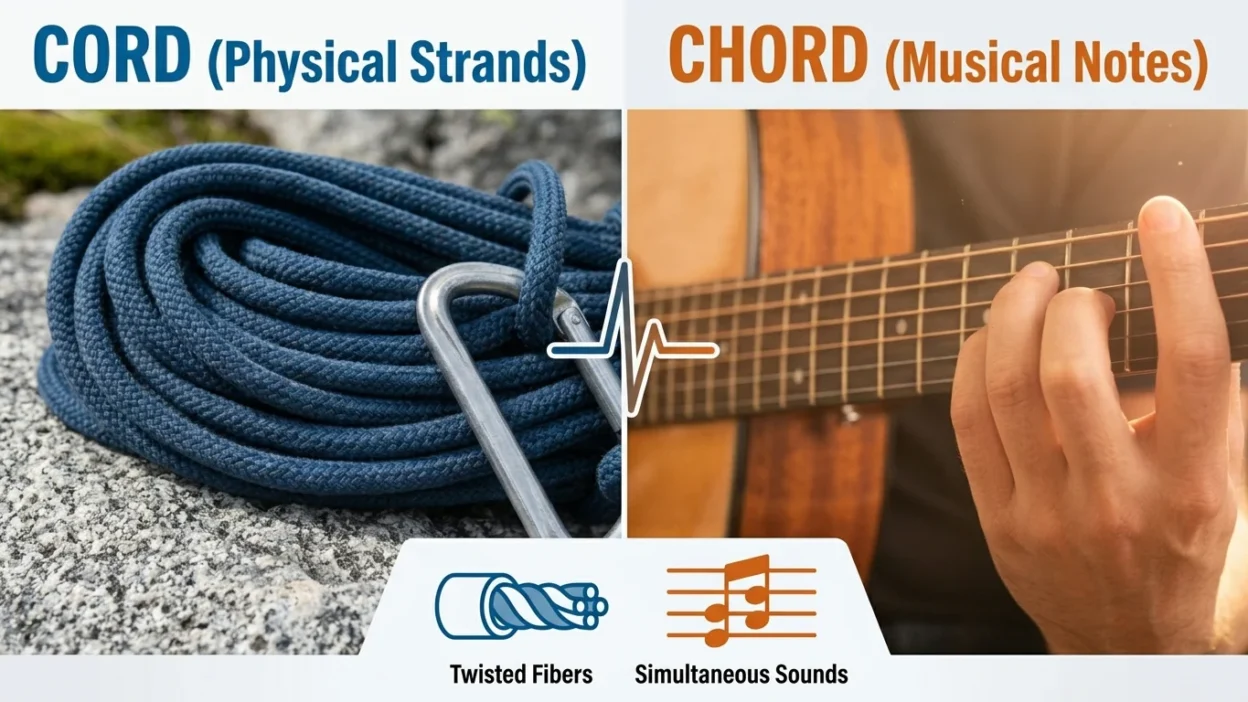
Cord = Physical Object
A cord is something you can usually touch.
Examples:
- Charging cord
- Power cord
- Rope cord
- Curtain cord
It is often:
- Long
- Thin
- Flexible
Chord = Music
A chord belongs to music.
It means:
- Two or more musical notes played together
You hear chords in:
- Songs
- Guitar music
- Piano music
- Choir singing
Easy Comparison Table
| Word | Meaning | Used For | Example |
| Cord | Rope, wire, or cable | Physical objects | The TV cord is too short. |
| Chord | Musical notes played together | Music | She played a sad chord on the piano. |
How to Remember the Difference
Here is a simple memory trick.
Cord → Cable
Both words start with a hard “c” sound and relate to physical things.
Think:
- Cord = cable
- Cord = wire
Chord → Choir
The word chord has an extra “h.”
You can connect that “h” with:
- Harmony
- Music
- Choir
That can help you remember that chord belongs to music.
Which One Should You Use?
Use “Cord” When Talking About Objects
Choose cord when talking about:
- Electronics
- Wires
- Ropes
- Strings
- Cables
Examples
- I need a longer charging cord.
- The curtain cord got stuck.
- He wrapped the cord around the box.
- The microphone cord is on the floor.
Use “Chord” When Talking About Music
Choose chord when talking about:
- Guitar
- Piano
- Singing
- Musical harmony
Examples
- She practiced the same guitar chord all evening.
- The song starts with a soft piano chord.
- He knows hundreds of chords.
- That final chord sounded powerful.
Common Mistakes People Make
Because the words sound alike, people often spell the wrong one.
Let’s look at some common mistakes.
Mistake 1: Using “Cord” in Music
❌ Wrong:
- I learned a new guitar cord.
✅ Correct:
- I learned a new guitar chord.
Why?
Because music uses chord, not cord.
Mistake 2: Using “Chord” for Wires
❌ Wrong:
- The phone chord is missing.
✅ Correct:
- The phone cord is missing.
Why?
A charger or cable is a cord.
Mistake 3: Depending Only on Sound
Many learners write words based only on pronunciation.
But:
- Cord and chord sound the same
- Their meanings are completely different
Always think about the topic:
- Object → cord
- Music → chord
Everyday Real-Life Examples
Seeing real examples can make the difference much clearer.
In Daily Conversation
Cord
- Can you unplug the power cord?
- The vacuum cord is too short.
- She bought a new extension cord.
Chord
- That guitar chord sounds amazing.
- He forgot the piano chord.
- I’m learning basic music chords.
In Emails
Cord
- Please replace the damaged computer cord.
Chord
- The musician played the wrong chord during practice.
On Social Media
Cord
- Why do phone cords always get tangled?
Chord
- Finally learned my first guitar chord today!
In News or Articles
Cord
- Officials warned people about damaged electrical cords.
Chord
- The opening chord of the song became famous worldwide.
Cord in Different Situations
The word cord appears in many areas of life.
Electrical Cord
Used for power or charging.
Example:
- The laptop cord stopped working.
Extension Cord
A longer cable used to reach electricity.
Example:
- We used an extension cord outside.
Decorative Cord
Used in clothing or decoration.
Example:
- The jacket has a gold cord.
Rope or Tie Cord
Used to tie objects.
Example:
- He secured the tent with a strong cord.
Chord in Different Musical Situations
The word chord is very common in music.
Guitar Chord
Example:
- Beginners usually learn simple guitar chords first.
Piano Chord
Example:
- The piano chord sounded soft and calm.
Vocal Chord Harmony
Sometimes singers create chords together with their voices.
Example:
- The singers ended the song with a beautiful chord.
Short Learning Section for Students and Beginners
Here is a simple way to practice the difference.
Step 1: Think About the Topic
Ask yourself:
- Is this about an object?
- Or is this about music?
Step 2: Choose the Correct Word
Physical object?
Use cord
Music?
Use chord
Step 3: Practice with Sentences
Fill in the blanks:
- The charger _____ is broken.
- She played a guitar _____ .
- The extension _____ is in the garage.
- That piano _____ sounded beautiful.
Answers
- cord
- chord
- cord
- chord
FAQ About Cord vs Chord
1. Are cord and chord pronounced the same?
Yes. They sound exactly the same in English.
They are homophones.
2. What does cord mean?
A cord usually means:
- Rope
- Cable
- Wire
- String
Example:
- The lamp cord is under the table.
3. What does chord mean?
A chord is a musical term.
It means:
- Multiple musical notes played together
Example:
- He practiced a guitar chord.
4. Is a guitar cord or chord correct?
Usually:
- Guitar chord = musical notes
- Guitar cord = cable connected to the guitar
Both can be correct, depending on meaning.
5. Which word is related to electricity?
Cord is related to electricity.
Examples:
- Power cord
- Charging cord
- Extension cord
6. Which word is related to music?
Chord is related to music.
Examples:
- Piano chord
- Guitar chord
- Musical chord
7. Why do people confuse these words?
People confuse them because:
- They sound identical
- Their spelling is very similar
8. Is “chord” ever used outside music?
Sometimes, but music is the most common use.
Most everyday uses of chord are musical.
Simple Practice Quiz
Choose the correct word.
- The phone _____ is tangled.
- She learned a new piano _____ .
- The power _____ needs replacing.
- That final guitar _____ sounded great.
Answers
- cord
- chord
- cord
- chord
Final Thoughts
The difference between cord and chord becomes easy once you connect each word with its main meaning.
Remember:
- Cord = wire, rope, cable, or string
- Chord = music and harmony
A simple trick is:
- If you can plug it in or tie something with it, use cord
- If you can play it on a guitar or piano, use chord
With a little practice, you will quickly stop mixing them up and start using both words correctly in everyday English.

Brandon Samuel is a dedicated writer and language enthusiast, serving as the lead author at WordHuts.com. He specializes in explaining word differences, grammar rules, and common language mistakes in simple terms. Brandon’s clear, practical writing style helps readers improve vocabulary, writing confidence, and everyday communication skills.