
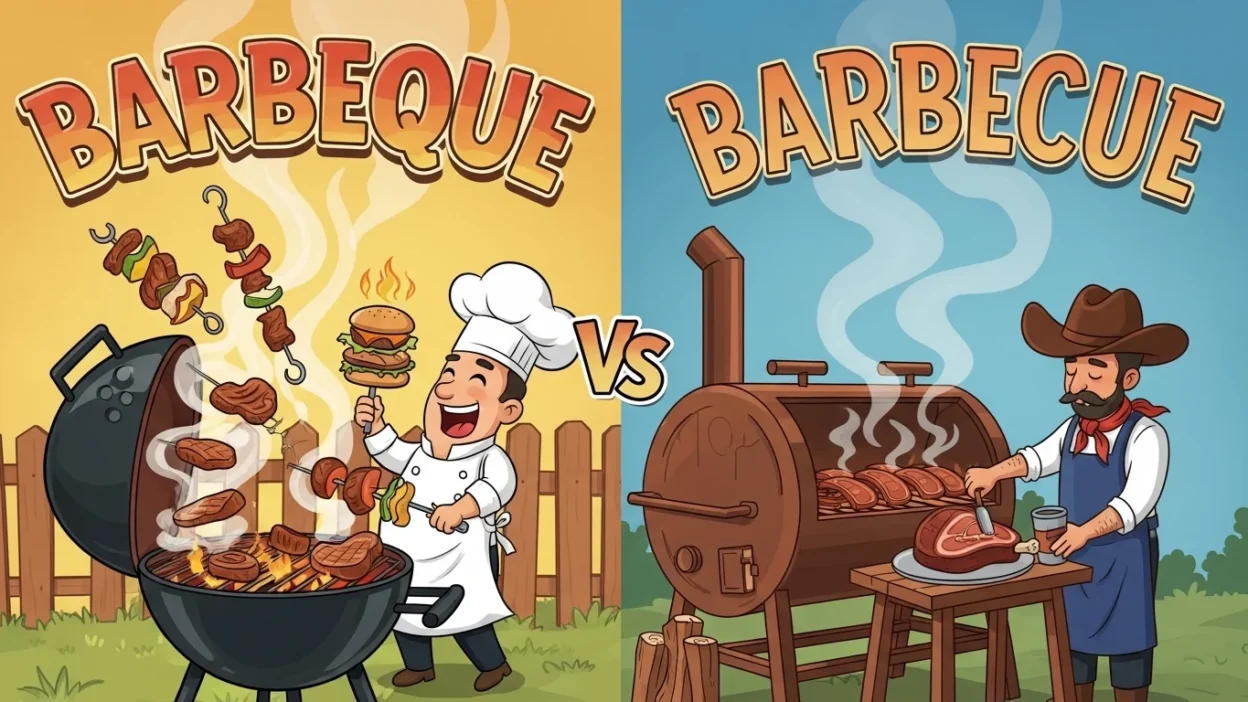
Many people wonder whether barbeque and barbecue mean different things. They look similar, sound the same, and are often used in the same way. This can make writing difficult, especially for students, English learners, and anyone who wants to use the correct spelling.
The good news is simple: these two words have the same meaning. The main difference is spelling. One spelling is standard and widely accepted, while the other is a less common variant.
Quick Answer
- Barbecue is the standard and correct spelling.
- Barbeque is an alternative spelling.
- Both words mean the same thing.
- Barbecue is much more common in writing.
- BBQ is a popular short form of barbecue.
If you are unsure, choose barbecue. It is the safest and most widely accepted option.
Where the Word Comes From
The word barbecue has a long history. It came into English many years ago from a word used in the Caribbean. That original word described a wooden frame used for cooking meat over fire.
Over time, English speakers adopted the word and changed its spelling slightly. Eventually, barbecue became the standard form.
Later, the spelling barbeque appeared. It likely developed because people wanted a spelling that matched the short form BBQ. Even so, barbecue remained the preferred spelling.
The Main Difference Between Barbeque and Barbecue
There is no difference in meaning.
Both words can refer to:
- A method of cooking food slowly over heat or smoke
- A meal cooked this way
- A social event where people cook and eat outdoors
- A grill or cooking equipment in some contexts
The only real difference is spelling.
- Barbecue = standard spelling
- Barbeque = less common alternative spelling
In formal writing, school assignments, and professional communication, barbecue is the better choice.
Easy Comparison Table
| Feature | Barbecue | Barbeque |
| Meaning | Same | Same |
| Standard spelling | Yes | No |
| Common in writing | Very common | Less common |
| Best for school and work | Yes | Usually no |
| Informal use | Yes | Yes |
| Short form | BBQ | BBQ |
Which One Should You Use?
Use barbecue when:
- Writing essays
- Sending formal emails
- Creating school assignments
- Writing articles or reports
- You want the safest choice
Use barbeque when:
- Following a brand’s spelling
- Reproducing a restaurant name
- Using a personal style preference in casual writing
For most situations, barbecue is the best option.
How the Word Is Used
The word barbecue can be a noun or a verb.
As a noun
- We had a barbecue on Sunday.
- The barbecue was delicious.
- They bought a new barbecue for the backyard.
As a verb
- We plan to barbecue chicken tonight.
- He loves to barbecue on weekends.
- They barbecued fish for dinner.
The same uses apply to barbeque, but barbecue is still preferred.
Common Mistakes People Make
1. Thinking the words have different meanings
They do not. They mean exactly the same thing.
2. Using barbeque in formal writing
This is not usually wrong, but barbecue is more accepted.
3. Confusing the word with BBQ
BBQ is simply a short form. It is very common in signs, menus, and casual writing.
4. Mixing spellings in the same piece of writing
Choose one spelling and stick with it. For formal writing, use barbecue throughout.
Real-Life Examples
In an Email
- We are hosting a barbecue this Saturday.
- Please join us for a family barbecue.
In a News Story
- The city will hold a summer barbecue festival.
- Local chefs competed in a barbecue contest.
On Social Media
- Best barbecue ever!
- Weekend BBQ with friends.
- Nothing beats a summer barbecue.
In Everyday Conversation
- Are you coming to the barbecue?
- Let’s barbecue burgers tonight.
- He makes great barbecue sauce.
Barbecue, BBQ, and Barbeque
These three forms are related.
- Barbecue = full standard spelling
- Barbeque = alternative spelling
- BBQ = abbreviation
Example
- Formal: We enjoyed a barbecue at the park.
- Casual: We enjoyed a BBQ at the park.
In formal writing, avoid using BBQ unless the style is intentionally casual.
A Simple Tip to Remember
If you are writing for school, work, or anything important, use barbecue.
Think of it this way:
- Barbecue = the dictionary choice
- Barbeque = a less common spelling
- BBQ = the quick, casual version
When in doubt, choose barbecue.
Learning Section for Students and Beginners
Here is an easy way to remember the correct spelling.
Remember This Rule
Barbecue is the standard spelling in English.
If your teacher, editor, or employer checks your writing, this is the spelling they will expect.
Practice Sentences
Fill in the blank with the best choice.
- We had a ________ in the backyard.
- My father loves to ________ ribs.
- They bought a new ________ grill.
Answers:
- barbecue
- barbecue
- barbecue
Frequently Asked Questions
1. Is barbeque wrong?
No, it is not wrong. It is simply less common than barbecue.
2. Which spelling is correct?
Barbecue is the standard and preferred spelling.
3. Do both words mean the same thing?
Yes, they have exactly the same meaning.
4. Can I use barbeque in school writing?
You can, but barbecue is a better and safer choice.
5. What does BBQ mean?
BBQ is a short form of barbecue.
6. Is BBQ formal or informal?
It is usually informal and best for casual writing.
7. Can barbecue be a verb?
Yes. For example: We will barbecue chicken tonight.
8. Which spelling is more common worldwide?
Barbecue is far more common in books, newspapers, and formal writing.
Final Thoughts
The difference between barbeque and barbecue is simple: it is only a spelling difference.
- Barbecue is the standard spelling.
- Barbeque is an alternative spelling.
- BBQ is the short, informal version.
All three refer to the same idea: cooking food over fire or smoke, or enjoying a meal or event centered around that cooking style.
For students, English learners, and everyday writers, the best choice is almost always barbecue. It is clear, correct, and widely accepted.
So the next time you write about grilled food, summer parties, or smoky flavors, you can use barbecue with confidence.

Gregory Alexander is a skilled writer and language researcher at WordHuts.com. He focuses on clarifying confusing word pairs, grammar rules, and common usage mistakes. With a passion for precise communication, Gregory creates simple, easy-to-understand content that helps readers strengthen vocabulary, writing accuracy, and everyday English skills.