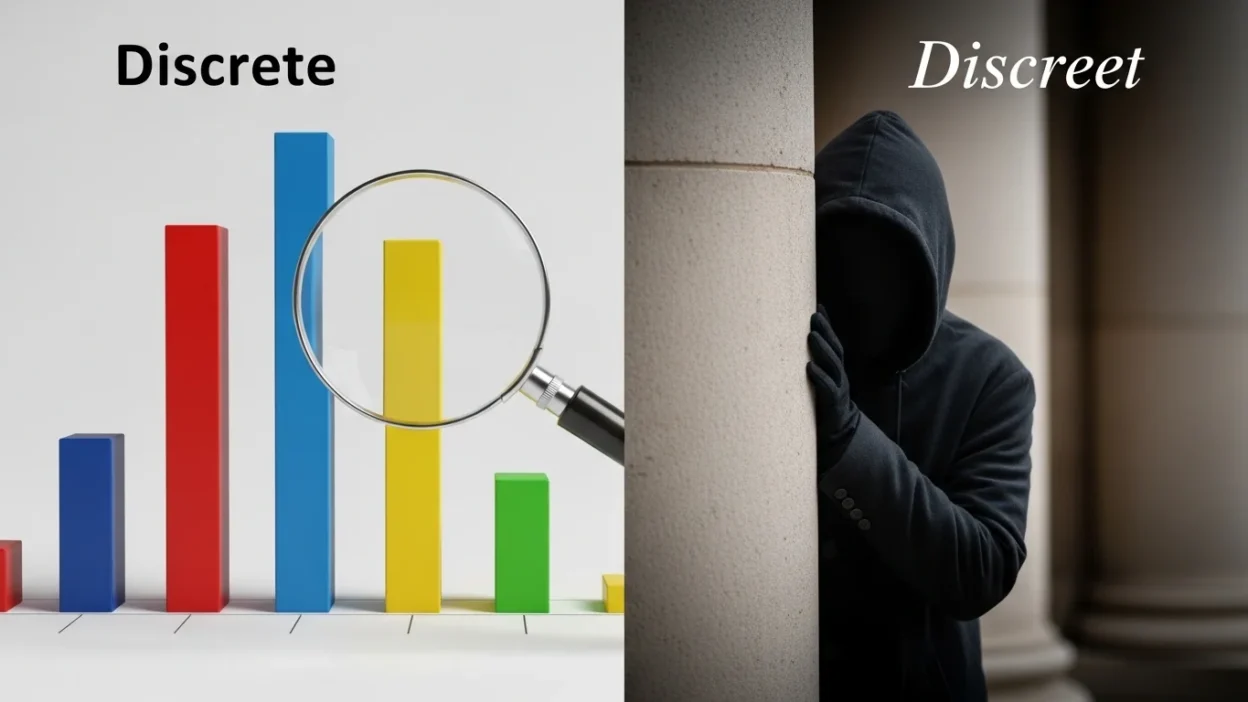
Many people confuse discrete and discreet because they look almost the same. They differ by just one letter. They also sound very similar when spoken.
This can make writing difficult, even for native English speakers. You may stop and wonder, “Which word should I use?”
The good news is that the difference is actually very simple. Once you understand the meaning of each word, it becomes much easier to choose the right one.
In this guide, you will learn exactly what each word means, when to use it, and how to remember the difference.
Quick Answer
- Discrete means separate, distinct, or individual.
- Discreet means careful, private, and not drawing attention.
Easy Memory Trick
- Discrete has an “e” in the middle, like separate.
- Discreet has two e’s together, like someone trying to keep a secret.
Where These Words Come From
Both words come from the same Latin root, which means “to separate” or “to distinguish.”
Over time, their meanings changed.
- Discrete kept the idea of things being separate from one another.
- Discreet developed the meaning of being careful and thoughtful, especially in private situations.
Even though they share a history, they are now used in very different ways.
What Does “Discrete” Mean?
Discrete describes things that are separate, individual, or clearly divided.
If something is discrete, it is not connected to other parts. It stands alone.
Simple Examples
- The project has three discrete stages.
- The report is divided into discrete sections.
- Each student completed a discrete task.
In each example, the parts are separate and distinct.
Common Areas Where You See “Discrete”
- Mathematics
- Science
- Technology
- Formal writing
- Business reports
For example:
- A computer processes discrete pieces of information.
- The survey looked at five discrete age groups.
What Does “Discreet” Mean?
Discreet describes someone or something that is careful, private, and not obvious.
A discreet person knows how to act quietly and wisely.
Simple Examples
- She was very discreet about the surprise party.
- Please be discreet when discussing private matters.
- The hotel offers discreet service.
In these examples, the focus is on privacy and careful behavior.
Common Situations for “Discreet”
- Private conversations
- Professional settings
- Sensitive topics
- Personal matters
- Customer service
The Main Difference
The easiest way to understand the difference is this:
- Use discrete for things that are separate.
- Use discreet for people, actions, or behavior that are careful and private.
One Talks About Separation
- discrete units
- discrete categories
- discrete choices
One Talks About Privacy
- discreet behavior
- discreet handling
- discreet service
Comparison Table
| Feature | Discrete | Discreet |
| Meaning | Separate, individual | Careful, private |
| Used For | Things, groups, parts | People, actions, behavior |
| Common Context | Math, science, writing | Social situations, business |
| Memory Tip | Separate items | Keep a secret |
| Example | Three discrete steps | A discreet response |
When Should You Use “Discrete”?
Use discrete when talking about things that are separate or clearly divided.
Use It For:
- Individual parts
- Separate categories
- Independent items
- Distinct groups
Examples
- The course has four discrete modules.
- We studied three discrete problems.
- The data was organized into discrete groups.
- Each department works as a discrete unit.
If you can replace the word with separate or individual, then discrete is probably correct.
When Should You Use “Discreet”?
Use discreet when talking about being careful, quiet, or private.
Use It For:
- Sensitive information
- Private behavior
- Quiet actions
- Professional handling
Examples
- He gave a discreet nod.
- The doctor was discreet during the conversation.
- They made a discreet entrance.
- Please handle this issue in a discreet manner.
If you can replace the word with careful, private, or tactful, then discreet is the right choice.
Common Mistakes People Make
Because the words look so similar, people often use the wrong one.
Mistake 1: Using “Discreet” for Separate Things
❌ The book is divided into discreet chapters.
✅ The book is divided into discrete chapters.
Why? Chapters are separate parts.
Mistake 2: Using “Discrete” for Private Behavior
❌ She was very discrete about the news.
✅ She was very discreet about the news.
Why? She was careful and private.
Mistake 3: Guessing Based on Sound
These words sound almost identical. Relying only on pronunciation can lead to errors.
Always think about the meaning.
Ask yourself:
- Are you talking about separate parts? → Discrete
- Are you talking about careful privacy? → Discreet
Everyday Examples
In Emails
- Please keep this information discreet.
- The report contains five discrete sections.
In News Writing
- The investigation focused on three discrete events.
- Sources requested discreet treatment.
On Social Media
- She shared the update in a very discreet way.
- The discussion covered several discrete topics.
At Work
- Our company has several discrete teams.
- Managers must be discreet with employee information.
In Daily Life
- He asked a discreet question.
- The recipe has several discrete steps.
Easy Memory Tricks
For “Discrete”
Think of separate.
Both words contain the idea of things being apart.
- discrete
- separate
A discrete thing stands on its own.
For “Discreet”
Notice the double ee.
Think of two eyes watching carefully and quietly.
Or remember:
- ee = extra careful
A discreet person is careful and private.
A Simple Learning Tip for Students
When you see these words, ask one quick question:
Is it about parts or privacy?
- Parts = Discrete
- Privacy = Discreet
This simple test works almost every time.
You can also practice by making your own sentences.
For example:
- The machine has several discrete components.
- The assistant handled the matter discreetly.
Practice helps the difference become natural.
Frequently Asked Questions
1. Are discrete and discreet pronounced the same?
They are pronounced very similarly. In everyday speech, they often sound almost identical.
2. Which word means private?
Discreet means private, careful, and not obvious.
3. Which word means separate?
Discrete means separate, individual, or distinct.
4. Is “discrete” used in math?
Yes. In mathematics, discrete describes separate values or items.
For example, whole numbers are discrete.
5. Can a person be discrete?
Usually, no. A person is normally described as discreet, not discrete.
6. Can information be discreet?
Yes. Information can be handled in a discreet way.
7. Can groups be discreet?
No. If groups are separate, the correct word is discrete.
8. What is the easiest way to remember the difference?
- Discrete = separate parts
- Discreet = private behavior
Practice Sentences
Choose the correct word:
- The company has three ______ departments.
- Please be ______ when discussing this issue.
- The study examined four ______ categories.
- She made a ______ exit.
Answers
- discrete
- discreet
- discrete
- discreet
Final Summary
Although discrete and discreet look almost the same, their meanings are very different.
- Discrete means separate or distinct.
- Discreet means careful, private, and tactful.
Final Memory Tip
- Discrete = separate pieces
- Discreet = secret and careful
Once you connect:
- parts with discrete
- privacy with discreet
you will rarely confuse them again.

Gregory Alexander is a skilled writer and language researcher at WordHuts.com. He focuses on clarifying confusing word pairs, grammar rules, and common usage mistakes. With a passion for precise communication, Gregory creates simple, easy-to-understand content that helps readers strengthen vocabulary, writing accuracy, and everyday English skills.