Many learners mix up “inpatient” and “impatient” because they look almost the same. The only difference is one small letter: “in” vs “im.” But even though they look similar, their meanings are very different.
This confusion is very common for students, ESL learners, and even native speakers sometimes. The good news is that once you understand the basic idea, it becomes very easy to remember.
Quick Answer
Here is the simple difference:
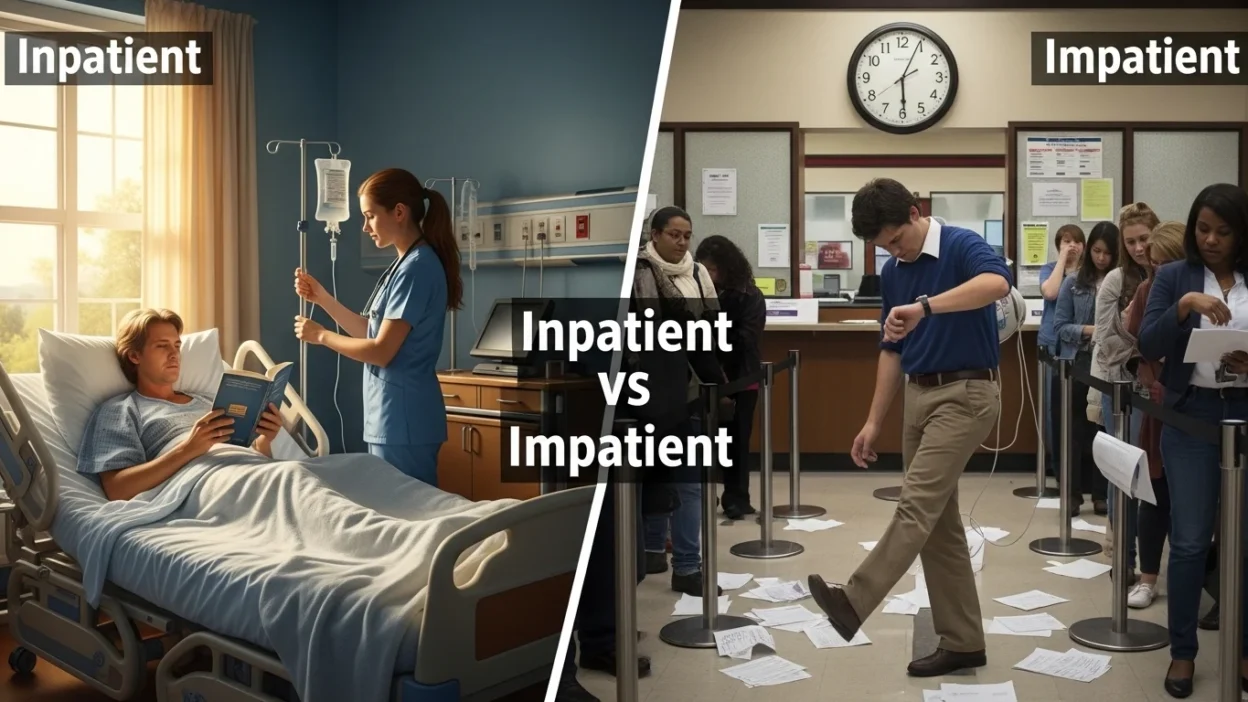
- Inpatient → A person who stays in a hospital for treatment
- Impatient → A person who cannot wait and feels annoyed
👉 Example:
- She is an inpatient at the hospital. (medical meaning)
- He is impatient in long lines. (feeling meaning)
Simple Origin or Background
Understanding the parts of the words can help:
Inpatient
- “In” = inside
- “Patient” = a person receiving medical care
So, inpatient = a patient who stays inside a hospital.
Impatient
- “Im” = not
- “Patient” = calm, able to wait
So, impatient = not patient, meaning someone who cannot wait.
Clear Explanation of the Difference
Let’s look at each word in simple terms.
What Does “Inpatient” Mean?
An inpatient is a person who is admitted to a hospital and stays there for treatment.
- They sleep in the hospital
- Doctors and nurses care for them
- They may stay for days or weeks
👉 Example:
- My uncle is an inpatient after his surgery.
What Does “Impatient” Mean?
Impatient describes a feeling. It means you are not willing to wait calmly.
- You feel annoyed
- You want things to happen quickly
- You may get angry or restless
👉 Example:
- She became impatient while waiting for the bus.
Comparison Table
| Feature | Inpatient | Impatient |
| Type | Noun (person) | Adjective (feeling) |
| Meaning | A hospital patient staying inside | Not willing to wait |
| Field | Medical | Emotions / behavior |
| Usage | Hospitals, health care | Daily life situations |
| Example | He is an inpatient. | He is impatient. |
Which One to Use and When
Use inpatient when talking about hospitals or medical care.
👉 Use it when:
- Someone is admitted to a hospital
- Someone stays overnight or longer for treatment
Example:
- The hospital has 50 inpatients.
Use impatient when talking about feelings.
👉 Use it when:
- Someone cannot wait
- Someone feels annoyed or restless
Example:
- The children are getting impatient.
Common Mistakes People Make
Here are some mistakes learners often make:
1. Using “inpatient” for feelings ❌
- ❌ I feel inpatient waiting here.
- ✅ I feel impatient waiting here.
2. Using “impatient” for hospital patients ❌
- ❌ The impatient needs care.
- ✅ The inpatient needs care.
3. Spelling confusion
People often forget:
- Inpatient → hospital word
- Impatient → emotion word
4. Thinking both words are the same
They are not the same at all:
- One is about health care
- One is about feelings
Everyday Real-Life Examples
Let’s see how these words are used in daily life.
In Emails
- The doctor wrote:
“The inpatient is recovering well.” - A hospital message:
“Family members can visit the inpatient after 5 PM.”
In News
- “The hospital admitted many inpatients after the accident.”
On Social Media
- “I’m so impatient waiting for my results!”
- “Why is this internet so slow? I’m getting impatient.”
In Daily Conversations
- “He became impatient in the long queue.”
- “She is an inpatient after her operation.”
Short Learning Section for Students and Beginners
Here is an easy trick to remember:
Memory Tip
- INpatient → IN the hospital
- IMpatient → I’M not patient (I can’t wait)
Practice Sentences
Fill in the blanks:
- The ______ is staying in the hospital.
- She is ______ because the bus is late.
Answers:
- inpatient
- impatient
Mini Exercise
Choose the correct word:
- He became (inpatient / impatient) during the meeting.
- The (inpatient / impatient) needs rest.
Correct answers:
- impatient
- inpatient
FAQ Section
1. Are “inpatient” and “impatient” pronounced the same?
No, they are slightly different.
- Inpatient → “in-pay-shent”
- Impatient → “im-pay-shent”
2. Can “inpatient” describe a feeling?
No. It only refers to a hospital patient.
3. Is “impatient” always negative?
Mostly yes, because it shows a lack of patience.
4. What is the opposite of “impatient”?
The opposite is patient (calm and able to wait).
5. Can “inpatient” be used outside hospitals?
No, it is mainly used in medical settings.
6. Is “impatient” a noun or adjective?
It is an adjective (it describes a feeling).
7. What is the plural of “inpatient”?
The plural is inpatients.
8. Which word is more common in daily speech?
Impatient is more common because we talk about feelings often.
Conclusion
Even though inpatient and impatient look very similar, their meanings are completely different.
- Inpatient is a medical word for someone staying in a hospital
- Impatient is a feeling when you cannot wait
If you remember:
- “IN = inside hospital”
- “IM = not patient”
…you will never confuse them again.
With a little practice, these words will become very easy to use in your daily English.

Justin Larry is a talented language writer and content creator at WordHuts.com. She specializes in explaining word differences, grammar tips, and common English mistakes in a clear, practical style. Her engaging content helps readers improve vocabulary, writing skills, and everyday communication, making language learning simple and effective.