
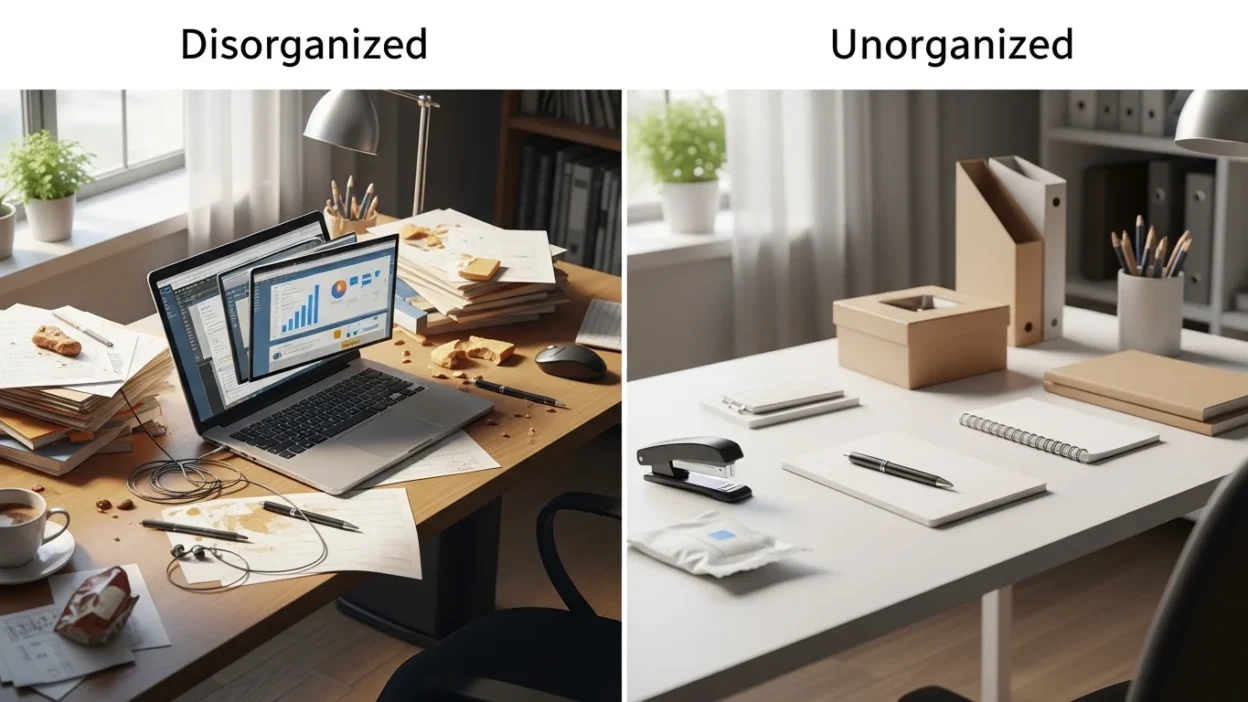
Many learners feel confused about “disorganized” and “unorganized.” These two words look very similar, and both seem to mean “not organized.” Because of this, people often use them in the same way.
But here’s the truth: they are not always the same. There is a small but important difference in meaning and usage.
This guide will explain everything in very simple English so you can understand it easily and use both words correctly in daily life.
Quick Answer
- Disorganized
- Means messy, not arranged, or lacking order
- Often describes people, thoughts, or things that are already in a messy state
- Unorganized
- Means not planned, not arranged, or not formally set up
- Often describes something that has never been organized
👉 Simple idea:
- Disorganized = was organized but now messy (or badly arranged)
- Unorganized = not organized at all from the start
Simple Background
Both words come from the base word “organize.”
- Organize = to arrange things in a clear and tidy way
Now look at the prefixes:
- Dis- = something is done badly or wrongly
- Un- = something is not done at all
So:
- Disorganized = organized in a bad or messy way
- Unorganized = not organized at all
This small difference changes how we use the words.
Clear Explanation of the Difference
Let’s break it down in a very simple way.
1. Disorganized
Use disorganized when something:
- Is messy
- Has no clear order
- Is confusing
- Was supposed to be organized but isn’t
It often describes:
- People
- Work
- Thoughts
- Rooms or spaces
👉 Example:
- My desk is disorganized. (Things are messy and scattered)
2. Unorganized
Use unorganized when something:
- Has never been planned or arranged
- Is not officially structured
- Lacks a system from the beginning
It often describes:
- Events
- Groups
- Activities
- Systems
👉 Example:
- The event was unorganized. (No proper planning was done)
Comparison Table
| Feature | Disorganized | Unorganized |
| Basic meaning | Messy or badly arranged | Not arranged at all |
| Time idea | Something went wrong | Nothing was planned from the start |
| Common use | People, rooms, thoughts | Events, systems, groups |
| Feeling | Confusing, messy | Lacking structure |
| Example | A disorganized student | An unorganized meeting |
Which One to Use and When
Here’s a simple guide you can follow:
Use disorganized when:
- Things are messy or chaotic
- Someone cannot manage things well
- Ideas are not clear
👉 Examples:
- She is very disorganized with her homework.
- His speech was disorganized and hard to follow.
- The files are disorganized.
Use unorganized when:
- Something was never planned properly
- There is no system or structure
- A group or activity lacks order from the beginning
👉 Examples:
- The trip was unorganized.
- The team is still unorganized.
- The process is unorganized.
Common Mistakes People Make
Mistake 1: Using both words the same way
❌ The meeting was disorganized (when it was never planned)
✔ The meeting was unorganized
Mistake 2: Using “unorganized” for messy things
❌ My room is unorganized
✔ My room is disorganized
Mistake 3: Confusing people and systems
- People → usually disorganized
- Systems/events → usually unorganized
Mistake 4: Overthinking the difference
You don’t need to be perfect every time. Just remember:
- Messy → disorganized
- Not planned → unorganized
Everyday Real-Life Examples
1. In Emails
- The report looks disorganized. Please fix the order.
- The event plan is unorganized. We need a clear schedule.
2. In School
- He is a disorganized student.
- The group project is unorganized.
3. In News or Media
- The response was disorganized and slow.
- The protest was unorganized.
4. On Social Media
- My life feels so disorganized right now 😅
- This event looks completely unorganized!
5. Daily Conversations
- Your notes are very disorganized.
- The system here is unorganized.
Learning Section for Students and Beginners
Here are some simple tips to remember:
Tip 1: Think about “before” and “after”
- Unorganized → before planning
- Disorganized → after things go wrong
Tip 2: Use a memory trick
- Disorganized = Disorder (both start with “dis”)
- Unorganized = Not done
Tip 3: Practice with sentences
Try to fill in the blanks:
- My bag is very ________.
- The event was completely ________.
Answers:
- disorganized
- unorganized
Tip 4: Keep it simple
If you are unsure:
- Use disorganized for mess
- Use unorganized for lack of planning
FAQ Section
1. Are “disorganized” and “unorganized” the same?
No. They are similar but not exactly the same. “Disorganized” means messy, while “unorganized” means not planned.
2. Which word is more common?
“Disorganized” is more commonly used in daily English.
3. Can I use “unorganized” for a messy room?
Not really. It’s better to say “disorganized room.”
4. Can a person be called “unorganized”?
It’s less common. We usually say “disorganized person.”
5. Is “unorganized” wrong?
No, it is correct, but it is used in more specific situations.
6. Which word is better for school writing?
Both are fine, but use them correctly:
- Disorganized → messy work
- Unorganized → lack of planning
7. Can something be both?
Yes. For example:
- An event can be unorganized (no plan) and also disorganized (messy execution).
Conclusion
The difference between disorganized and unorganized is small but important.
- Disorganized = messy, confusing, or badly arranged
- Unorganized = not planned or not arranged at all
If you remember one simple idea, remember this:
👉 Messy = disorganized
👉 Not planned = unorganized
With this understanding, you can now use both words correctly in writing, speaking, and daily life. Keep practicing, and soon it will feel natural.

Brandon Samuel is a dedicated writer and language enthusiast, serving as the lead author at WordHuts.com. He specializes in explaining word differences, grammar rules, and common language mistakes in simple terms. Brandon’s clear, practical writing style helps readers improve vocabulary, writing confidence, and everyday communication skills.