Many people feel confused when choosing between “laid” and “layed.” They look very similar, and both seem like they could be correct. But here is the truth: one is correct in standard English, and the other is almost always wrong.
This confusion often happens because English has many irregular verbs, and the verb “lay” changes its form in a way that is not easy to remember at first. Don’t worry—this guide will explain everything in very simple English so you can understand it quickly and use it with confidence.
Quick Answer
- “Laid” is the correct past form of the verb lay
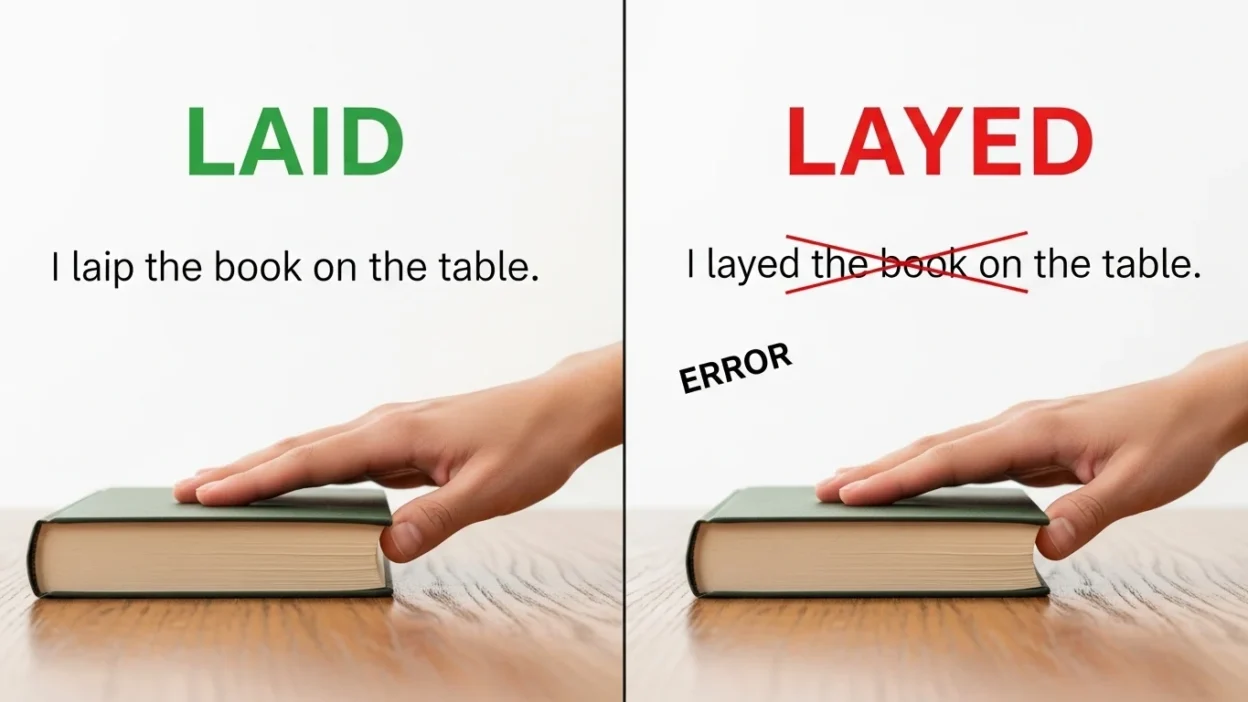
- “Layed” is usually incorrect in standard English
- Use “laid” when something is placed somewhere
- Example: She laid the book on the table. ✅
- Example: She layed the book on the table. ❌
Simple Background (Why This Is Confusing)
The confusion comes from how English verbs change over time.
The verb “lay” is an irregular verb, which means it does not follow the normal “-ed” rule like many other verbs.
Most verbs:
- play → played
- work → worked
But “lay” is different:
- lay → laid (not “layed”)
Because people are used to adding “-ed” to verbs, they sometimes write “layed” by mistake.
Clear Explanation of the Difference
Let’s break it down in the simplest way.
1. What Does “Lay” Mean?
“Lay” means to put or place something somewhere.
It always needs an object (something you are placing).
- I lay the keys on the table.
- She lays the baby in the bed.
2. What Is “Laid”?
“Laid” is the past tense and past participle of “lay.”
- Yesterday, I laid the keys on the table.
- He has laid the book down.
3. What About “Layed”?
“Layed” is not correct in modern standard English.
There is no common situation where “layed” should be used instead of “laid.”
Comparison Table
| Word | Correct? | Meaning | Example Sentence |
| Laid | ✅ Yes | Past of “lay” (to place something) | She laid the phone on the desk. |
| Layed | ❌ No | Not standard English | She layed the phone on the desk. (Wrong) |
Which One to Use and When
Always Use “Laid” When:
- You are talking about the past
- You placed something somewhere
- There is an object in the sentence
Examples:
- He laid the bag on the chair.
- They laid the carpet yesterday.
- She laid her head on the pillow.
Never Use “Layed” In Normal Writing
- Not in school work
- Not in emails
- Not in exams
- Not in formal or informal writing
Common Mistakes People Make
Mistake 1: Adding “-ed” Automatically
❌ He layed the book down.
✅ He laid the book down.
People think every past verb needs “-ed,” but “lay” is different.
Mistake 2: Mixing “Lay” and “Lie”
This is another common confusion.
- Lay = to put something (needs an object)
- Lie = to rest (no object)
Examples:
- I laid the blanket on the bed.
- I lay on the bed all day.
Mistake 3: Using “Layed” in Messages or Social Media
You may see “layed” online, but that does not make it correct.
Always use “laid” if you want to write correctly.
Everyday Real-Life Examples
In Emails
- I have laid the documents on your desk.
- She laid out the plan clearly in the meeting.
In News Writing
- The workers laid new roads last year.
- The company laid the foundation for the building.
On Social Media
- I finally laid my phone down and relaxed.
- She laid everything out in her post.
In Daily Conversation
- He laid the baby in the crib.
- I laid my jacket on the chair.
Short Learning Section for Students and Beginners
Here is an easy trick to remember:
👉 Think: “Lay → Laid (NOT layed)”
You can also remember this pattern:
- say → said
- pay → paid
- lay → laid
See how the pattern works? The “y” changes to “i”.
Practice Sentences
Fill in the blank:
- She ______ the book on the table.
- He has ______ the tools in the box.
- They ______ the tiles yesterday.
Answers:
- laid
- laid
- laid
FAQ Section
1. Is “layed” ever correct?
No. In modern standard English, “layed” is considered incorrect.
2. Why do people still use “layed”?
Because they follow the regular “-ed” rule by mistake.
3. What is the past tense of “lay”?
The past tense of “lay” is “laid.”
4. Can I use “laid” in formal writing?
Yes. “Laid” is correct in both formal and informal writing.
5. What is the difference between “lay” and “laid”?
- “Lay” = present
- “Laid” = past
Example:
- I lay the book down.
- I laid the book down yesterday.
6. Is “laid” used with objects?
Yes. It always involves placing something.
7. What is a simple way to remember this?
Just remember:
👉 There is no “layed” — only “laid.”
8. Is this important for exams?
Yes. Using “laid” correctly can help you avoid grammar mistakes in exams and writing tasks.
Conclusion
The difference between “laid” and “layed” is actually very simple once you understand it.
- “Laid” is correct and should always be used as the past form of “lay.”
- “Layed” is incorrect and should be avoided.
Even though the words look similar, only one is accepted in proper English. By remembering this small rule and practicing a few examples, you can easily avoid this common mistake.
Keep it simple:
👉 Use “laid,” forget “layed.”
With a little practice, this confusion will disappear completely.

Brandon Samuel is a dedicated writer and language enthusiast, serving as the lead author at WordHuts.com. He specializes in explaining word differences, grammar rules, and common language mistakes in simple terms. Brandon’s clear, practical writing style helps readers improve vocabulary, writing confidence, and everyday communication skills.