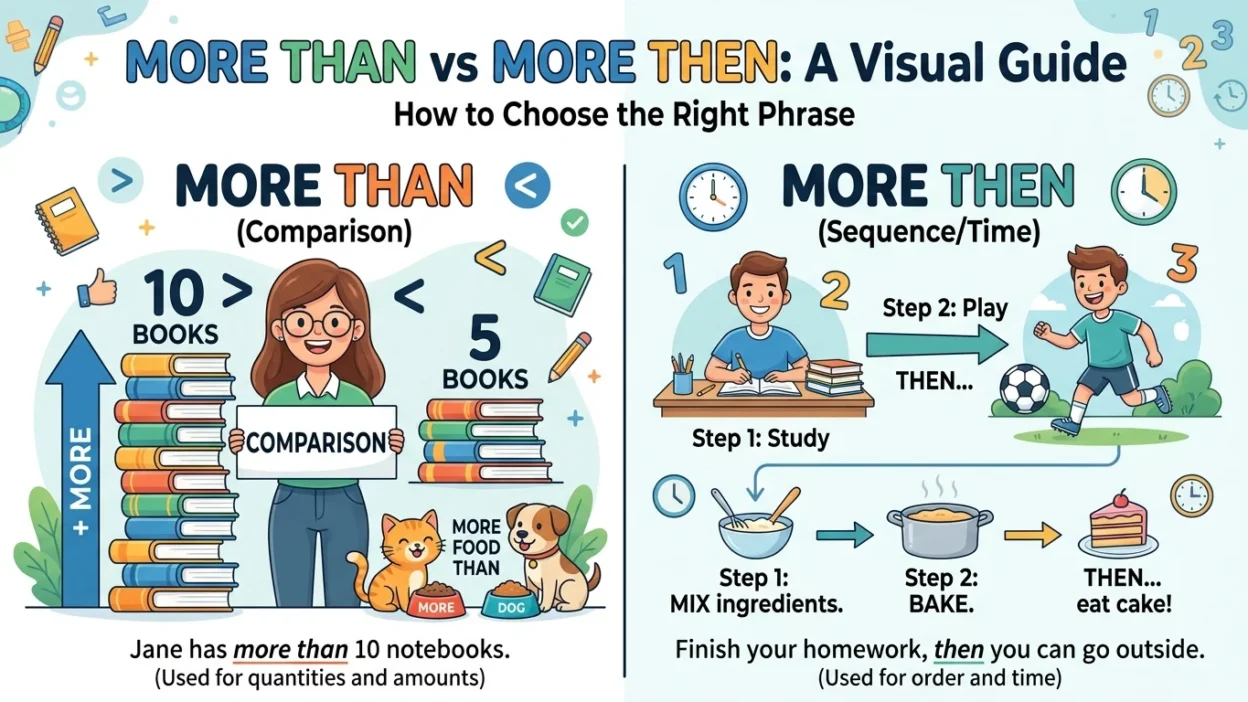
Many English learners mix up more than and more then because the words than and then look and sound very similar. Just one letter changes, but the meaning changes too.
This is a very common mistake. Even native English speakers sometimes type the wrong one by accident. The good news is that the difference is simple once you understand it.
In this guide, you will learn exactly when to use more than, why more then is usually incorrect, and how to avoid this mistake in everyday writing.
Quick Answer
- More than is the correct phrase when you compare things.
- More then is almost always incorrect.
- Use than for comparisons.
- Use then for time, sequence, or what happens next.
Correct:
- She has more than ten books.
- I like tea more than coffee.
Incorrect:
- She has more then ten books.
- I like tea more then coffee.
Why Do People Get Confused?
The confusion happens because than and then:
- look very similar
- sound almost the same
- are both common words
- are often typed quickly
But they have very different jobs in English.
- Than is used for comparing.
- Then is used for time or order.
Once you remember this basic rule, the choice becomes much easier.
The Simple Background
What Does “Than” Mean?
Than is a word used when comparing two things.
Examples:
- This bag is bigger than that one.
- He is taller than his brother.
It helps show a difference between two people, things, or ideas.
What Does “Then” Mean?
Then relates to time or sequence.
Examples:
- First, wash your hands. Then, eat.
- I was younger then.
It tells us what happens next or refers to a certain time.
The Main Difference
Use “More Than” for Comparison
When you want to say that one amount, number, or thing is greater than another, use more than.
Examples:
- There were more than 100 people at the event.
- She earns more than her sister.
- I need more than one day to finish this.
Here, you are comparing amounts, numbers, or ideas.
Why “More Then” Is Usually Wrong
More then does not work in normal English because then is not used for comparisons.
For example:
❌ I have more then five pencils.
✅ I have more than five pencils.
The second sentence is correct because you are comparing the number of pencils to five.
Comparison Table
| Phrase | Correct? | Meaning | Example |
| More than | Yes | Greater in amount, number, or degree | She has more than enough food. |
| More then | No (usually) | Incorrect in standard English | Incorrect usage |
When to Use “More Than”
Use more than when talking about:
Numbers
- More than 50 students attended.
Amounts
- We need more than a cup of sugar.
Comparisons
- He works more than I do.
Preferences
- I enjoy reading more than watching TV.
Importance
- Friendship means more than money.
When to Use “Then”
Use then by itself when talking about time or sequence.
Examples:
- Finish your homework, and then you can play.
- Back then, life was simpler.
- If it rains, then we will stay inside.
Notice that then is not part of the phrase more than.
A Helpful Memory Trick
Here is an easy way to remember:
- Than = Comparison
- Then = Time
Think of it this way:
- Are you comparing? Use than.
- Are you talking about what happens next? Use then.
This little trick can save you from many writing mistakes.
Common Mistakes People Make
Mistake 1: Using “Then” in Comparisons
❌ This costs more then that.
✅ This costs more than that.
Mistake 2: Confusing Sound with Meaning
Because the words sound alike, people often write the wrong one without noticing.
Always check:
- Comparison = than
- Time/order = then
Mistake 3: Typing Too Quickly
Many mistakes happen simply because of fast typing.
For example:
- more then → typo
- more than → correct
Always proofread your writing.
Everyday Examples
In Emails
- We received more than expected.
- I need more than a week to complete the project.
In News Reports
- More than 1,000 homes were affected.
- The company earned more than last year.
On Social Media
- I love pizza more than anything.
- More than 500 people liked the post.
In Daily Conversation
- This is more than enough.
- She knows more than I do.
More Example Sentences
Correct Uses of “More Than”
- He has more than three dogs.
- The movie was more than two hours long.
- I trust you more than anyone.
- This task is more than difficult—it is exhausting.
- They sold more than expected.
Correct Uses of “Then”
- We ate dinner, then watched a movie.
- I lived in Lahore back then.
- Finish this, then start the next task.
Which One Should You Use?
In almost every case, if you are writing the phrase more ___, the correct word is than.
Use “More Than” When:
- comparing numbers
- comparing amounts
- comparing people or things
- showing preference
- emphasizing something
Do Not Use “More Then” For:
- comparisons
- quantities
- amounts
- preferences
The phrase more then is almost always a mistake.
A Simple Practice Test
Choose the correct word.
- She has more ___ enough money.
- I like apples more ___ oranges.
- Finish your work, and ___ relax.
- More ___ 20 people came.
Answers
- than
- than
- then
- than
If you got them right, you understand the difference.
For Students and Beginners
Here is the easiest rule to remember:
More than = correct for comparisons
More then = usually wrong
Ask yourself:
- Am I comparing? → use than
- Am I talking about time or next steps? → use then
This one question will help you choose the right word every time.
Frequently Asked Questions (FAQ)
1. Is “more then” ever correct?
Usually, no. It is almost always a mistake.
2. Why is “more than” correct?
Because than is the word used for comparisons.
3. What does “then” mean?
It refers to time, sequence, or what happens next.
4. Can I say “more then enough”?
No. The correct phrase is more than enough.
5. Which is correct: “more than me” or “more then me”?
More than me is correct.
6. How can I remember the difference?
- Than = comparison
- Then = time
7. Is this a common mistake?
Yes, very common, especially in informal writing and typing.
8. Do native speakers make this mistake?
Yes, especially when typing quickly.
Final Tips
Before writing then, ask yourself:
- Am I comparing something?
If the answer is yes, use than.
Examples:
- more than five
- more than enough
- more than before
- more than I expected
If you are talking about what happens next, use then.
Examples:
- Eat first, then sleep.
- Back then, we were young.
Conclusion
The difference between more than and more then is simple once you know the rule.
- More than is the correct phrase for comparisons.
- More then is almost always incorrect.
- Use than when comparing.
- Use then for time or sequence.
Remember this:
Than compares. Then tells time.
With this easy rule, you can avoid this common mistake and write with more confidence.

Gregory Alexander is a skilled writer and language researcher at WordHuts.com. He focuses on clarifying confusing word pairs, grammar rules, and common usage mistakes. With a passion for precise communication, Gregory creates simple, easy-to-understand content that helps readers strengthen vocabulary, writing accuracy, and everyday English skills.