Many people use the words resume and CV as if they mean the same thing. This is very common. If you are applying for a job, internship, scholarship, or university program, you may wonder which one you need.
The confusion happens because both documents tell others about your education, skills, and work experience. They are both used when you apply for something important. But they are not exactly the same.
The good news is that the difference is easy to understand. Once you know the purpose of each one, choosing the right document becomes simple.
This guide will explain everything in clear and easy English.
Quick Answer: Resume vs CV
- A resume is short and focused.
- A CV is longer and more detailed.
- A resume is usually used for most jobs in business and industry.
- A CV is often used for academic, research, education, and medical positions.
- In some countries, people use the term CV for almost all job applications.
In Simple Words
- Resume = short summary
- CV = full record of your academic and professional life
Where Do These Words Come From?
Understanding the history of these words can help you remember them.
Resume
The word resume comes from a French word that means summary. That makes sense because a resume is a short summary of your skills, education, and work experience.
CV
CV stands for Curriculum Vitae. This is a Latin phrase that means course of life.
A CV shows the full story of your education, work, achievements, research, and other professional activities.
So the names themselves explain the difference:
- Resume = summary
- CV = full life record (for education and career)
The Main Difference Between a Resume and a CV
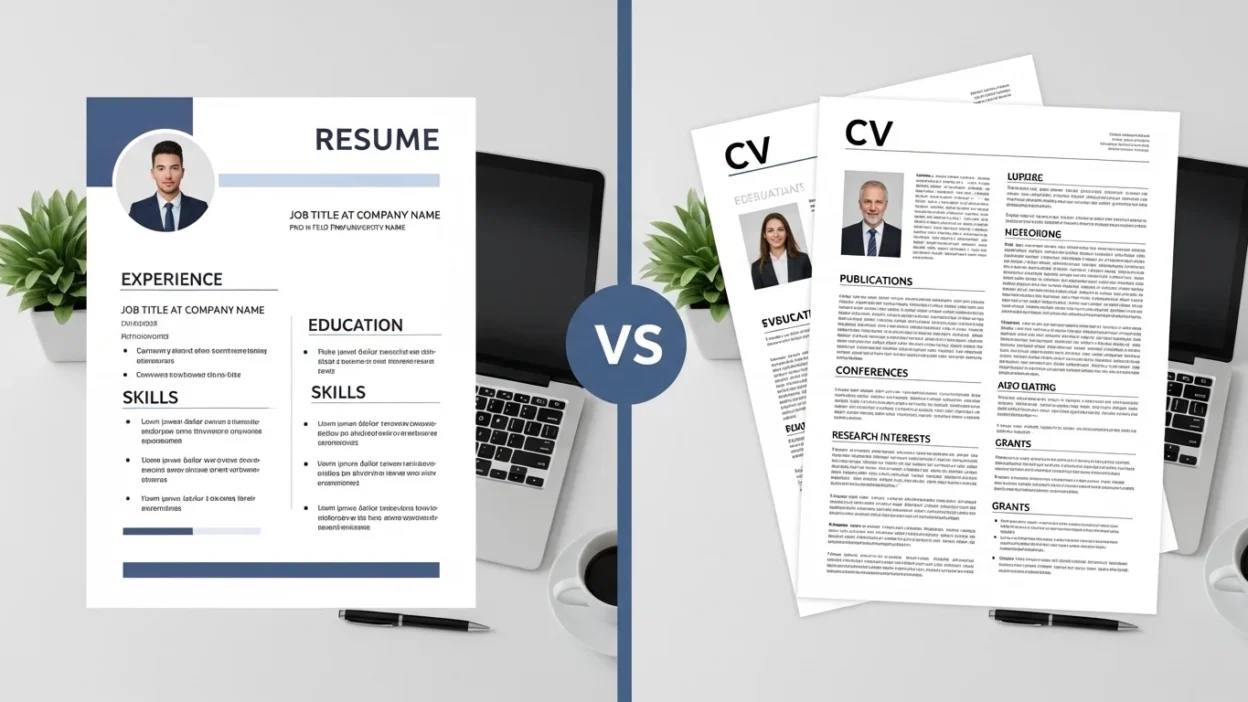
The biggest difference is length and detail.
Resume
A resume is:
- Short
- Usually one or two pages
- Customized for each job
- Focused on skills and relevant experience
It highlights only the information that matters for the specific position.
CV
A CV is:
- Longer
- Often two or more pages
- Very detailed
- Includes your full academic and professional history
It usually stays the same, though you may update it when you gain new experience.
Resume vs CV: Side-by-Side Comparison
| Feature | Resume | CV |
| Length | 1–2 pages | 2 or more pages |
| Purpose | Job applications | Academic and research roles |
| Detail Level | Brief summary | Full detailed record |
| Customization | Tailored for each job | Mostly the same |
| Focus | Skills and work experience | Education, research, publications |
| Common Use | Companies and businesses | Universities, research, medicine |
What Goes in a Resume?
A resume usually includes:
- Your name and contact details
- A short professional summary
- Work experience
- Education
- Skills
- Certifications (if needed)
- Relevant achievements
A resume only includes the most important information.
Think of it as your “best highlights.”
What Goes in a CV?
A CV may include:
- Your name and contact details
- Professional profile
- Education history
- Teaching experience
- Research experience
- Publications
- Presentations
- Awards and honors
- Certifications
- Skills
- Professional memberships
- Volunteer work
- References
A CV gives a much fuller picture of your background.
When Should You Use a Resume?
Use a resume when applying for:
- Business jobs
- Corporate positions
- Private company roles
- Internships
- Part-time jobs
- Entry-level jobs
- Most non-academic positions
Examples:
- Marketing assistant
- Sales executive
- Graphic designer
- Software developer
- Customer service representative
For these roles, employers usually want a quick overview.
When Should You Use a CV?
Use a CV when applying for:
- University positions
- Teaching jobs
- Research roles
- Scholarships
- Fellowships
- Graduate school programs
- Medical positions
- Academic conferences
Examples:
- University lecturer
- Research assistant
- Doctor
- Scientist
- PhD program applicant
These positions often require a detailed record of your academic work.
Important: It Depends on the Country
This is where many people get confused.
In the United States and Canada
- Resume is used for most jobs.
- CV is used mainly for academic, research, and medical roles.
In the UK, Europe, Asia, and Many Other Countries
- The word CV is often used for almost all job applications.
- Even if the document is short, people may still call it a CV.
So always check what the employer asks for.
How to Choose the Right One
Ask yourself these simple questions:
Are you applying for a regular job in a company?
Use a resume.
Are you applying for a university, research, or academic role?
Use a CV.
Does the employer specifically ask for one?
Always send exactly what they request.
If they ask for a CV, send a CV.
If they ask for a resume, send a resume.
Simple as that.
Common Mistakes People Make
1. Using the Wrong Document
Sending a resume when a CV is required can make you seem unprepared.
2. Making a Resume Too Long
A resume should be short. Employers do not want to read your entire life story.
3. Making a CV Too Short
A CV should include detailed information, especially for academic roles.
4. Using the Same Resume for Every Job
A resume should be tailored for each position.
5. Forgetting Country Differences
What is called a resume in one country may be called a CV in another.
Real-Life Examples
Example 1: Job Application Email
“I have attached my resume for the marketing position.”
Example 2: University Application
“Please submit your CV, research statement, and references.”
Example 3: Social Media Post
“Tips for building a strong resume for your first job.”
Example 4: Academic Announcement
“Applicants must provide a detailed CV.”
Example 5: Casual Conversation
“I need to update my resume before applying.”
or
“I am working on my academic CV.”
Resume and CV: Which Is Better?
Neither is better. They serve different purposes.
It is like comparing a short movie trailer and a full movie.
- A resume gives the highlights.
- A CV gives the complete story.
The best one is the one that matches your goal.
Helpful Tips for Students and Beginners
If you are just starting out, here is what you should know:
- Keep your resume simple and clean.
- Focus on your education, skills, and projects.
- Include internships, volunteer work, or part-time jobs.
- Use a CV if you are applying for scholarships or academic programs.
- Update your documents regularly.
Start early. It is much easier to update your resume or CV over time than to create one from scratch later.
Easy Memory Trick
Remember this:
- Resume = Review in a minute
- CV = Complete Version
A resume is quick to read.
A CV is complete and detailed.
Frequently Asked Questions (FAQ)
1. Is a resume the same as a CV?
Not always. A resume is shorter, while a CV is more detailed.
2. Which is longer, a resume or a CV?
A CV is usually longer.
3. Can I use a resume instead of a CV?
Only if the employer allows it. Always follow the instructions.
4. Do students need a resume or a CV?
It depends on the purpose. Use a resume for jobs and a CV for academic applications.
5. How long should a resume be?
Usually one page, or two pages if you have more experience.
6. How long should a CV be?
There is no strict limit. It can be several pages.
7. What if the job posting asks for a CV?
Send a CV, even if you normally use a resume.
8. Can I have both?
Yes. In fact, many professionals keep both updated.
Final Thoughts
The difference between a resume and a CV is actually very simple.
A resume is a short summary made for most job applications.
A CV is a detailed record used mainly for academic, research, and specialized roles.
Remember:
- Choose a resume for most business and company jobs.
- Choose a CV for academic, research, education, and medical opportunities.
- Always check the employer’s instructions.
- Be aware that different countries use these terms differently.
Once you understand this difference, applying for jobs or programs becomes much easier.
Keep both documents updated, and you will always be ready for your next opportunity.

Gregory Alexander is a skilled writer and language researcher at WordHuts.com. He focuses on clarifying confusing word pairs, grammar rules, and common usage mistakes. With a passion for precise communication, Gregory creates simple, easy-to-understand content that helps readers strengthen vocabulary, writing accuracy, and everyday English skills.