
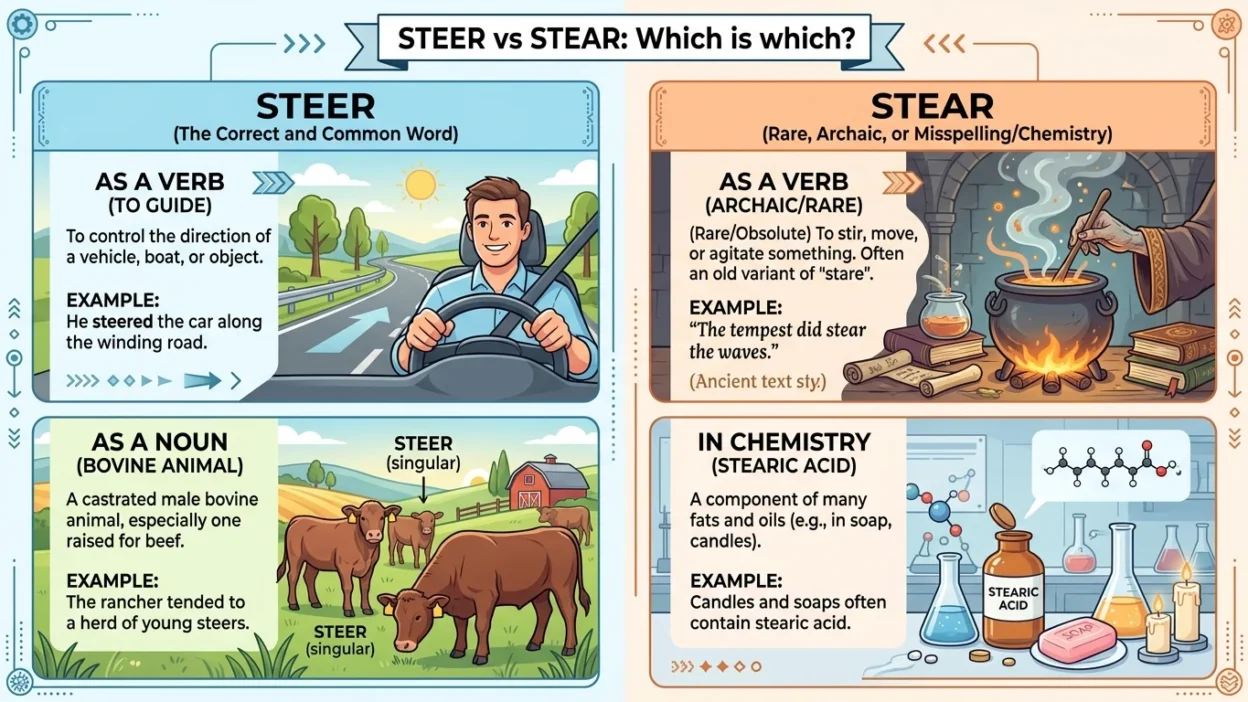
Many people get confused by steer and stear because they look almost the same. They sound similar, and just one letter changes. That can make spelling tricky, especially when writing quickly.
The good news is that the difference is very simple. In fact, only one of these words is a standard English word used in everyday writing.
Once you understand how each one works, you will never need to guess again.
Quick Answer
- Steer is the correct English word.
- It can be a verb or a noun.
- As a verb, it means to guide or control direction.
- As a noun, it means a male cow that has been castrated.
- Stear is usually a spelling mistake.
- In modern standard English, stear is not the correct spelling for the common word.
Where the Confusion Comes From
English has many words with similar spellings. Words like bear, hear, and wear may make people think that stear could also be correct.
But English does not always follow neat spelling patterns. That is why this pair causes confusion.
Another reason is typing errors. The letters e and a are close in many common word patterns, so people sometimes write stear by mistake.
What Does “Steer” Mean?
As a Verb
Steer means to guide, direct, or control where something goes.
For example:
- Please steer the car carefully.
- She steered the boat toward the shore.
- Good advice can steer you in the right direction.
In all these examples, steer means to control movement or direction.
As a Noun
A steer is a young male cow that cannot breed.
For example:
- The farmer bought a new steer.
- That steer is grazing in the field.
This meaning is mostly used in farming and agriculture.
What Does “Stear” Mean?
In modern everyday English, stear is not the correct spelling of the word most people mean.
If you write stear when you mean to guide a car, boat, or person, it is considered a spelling error.
For example:
- Incorrect: Please stear the car carefully.
- Correct: Please steer the car carefully.
You may sometimes see stear in very old texts, regional language, or as a surname. However, for normal writing, you should use steer.
Steer vs Stear: The Main Difference
The difference is simple:
- Steer = correct standard English word
- Stear = usually incorrect spelling
If you are talking about guiding something, controlling direction, or referring to the animal, always use steer.
Comparison Table
| Feature | Steer | Stear |
| Correct modern spelling | Yes | No |
| Used in everyday English | Yes | No |
| Can be a verb | Yes | No |
| Can be a noun | Yes | No |
| Commonly seen as a typo | No | Yes |
When Should You Use “Steer”?
Use steer when you mean:
1. To Control Direction
- Steer the bicycle carefully.
- He steered around the corner.
2. To Guide Someone
- Her teacher helped steer her toward success.
- Good parents steer their children wisely.
3. To Name the Animal
- The steer stood quietly in the field.
When Should You Use “Stear”?
In almost all cases, you should not use stear.
If you write it in school, at work, in emails, or online, it will usually be marked as incorrect.
The only time you might see it is:
- in old historical writing
- in some regional dialects
- as a family name
- in place names
For normal English writing, choose steer every time.
Common Mistakes People Make
Mistake 1: Spelling by Sound
Because steer and stear may sound similar, some people write the wrong one.
- Wrong: Can you stear the truck?
- Right: Can you steer the truck?
Mistake 2: Mixing Up Letter Patterns
People often think words ending in -ear are always correct. English loves to break its own rules.
Mistake 3: Not Checking Auto-Correct
Sometimes typing quickly leads to mistakes. Always reread your writing.
Everyday Examples
In Emails
- Please steer the discussion back to the main topic.
- We need someone to steer this project.
In News Writing
- The pilot safely steered the plane to the airport.
- The company was steered through difficult times.
On Social Media
- She really knows how to steer a conversation.
- Learning to steer a manual car takes practice.
In Daily Conversation
- Can you steer while I check the map?
- He steered the shopping cart with one hand.
Easy Trick to Remember
Think of the word steering wheel.
Both words begin with steer.
- steer
- steering
Since steering comes from steer, you can remember that steer is the correct spelling.
If it works with steering, it must be steer.
For Students and Beginners
Here is the easiest way to remember:
- If you mean guide or control, use steer.
- If you mean the farm animal, use steer.
- If you write stear, it is almost always wrong.
A simple sentence pattern:
- I steer the car.
- The farmer owns a steer.
That is all you need.
Frequently Asked Questions
1. Is “stear” a real word?
It is not a standard modern English word for everyday use. Most of the time, it is a misspelling of steer.
2. Which spelling is correct: steer or stear?
Steer is the correct spelling.
3. Can “steer” be both a noun and a verb?
Yes. It can mean to guide something, or it can refer to a male cow.
4. Why do people write “stear”?
Usually because of spelling confusion or typing mistakes.
5. How do I remember the correct spelling?
Think of steering wheel. Both words use steer.
6. Is “stear” acceptable in formal writing?
No. In formal writing, you should use steer.
7. What does “steer someone” mean?
It means to guide or influence someone.
Example: She steered him toward a better choice.
8. What is a steer on a farm?
It is a male cow raised mainly for beef.
Final Thoughts
The choice between steer and stear is easy once you know the rule.
- Steer is the correct word.
- Stear is usually a spelling mistake.
Use steer when talking about guiding, directing, controlling, or the farm animal.
If you ever feel unsure, just remember steering wheel. That simple connection will help you choose the right spelling every time.

Justin Larry is a talented language writer and content creator at WordHuts.com. She specializes in explaining word differences, grammar tips, and common English mistakes in a clear, practical style. Her engaging content helps readers improve vocabulary, writing skills, and everyday communication, making language learning simple and effective.