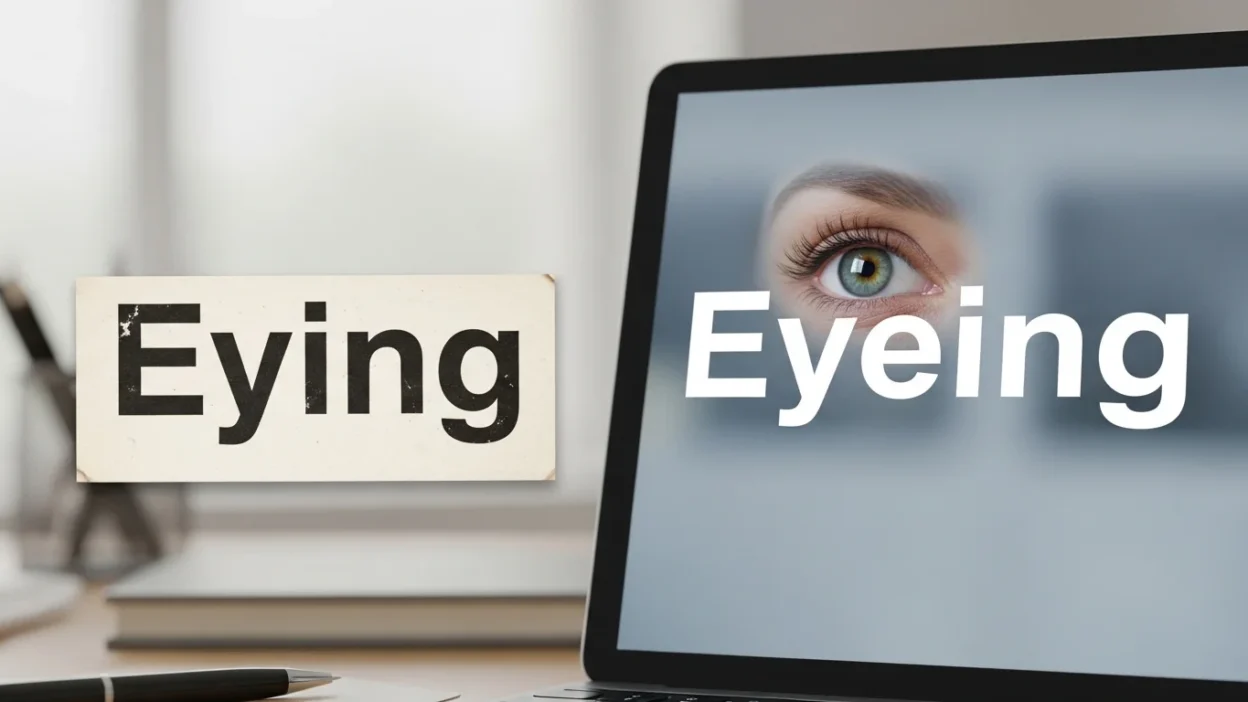
Many people get confused by eying and eyeing. At first glance, one of them may look wrong. After all, English spelling does not always follow simple rules. Sometimes a word keeps the final e, and sometimes it drops it when adding -ing.
That is exactly why this pair causes trouble.
The good news is that both eying and eyeing are correct. They mean the same thing. The difference is mainly about spelling style, not meaning.
If you have ever stopped while writing and wondered which one to use, this guide will make it clear.
Quick Answer
- Eying and eyeing both mean the same thing.
- Both come from the verb eye, which means to look at something carefully.
- Eyeing is the more common spelling today.
- Eying is also correct, but it is less common.
- In most everyday writing, eyeing is the safer choice.
Where Do These Words Come From?
Both words come from the noun and verb eye.
As a verb, eye means:
- to look at something closely
- to watch with interest
- to consider something carefully
- to want something
For example:
- She was eyeing the last piece of cake.
- He eyed the new car with excitement.
When we add -ing to make the present participle, two spellings appear:
- eye + ing = eyeing
- eye + ing = eying
That is why both forms exist.
Why Are There Two Spellings?
English usually drops a silent e before adding -ing.
For example:
- make → making
- take → taking
- smile → smiling
So, by that rule, eye would become eying.
But the word eye is unusual. If we remove the final e, the spelling looks strange. Some people find eying harder to read at first.
That is why many writers keep the e and write eyeing instead.
So:
- Eying follows the normal spelling rule.
- Eyeing keeps the original word clearer.
Both are accepted.
The Main Difference
There is no difference in meaning or pronunciation.
Both words mean:
- looking at something carefully
- watching with interest
- wanting something
- considering something
The only difference is spelling.
Example
- She is eyeing the promotion.
- She is eying the promotion.
Both sentences are correct and mean exactly the same thing.
Comparison Table
| Feature | Eying | Eyeing |
| Correct spelling? | Yes | Yes |
| Meaning | Same | Same |
| Pronunciation | Same | Same |
| More common today | No | Yes |
| Best for most writing | Acceptable | Recommended |
Which One Should You Use?
For most people, eyeing is the better choice.
Why?
- It is more common in modern writing.
- It looks more natural to many readers.
- It is easier to recognize quickly.
- It avoids confusion.
Use eyeing in:
- school writing
- emails
- blog posts
- social media
- business writing
- news articles
You can still use eying, especially if you prefer the shorter form. It is not wrong. It is simply less common.
When to Use “Eyeing”
Use eyeing when someone is:
- looking at something with interest
- thinking about getting something
- watching carefully
- considering an option
Examples
- I am eyeing a new laptop.
- They are eyeing a move to another city.
- The cat is eyeing the bird.
- Investors are eyeing new opportunities.
When to Use “Eying”
Use eying in the same situations.
Examples
- I am eying a new laptop.
- They are eying a move to another city.
- The cat is eying the bird.
- Investors are eying new opportunities.
Again, the meaning does not change.
Common Mistakes People Make
1. Thinking One Is Wrong
Many people believe only one spelling is correct. That is not true.
Both are correct.
2. Mixing Them in the Same Piece of Writing
Choose one spelling and stay consistent.
For example, do not write:
- She was eyeing the dress.
- Later, she kept eying it.
Pick one style and use it throughout.
3. Using the Wrong Meaning
Remember, these words are verbs.
They describe an action: looking, watching, or considering.
Everyday Examples
In Emails
- I am eyeing the new project for next month.
- We are eyeing a better solution.
In News Writing
- The company is eyeing international expansion.
- Officials are eyeing new safety measures.
On Social Media
- Totally eyeing those shoes!
- I’m eyeing a weekend trip.
In Daily Conversation
- Are you eyeing my fries?
- She has been eyeing that apartment for weeks.
Simple Sentence Examples
Here are more examples with eyeing:
- He is eyeing the clock.
- We are eyeing a summer vacation.
- She is eyeing the top shelf.
- The dog is eyeing my sandwich.
- They are eyeing a new business idea.
The same sentences can also use eying.
A Helpful Memory Tip
If you are unsure, choose eyeing.
Why?
Because it keeps the full word eye visible.
- eye → eyeing
This makes it easy to remember and easy for readers to understand.
Think of it this way:
If you can still clearly see the eye, many readers will find it easier to read.
For Students and Beginners
Here is the easiest rule to remember:
- Both spellings are correct.
- Eyeing is more common.
- Use eyeing if you want the safest choice.
When writing for school or work, eyeing is usually the best option.
It is widely accepted and instantly familiar.
FAQ
Is eyeing a real word?
Yes. It is a correct and very common spelling.
Is eying also correct?
Yes. It is also correct, though less common.
Which spelling is more popular?
Eyeing is more widely used today.
Do they mean different things?
No. They have exactly the same meaning.
How do you pronounce them?
Both are pronounced the same way: EYE-ing.
Which one should students use?
Students should usually use eyeing.
Can I use eying in formal writing?
Yes, but eyeing is often preferred because it is more familiar.
Why does eyeing keep the letter e?
It keeps the original word eye easy to recognize.
Final Thoughts
The choice between eying and eyeing is much simpler than it seems.
Both spellings are correct. Both mean the same thing. Both are pronounced the same way.
The only real difference is usage.
- Eyeing is more common and easier for most readers.
- Eying is correct but less widely used.
If you want the safest and clearest option, choose eyeing.
That way, your writing will look natural, modern, and easy to read.
And now, the next time you are eyeing this word, you will know exactly which spelling to choose.

Brandon Samuel is a dedicated writer and language enthusiast, serving as the lead author at WordHuts.com. He specializes in explaining word differences, grammar rules, and common language mistakes in simple terms. Brandon’s clear, practical writing style helps readers improve vocabulary, writing confidence, and everyday communication skills.