Many English learners get confused when choosing between “an unique” and “a unique.” At first, it seems simple. We often learn that “a” comes before consonants and “an” comes before vowels.
Since the word “unique” starts with the vowel letter u, many people think “an unique” must be correct.
But English does not work that way.
The choice between “a” and “an” depends on the sound at the beginning of the next word, not just the first letter. That is why this small grammar point can be tricky.
The good news? Once you understand the sound rule, this confusion disappears completely.
Quick Answer
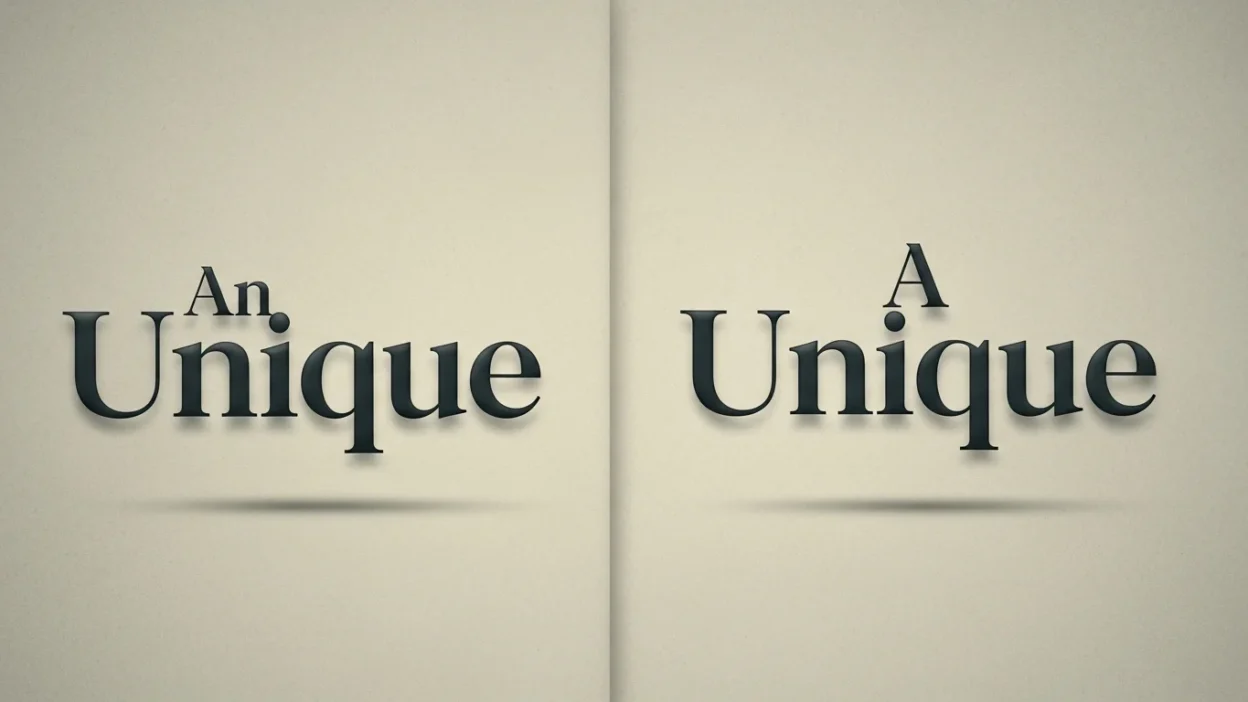
- ✅ A unique is correct.
- ❌ An unique is incorrect.
Why?
- The word unique begins with a “yoo” sound.
- That sound is like the first sound in you.
- Since “y” is a consonant sound, we use “a,” not “an.”
Correct: a unique idea
Incorrect: an unique idea
Why This Is Confusing
Most people learn this simple rule:
- Use a before consonants
- Use an before vowels
This rule is helpful, but it is incomplete.
The real rule is:
- Use a before a consonant sound
- Use an before a vowel sound
The first letter does not always tell you the first sound.
For example:
- a university (starts with “yoo”)
- a uniform (starts with “yoo”)
- a unicorn (starts with “yoo”)
- a unique (starts with “yoo”)
Even though these words begin with u, they sound like they begin with y.
The Sound Rule: The Real Key
Let’s say the word out loud:
unique = yoo-neek
Notice the first sound: yoo
That is not a vowel sound like:
- apple → a
- orange → an
- elephant → an
Instead, it starts with a consonant sound, just like:
- yes
- yellow
- you
Because of that, we say:
- a unique opportunity
- a unique design
- a unique experience
Never an unique.
Simple Difference Between “A” and “An”
Use a before words that begin with a consonant sound.
Examples:
- a book
- a car
- a house
- a unique idea
Use an before words that begin with a vowel sound.
Examples:
- an apple
- an hour
- an honest person
- an umbrella
Notice something interesting:
- hour starts with h, but the h is silent.
- So it begins with the vowel sound ow.
That is why we say an hour, not a hour.
English listens to sounds, not just letters.
Comparison Table
| Phrase | Correct? | Why? |
| a unique idea | ✅ Yes | “Unique” starts with a “yoo” sound |
| an unique idea | ❌ No | It does not start with a vowel sound |
| a university | ✅ Yes | Starts with “yoo” |
| an umbrella | ✅ Yes | Starts with “uh” |
| an hour | ✅ Yes | Silent “h,” starts with vowel sound |
Which One Should You Use?
Always use “a unique.”
Correct Examples
- She has a unique style.
- This is a unique chance.
- He came up with a unique solution.
- It was a unique experience.
- They built a unique home.
Incorrect Examples
- She has an unique style.
- This is an unique chance.
These sound unnatural and are grammatically wrong.
Words Similar to “Unique”
If a word starts with the “yoo” sound, use a.
Examples:
- a unique idea
- a university
- a uniform
- a unicorn
- a European city
- a eulogy
- a useful tool
- a user account
Even though some of these words start with vowels, their sound begins like “you.”
That is why they all take a.
Common Mistakes People Make
Mistake 1: Looking Only at the First Letter
Many people see the letter u and automatically choose an.
Wrong:
- an unique story
Correct:
- a unique story
Mistake 2: Forgetting the Sound Rule
Remember: articles depend on pronunciation.
Ask yourself:
Does the word start with a vowel sound or a consonant sound?
- yoo = consonant sound → use a
- uh, ah, eh, oh = vowel sound → use an
Mistake 3: Applying the Rule Too Simply
The “vowel letter = an” rule does not always work.
For example:
- a one-time offer (starts with “w” sound)
- a European trip (starts with “y” sound)
- an MBA degree (starts with “em” sound)
Sound is always the boss.
Everyday Examples
In Emails
- We have developed a unique plan for your project.
- Thank you for sharing a unique perspective.
In News Writing
- The artist created a unique piece of art.
- Scientists discovered a unique species.
On Social Media
- What a unique idea!
- She has a unique way of telling stories.
In Daily Conversation
- That’s a unique dress.
- He has a unique voice.
- It was a unique experience.
Easy Trick to Remember
Try replacing the word with “special.”
- a special idea
- a special design
Since unique and special are similar in meaning, you can hear that a unique sounds natural too.
Another trick:
Say the first part aloud:
- unique = yoo…
Since it sounds like you, use a.
You would say:
- a you…
- not an you…
So:
- a unique
Simple.
For Students and Beginners
When choosing between a and an, do not look only at the spelling.
Instead, listen to the first sound.
Step-by-Step
- Say the word aloud.
- Listen to the first sound.
- If it starts with a vowel sound, use an.
- If it starts with a consonant sound, use a.
For unique:
- Say it: yoo-neek
- First sound: y
- Result: a unique
This method works every time.
Practice Sentences
Choose the correct phrase:
- It was ___ unique opportunity.
- She has ___ unique personality.
- That is ___ unique solution.
Answers:
- a unique opportunity
- a unique personality
- a unique solution
Frequently Asked Questions
1. Is “an unique” ever correct?
No. It is always incorrect in modern English.
2. Why do some people say “an unique”?
They focus on the letter u instead of the sound “yoo.”
3. What is the correct phrase?
The correct phrase is “a unique.”
4. Why do we use “a” before “unique”?
Because unique starts with a consonant sound: yoo.
5. Is the rule based on letters or sounds?
It is based on sounds.
6. What other words follow this rule?
- university
- uniform
- unicorn
- useful
- user
- European
7. Can vowel letters take “a”?
Yes, if they begin with a consonant sound.
Example:
- a university
- a European country
8. Can consonant letters take “an”?
Yes, if they begin with a vowel sound.
Example:
- an hour
- an honest answer
Final Summary
The correct phrase is always “a unique.”
Here is why:
- Unique starts with the sound “yoo.”
- That is a consonant sound.
- We use “a” before consonant sounds.
So remember:
- ✅ a unique idea
- ✅ a unique opportunity
- ✅ a unique experience
- ❌ an unique
When choosing between a and an, always listen to the sound, not just the first letter.
That one simple rule will help you use articles correctly in many other English words too.

Justin Larry is a talented language writer and content creator at WordHuts.com. She specializes in explaining word differences, grammar tips, and common English mistakes in a clear, practical style. Her engaging content helps readers improve vocabulary, writing skills, and everyday communication, making language learning simple and effective.