Many students and English learners get confused between “onamonapia” and “onomatopoeia.” The reason is simple: the word is long, unusual, and difficult to spell. Even native English speakers often spell it the wrong way.
You may see people type “onamonapia” in messages, school work, social media posts, or online searches. But is it a real English word?
This article explains everything in very simple English so you can clearly understand the difference and never feel confused again.
Quick Answer
- Onomatopoeia = the correct English word
- Onamonapia = incorrect spelling
- “Onomatopoeia” describes words that sound like the noise they represent
- Examples:
- buzz
- bang
- splash
- meow
Simple Rule
If you are writing for:
- school
- emails
- exams
- articles
- social media
- daily English
Use onomatopoeia, not “onamonapia.”
Simple Background of the Word
The word onomatopoeia comes from old Greek language roots. It was later used in Latin and then entered English.
The word may look difficult, but its meaning is actually very easy.
It simply means:
A word that sounds like the sound it describes.
For example:
- “Boom” sounds like an explosion
- “Tick-tock” sounds like a clock
- “Hiss” sounds like a snake
These are all examples of onomatopoeia.
People usually spell the word wrong because:
- it has many vowels
- the pronunciation is tricky
- it is not used every day
- the spelling does not look the way it sounds
That is why many people accidentally write “onamonapia.”
What Is the Difference Between Onamonapia and Onomatopoeia?
The difference is very simple.
Onomatopoeia
This is the correct spelling and the real English word.
It is used in:
- grammar
- writing
- poetry
- comics
- literature
- classrooms
Example
“Buzz” is an example of onomatopoeia.
Onamonapia
This is not a correct English word.
It is only a spelling mistake of “onomatopoeia.”
People write it because they:
- hear the word incorrectly
- forget the spelling
- type too quickly
- guess the spelling from pronunciation
You should avoid using it in formal writing.
Comparison Table
| Feature | Onamonapia | Onomatopoeia |
| Correct spelling? | No | Yes |
| Real English word? | No | Yes |
| Used in dictionaries? | No | Yes |
| Safe for school writing? | No | Yes |
| Common mistake? | Yes | No |
| Meaning | None | Words that sound like sounds |
What Does Onomatopoeia Mean?
Onomatopoeia means words that imitate sounds.
These words sound similar to the noises they describe.
Common Examples
| Word | Sound |
| Meow | Cat sound |
| Woof | Dog sound |
| Bang | Loud hit or explosion |
| Splash | Water sound |
| Buzz | Bee or machine sound |
| Crack | Breaking sound |
| Tick-tock | Clock sound |
| Hiss | Snake sound |
Which One Should You Use and When?
Use “Onomatopoeia”
Always use this spelling when:
- writing essays
- doing homework
- teaching English
- reading literature
- creating stories
- talking about grammar
Correct Sentence
Comic books often use onomatopoeia like “bam” and “pow.”
Do Not Use “Onamonapia”
Avoid this spelling because it is incorrect.
Incorrect Sentence
The poem uses onamonapia.
This sentence contains a spelling mistake.
Why Is “Onomatopoeia” So Hard to Spell?
Many learners struggle with this word because:
- it has many syllables
- several vowels appear together
- the pronunciation feels unusual
- it is not phonetic for beginners
The pronunciation is usually:
on-uh-mat-uh-PEE-uh
A lot of people hear it differently and spell it based on sound alone.
That is why mistakes like these happen:
- onamonapia
- onomatapia
- onamatopoeia
- onomatapoeia
Easy Trick to Remember the Correct Spelling
Try breaking the word into smaller parts:
ono + mato + poeia
Or remember this simple sound pattern:
ono – mato – pee – uh
You can also practice by writing it slowly several times.
Helpful Tip
The middle part contains:
“mato”
Not:
“mona”
That helps many students avoid writing “onamonapia.”
Common Mistakes People Make
1. Spelling It by Sound
Many people write what they hear instead of checking the correct spelling.
Wrong
- onamonapia
Correct
- onomatopoeia
2. Forgetting the “toe” Sound
Some learners remove letters from the middle.
Wrong
- onomatapia
Correct
- onomatopoeia
3. Using It Incorrectly
Some people think it means “a loud word” or “a dramatic word.”
But it only refers to words that imitate sounds.
Incorrect Understanding
“Beautiful” is onomatopoeia.
No, because “beautiful” does not sound like a noise.
Everyday Real-Life Examples
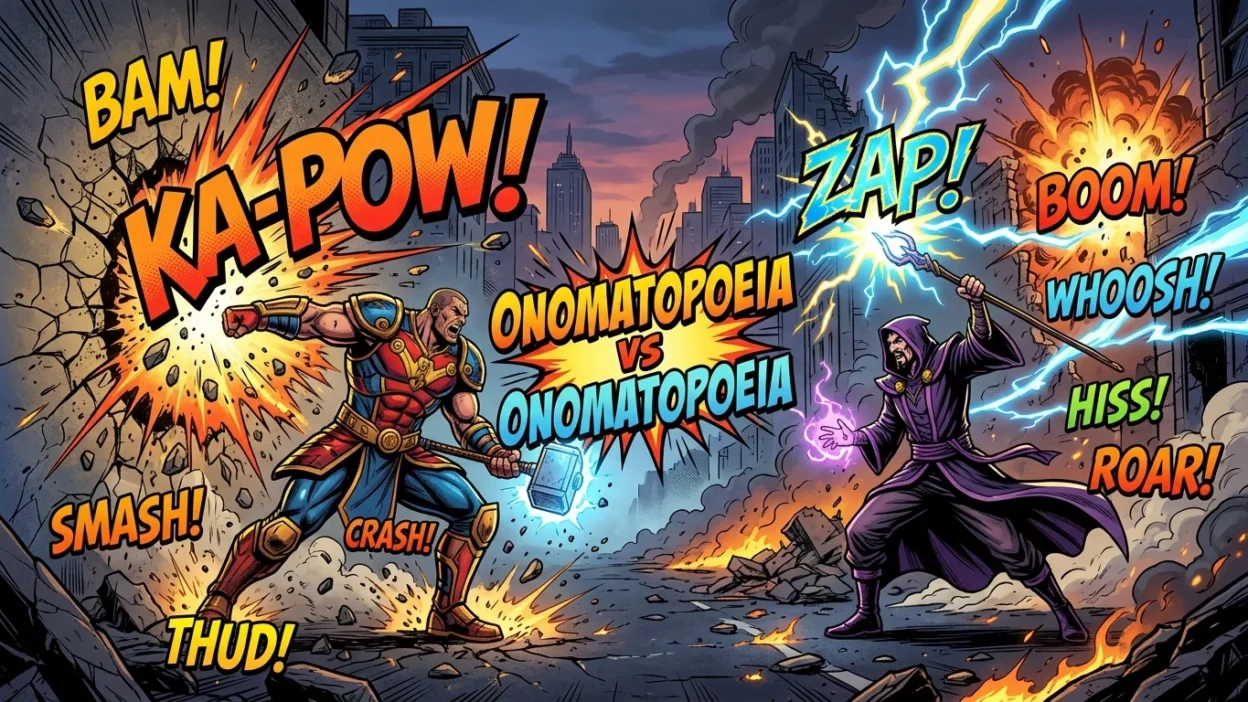
In Comics
Comic books often use sound words like:
- BAM!
- POW!
- BOOM!
These are examples of onomatopoeia.
In Social Media
People often write:
- haha
- buzz
- boom
- clap
Some of these can act as onomatopoeic expressions because they copy sounds.
In Daily Conversation
You may hear sentences like:
The bacon was sizzling in the pan.
“Sizzling” sounds like the actual cooking noise.
In News Writing
News stories sometimes use sound words to create stronger images.
Example:
The fireworks went boom across the city.
In Children’s Books
Children learn sounds through simple onomatopoeic words like:
- moo
- quack
- beep
- chirp
These words help young learners connect sounds and language.
Short Learning Section for Students and Beginners
Simple Definition
Onomatopoeia = words that sound like real noises.
Quick Practice
Which words are onomatopoeia?
- buzz
- whisper
- crash
- banana
Answers
✔ buzz
✔ crash
“Whisper” and “banana” are not true onomatopoeia in this example.
Easy Memory Sentence
Onomatopoeia uses words that sound like sounds.
Repeat this sentence a few times to remember the meaning.
FAQ
1. Is “onamonapia” a real word?
No. It is only a spelling mistake of “onomatopoeia.”
2. What is the correct spelling?
The correct spelling is:
onomatopoeia
3. What does onomatopoeia mean?
It means words that imitate sounds.
Example:
- bang
- splash
- buzz
4. Why do people spell it wrong?
Because the word is long and difficult to pronounce and remember.
5. Is onomatopoeia used in poetry?
Yes. Poets often use it to create stronger sound effects and clearer images.
6. Is “meow” an example of onomatopoeia?
Yes. “Meow” sounds like the noise a cat makes.
7. Can onomatopoeia be used in comics?
Yes. Comic books use many sound words like:
- boom
- bam
- pow
8. How can I remember the spelling?
Break it into parts:
ono + mato + poeia
Practice writing it slowly until it becomes familiar.
Conclusion
The confusion between “onamonapia” and “onomatopoeia” is very common, especially for students and English learners. The important thing to remember is simple:
- Onomatopoeia is the correct English word.
- Onamonapia is just a misspelling.
Onomatopoeia describes words that sound like the noises they represent, such as:
- buzz
- splash
- hiss
- boom
Even though the spelling looks difficult at first, it becomes easier with practice. Once you remember that it refers to sound words, the meaning is very simple.
If you use the correct spelling and practice a few examples, you will quickly become comfortable using the word in school, writing, reading, and daily English.

Justin Larry is a talented language writer and content creator at WordHuts.com. She specializes in explaining word differences, grammar tips, and common English mistakes in a clear, practical style. Her engaging content helps readers improve vocabulary, writing skills, and everyday communication, making language learning simple and effective.