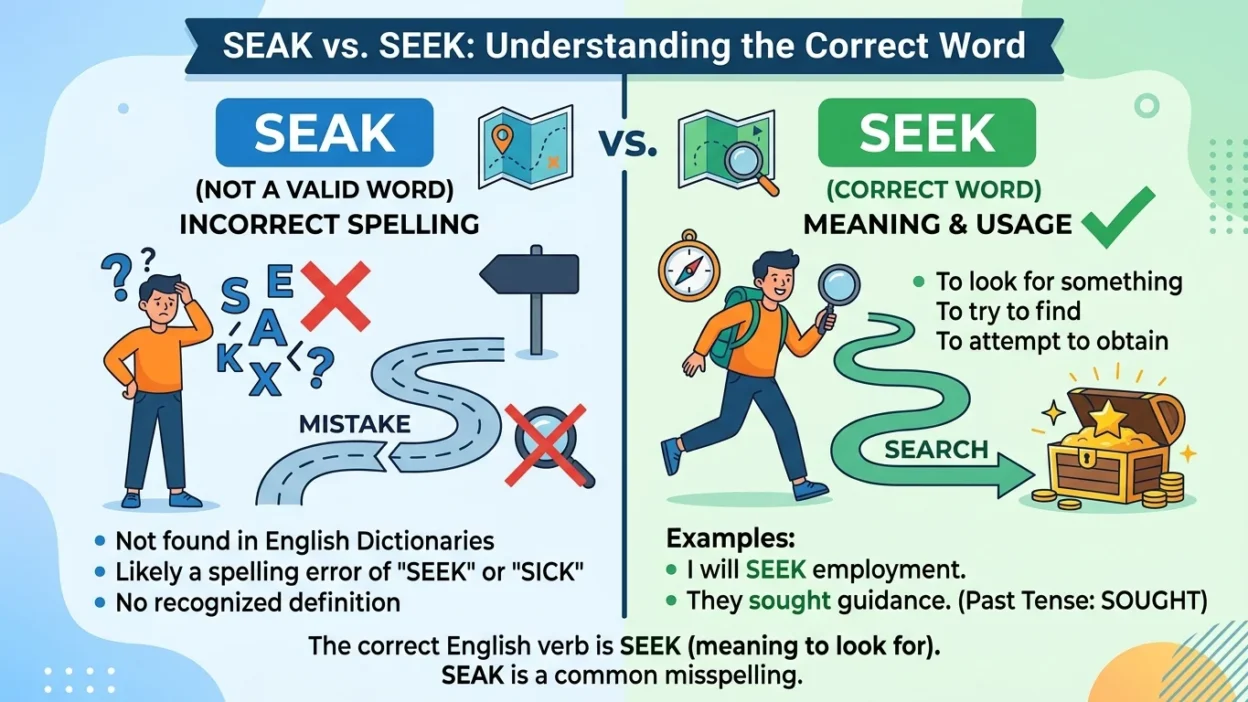
Many people get confused between “seak” and “seek” because the two words sound similar when spoken quickly. Some learners also type “seak” by mistake because English spelling can be tricky.
The good news is simple:
- “Seek” is the correct English word
- “Seak” is not a standard English word
If you understand this one important point, the confusion becomes much easier to handle.
In this guide, you will learn the difference in very simple English with examples, tips, tables, and common mistakes.
Quick Answer
Here is the short and simple answer:
- Seek = a real English verb that means to look for something or try to get something
- Seak = usually a spelling mistake of “seek”
- You should use seek in writing, speaking, school work, emails, and daily English
- Avoid using seak unless it is a name, brand, or special term
Correct Examples
- I want to seek help.
- They seek better jobs.
- She is seeking information online.
Incorrect Examples
- I want to seak help.
- They seak better jobs.
Simple Background of the Word
The word seek is an old English word that has been used for hundreds of years. It comes from early English language forms that meant:
- to search
- to look for
- to try to find
Over time, the spelling became seek.
The spelling “seak” did not become a standard English word. Today, most dictionaries do not accept it as correct English.
People often write “seak” because:
- the sound is similar
- typing errors happen
- English spelling is not always easy
- learners confuse it with words like “speak” or “sneak”
What Does “Seek” Mean?
The word seek means:
- to look for something
- to try to find something
- to ask for something
- to attempt to get something
It is usually used in formal and everyday English.
Examples of “Seek”
Looking for something
- We seek the truth.
- She is seeking her lost bag.
- They seek answers online.
Asking for help
- You should seek medical advice.
- He sought help from his teacher.
Trying to achieve something
- Many people seek success.
- Students seek better opportunities.
Is “Seak” a Real Word?
In normal English, seak is not considered a correct standard word.
Most of the time, it is simply:
- a spelling mistake
- a typing error
- confusion with “seek”
For example:
❌ Wrong: I seak new opportunities.
✅ Correct: I seek new opportunities.
However, “Seak” may sometimes appear as:
- a surname
- a company name
- a username
- a fictional name
But in normal grammar and vocabulary lessons, seek is the correct word.
Main Difference Between Seak and Seek
The biggest difference is very easy:
| Word | Correct English Word? | Meaning |
| Seek | Yes | To look for or try to get something |
| Seak | No (usually) | Usually a misspelling of “seek” |
Comparison Table
Seak vs Seek
| Feature | Seak | Seek |
| Standard English word | No | Yes |
| Correct spelling | No | Yes |
| Used in dictionaries | Usually no | Yes |
| Meaning | No standard meaning | To search or try to find |
| Common in writing | Only by mistake | Very common |
| Used in school English | No | Yes |
| Verb form | No | Yes |
Which One Should You Use and When?
You should almost always use seek.
Use “Seek” When You Mean:
1. Looking for something
- seek information
- seek a solution
- seek the truth
2. Asking for help
- seek advice
- seek support
- seek permission
3. Trying to achieve something
- seek success
- seek peace
- seek improvement
Verb Forms of “Seek”
Learning the verb forms can help students avoid mistakes.
| Tense | Form |
| Base verb | seek |
| Past tense | sought |
| Past participle | sought |
| Present participle | seeking |
Examples
- I seek knowledge.
- Yesterday, I sought help.
- She has sought advice before.
- They are seeking new ideas.
Common Mistakes People Make
Many learners make small mistakes with this word.
1. Writing “Seak” Instead of “Seek”
❌ I seak help online.
✅ I seek help online.
This is the most common mistake.
2. Using the Wrong Past Form
❌ He seeked advice.
✅ He sought advice.
The correct past tense is sought, not “seeked.”
3. Confusing “Seek” With “Search”
These words are similar, but not always used the same way.
Example
- We seek peace. ✅
- We search for peace. ✅
Both can work, but “seek” often sounds a little more formal.
4. Spelling Problems During Fast Typing
Some people accidentally type:
- seak
- siek
- sek
Always check your spelling before sending messages or homework.
Everyday Real-Life Examples
Here are simple examples from daily life.
In Emails
Correct
- I am seeking more information about the course.
- Please seek approval before starting.
Incorrect
- I am seaking more information.
- Please seak approval.
On Social Media
Correct
- People seek happiness in different ways.
- Always seek the truth before sharing news.
Incorrect
- People seak happiness.
- Always seak the truth.
In News Sentences
Correct
- Workers seek higher salaries.
- The police seek more details.
Incorrect
- Workers seak higher salaries.
In School or Student Writing
Correct
- Students seek knowledge.
- Researchers seek answers.
Incorrect
- Students seak knowledge.
Easy Memory Trick
Here is a simple trick to remember the correct spelling.
Think About “EE”
The word seek has “ee” in the middle.
Many English words with “ee” are connected to seeing or finding:
- see
- seek
- peek
So remember:
If you are looking for something, use seek with “ee”.
Short Learning Section for Students and Beginners
If you are learning English, focus on these simple points:
Remember These Rules
- “Seek” is correct
- “Seak” is usually wrong
- “Seek” means to look for or try to get
- The past tense is “sought”
Practice Sentences
Fill in the blanks with the correct word.
- I ___ help from my teacher.
- They ___ better jobs.
- She sought advice yesterday.
- We are ___ a solution.
Answers
- seek
- seek
- correct sentence already
- seeking
FAQ About Seak vs Seek
1. Is “seak” a real English word?
Usually no. In most cases, it is a spelling mistake of “seek.”
2. What does “seek” mean?
“Seek” means to look for something or try to get something.
3. Which spelling is correct: seak or seek?
The correct spelling is seek.
4. Why do people write “seak”?
People often confuse the spelling because English pronunciation can be difficult.
5. What is the past tense of “seek”?
The past tense is sought.
Example
- She sought help from her friend.
6. Can I use “seek” in formal writing?
Yes. “Seek” is very common in formal English.
Example
- The company seeks new employees.
7. Is “seek” used in daily conversation?
Yes. People use it in both spoken and written English.
8. How can I remember the correct spelling?
Remember the phrase:
“Seek with double e.”
That can help you avoid writing “seak.”
Simple Practice Quiz
Choose the correct word.
- We ___ the truth.
- seak
- seek
- She ___ help yesterday.
- sought
- seeked
- They are ___ new opportunities.
- seeking
- seaking
Answers
- seek
- sought
- seeking
Conclusion
The difference between seak and seek is actually very simple once you understand it clearly.
- Seek is the correct English word.
- It means to look for something, ask for something, or try to achieve something.
- Seak is usually just a spelling mistake.
If you remember that seek uses “ee,” you will avoid the mistake easily in school, emails, social media, and daily writing.
With regular reading and practice, the correct spelling will soon feel natural.

Gregory Alexander is a skilled writer and language researcher at WordHuts.com. He focuses on clarifying confusing word pairs, grammar rules, and common usage mistakes. With a passion for precise communication, Gregory creates simple, easy-to-understand content that helps readers strengthen vocabulary, writing accuracy, and everyday English skills.