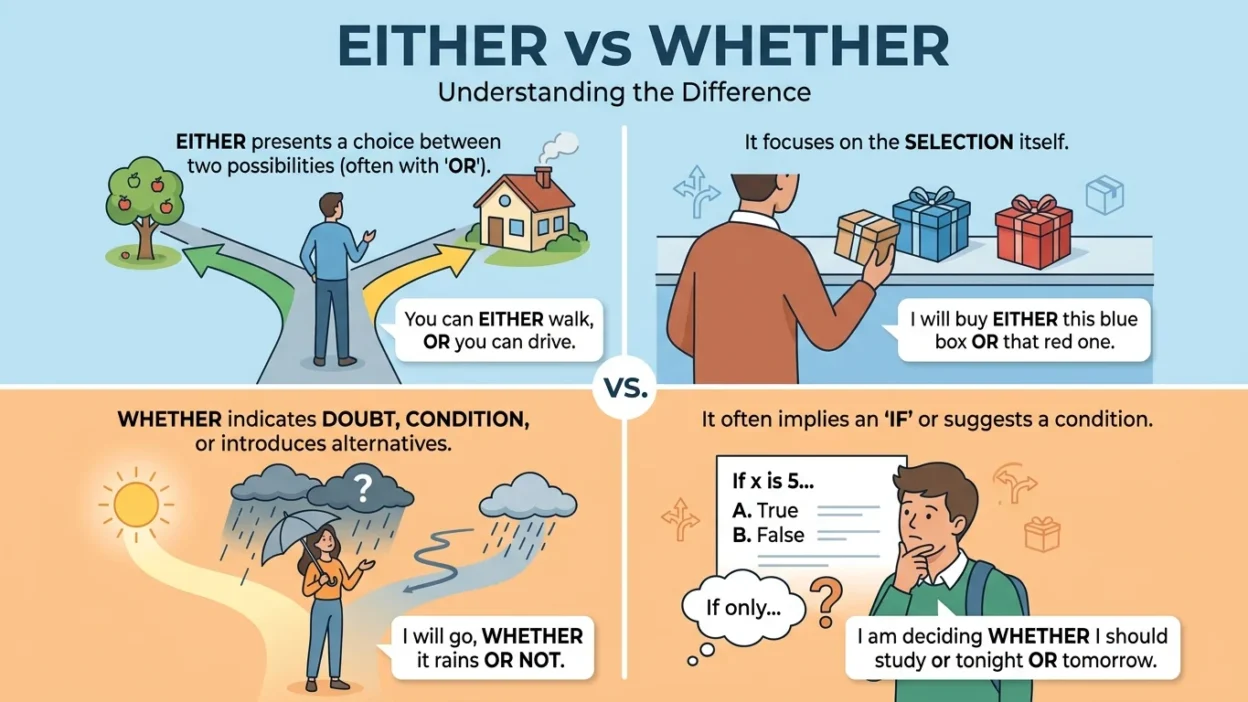
Many English learners get confused by either and whether because both words can appear in sentences about choices or possibilities. At first, they may seem similar, but they are used in very different ways.
The good news is that the difference is actually simple once you understand the job each word does in a sentence.
In this guide, you will learn:
- What either means
- What whether means
- When to use each one
- Common mistakes to avoid
- Easy examples from daily life
By the end, you should feel comfortable using both words correctly.
Quick Answer
Use either when:
- You talk about a choice between two things
- You mean “one or the other”
- You agree with a negative statement
- You want to say “also not”
Examples:
- You can choose either tea or coffee.
- I don’t like spinach, and my brother doesn’t either.
Use whether when:
- You talk about doubt or uncertainty
- You are not sure something is true
- You mean “if”
Examples:
- I don’t know whether she is coming.
- We are deciding whether to travel next week.
Simple Background Explanation
Both words have been part of English for a very long time.
- Either came from old English words meaning “one of two.”
- Whether came from old English words connected to doubt, choice, or uncertainty.
Even today, those old meanings still help explain the difference.
- Either = one choice from two options
- Whether = uncertainty about something
That is the easiest way to remember them.
What Is the Difference Between Either and Whether?
Meaning of “Either”
The word either usually talks about two choices.
It often means:
- one or the other
- any one of two choices
- also not
Examples:
- Sit on either side of the table.
- You may take either book.
- I don’t watch horror movies, and she doesn’t either.
In many sentences, either works with the word or.
Example:
- You can either study now or study later.
Meaning of “Whether”
The word whether talks about uncertainty, doubt, or possibility.
It shows that someone is not sure about something.
Examples:
- I don’t know whether he called.
- She is thinking about whether to change jobs.
- We cannot decide whether to stay or leave.
You can often replace whether with “if” in some sentences.
Example:
- I don’t know whether it will rain.
- I don’t know if it will rain.
Comparison Table
| Feature | Either | Whether |
| Main meaning | One of two choices | Uncertainty or doubt |
| Used for | Choices | Questions or possibilities |
| Often appears with | Or | Or |
| Part of speech | Adverb, pronoun, adjective | Conjunction |
| Common idea | This or that | Not sure |
| Example | Choose either dress | I wonder whether she agrees |
Which One to Use and When
Use “Either” for Choices
Use either when two options are possible and one can be chosen.
Examples:
- You can park on either side of the road.
- We can meet on either Monday or Tuesday.
- Either answer is acceptable.
Easy Tip:
If you can say “one of the two,” use either.
Use “Whether” for Uncertainty
Use whether when someone is unsure or thinking about possibilities.
Examples:
- I am not sure whether they arrived.
- She asked whether dinner was ready.
- We discussed whether to move to another city.
Easy Tip:
If the sentence means “I’m not sure,” use whether.
Common Sentence Patterns
Either + Or
This pattern gives two choices.
Examples:
- You can either call me or send a message.
- We will travel either by train or by bus.
Whether + Or Not
This pattern talks about uncertainty.
Examples:
- I don’t know whether or not he understands.
- She must decide whether or not to apply.
Sometimes “or not” is optional.
Example:
- I don’t know whether he understands.
Common Mistakes People Make
Mistake 1: Using “Either” Instead of “Whether”
❌ I don’t know either he is busy.
✅ I don’t know whether he is busy.
Why?
Because the sentence is about uncertainty, not choice.
Mistake 2: Using “Whether” for Direct Choices
❌ You can whether stay or leave.
✅ You can either stay or leave.
Why?
Because the sentence gives two choices.
Mistake 3: Forgetting “Or” After “Either”
❌ Either you study today.
✅ Either you study today or tomorrow.
Usually, either introduces two options.
Mistake 4: Confusing “Whether” and “If”
Sometimes both are possible, but not always.
Correct:
- I don’t know whether he called.
- I don’t know if he called.
Better with “Whether”:
- We discussed whether to move.
- She wondered whether or not to join.
In formal or careful English, whether is often clearer.
Everyday Real-Life Examples
In Emails
- Please tell me whether you can attend the meeting.
- You may contact me by either email or phone.
In Social Media Posts
- I cannot decide whether to watch the movie tonight.
- We can go either to the beach or the park.
In News Sentences
- Officials are unsure whether the storm will continue.
- Residents can use either road to leave the area.
In School Conversations
- You may answer either question.
- The teacher asked whether everyone finished the test.
In Daily Life
- We can eat either pizza or burgers.
- I’m not sure whether the shop is open.
Easy Memory Tricks
Remember “Either” Like This
Either = two choices
Think:
- this OR that
- one OR the other
Example:
- You can choose either color.
Remember “Whether” Like This
Whether = not sure
Think:
- maybe yes
- maybe no
Example:
- I don’t know whether it is true.
Short Learning Section for Students and Beginners
Here is a very simple way to learn the difference quickly.
Ask Yourself Two Questions
1. Is the sentence about choosing between two things?
If yes, use either.
Example:
- You can either walk or ride a bike.
2. Is the sentence about uncertainty or doubt?
If yes, use whether.
Example:
- I wonder whether she is happy.
Mini Practice
Choose the correct word.
1.
I don’t know ___ he will come.
✅ whether
2.
You can choose ___ cake.
✅ either
3.
We must decide ___ to stay home.
✅ whether
4.
You may ___ call or text me.
✅ either
FAQs
1. Can “either” and “whether” mean the same thing?
No. Their meanings are different.
- Either talks about choices.
- Whether talks about uncertainty.
2. Can I replace “whether” with “if”?
Sometimes yes.
Example:
- I don’t know whether he called.
- I don’t know if he called.
But in some sentences, whether sounds clearer and more correct.
3. Does “either” always need “or”?
Usually yes when showing choices.
Example:
- Either tea or coffee.
But not always.
Example:
- I don’t like it either.
4. What does “whether or not” mean?
It means something may happen or may not happen.
Example:
- I will go whether or not it rains.
5. Is “either” singular or plural?
It is usually treated as singular.
Example:
- Either answer is correct.
6. Which word is used in questions about doubt?
Use whether.
Example:
- She asked whether I was ready.
7. Can “either” be used at the end of a sentence?
Yes.
Example:
- I don’t want to go either.
8. Which word is easier to remember for choices?
Remember:
- Either = choice
- Whether = uncertainty
That simple rule helps most learners.
Conclusion
The difference between either and whether becomes much easier when you focus on their main ideas.
- Use either for choices between two things.
- Use whether for doubt, uncertainty, or possibility.
Simple Final Reminder
- Either = this or that
- Whether = not sure
With practice and real-life examples, these words will start to feel natural in everyday English.

Brandon Samuel is a dedicated writer and language enthusiast, serving as the lead author at WordHuts.com. He specializes in explaining word differences, grammar rules, and common language mistakes in simple terms. Brandon’s clear, practical writing style helps readers improve vocabulary, writing confidence, and everyday communication skills.