
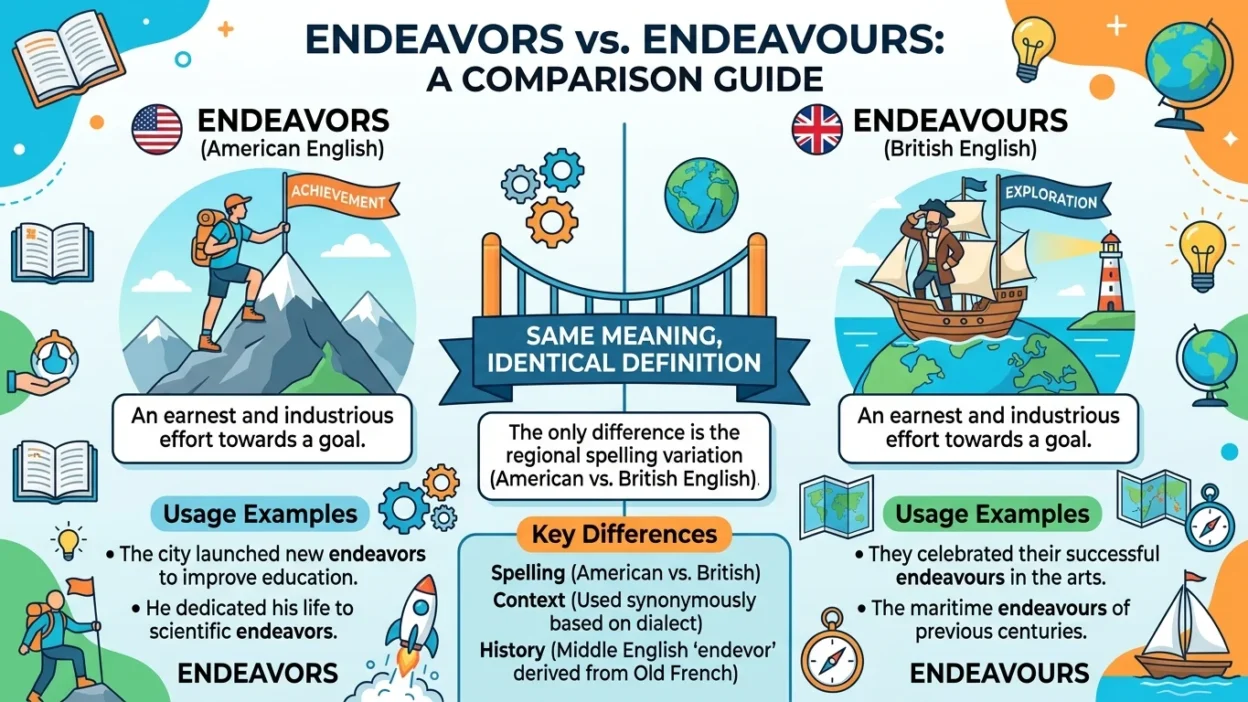
Many people get confused by “endeavors” and “endeavours” because both words look almost the same and have the same meaning. The only real difference is the spelling style.
You may see one version in American writing and another version in British writing. This can make students, ESL learners, and even native English speakers wonder which one is correct.
The good news is simple:
Both spellings are correct.
You just need to know where and when to use each one.
Quick Answer
- Endeavors = American English spelling
- Endeavours = British English spelling
- Both words mean:
- efforts
- attempts
- serious activities or projects
- The meaning does not change
- Use the spelling that matches your audience or writing style
Simple Example
- American English:
- “She supports educational endeavors.”
- British English:
- “She supports educational endeavours.”
Both sentences mean exactly the same thing.
Simple Origin and Background
The word comes from the older English word “endeavour.”
For many years, British English kept the spelling with “ou.”
Later, American English simplified many spellings by removing the “u” from words like:
| British English | American English |
| colour | color |
| favour | favor |
| labour | labor |
| endeavour | endeavor |
Because of this spelling style, the plural forms also changed:
- endeavour → endeavours
- endeavor → endeavors
The meaning stayed the same.
What Do “Endeavors” and “Endeavours” Mean?
Both words are plural nouns.
They refer to:
- hard work
- serious attempts
- projects
- efforts to achieve something
Simple Meaning
If someone is trying hard to do something important, that activity can be called an endeavor or endeavour.
Examples
- scientific endeavors
- artistic endeavours
- business endeavors
- community endeavours
The Main Difference
The only difference is the spelling style.
“Endeavors”
This spelling is used in:
- the United States
- American schools
- American newspapers
- most American businesses
“Endeavours”
This spelling is used in:
- the United Kingdom
- Australia
- New Zealand
- many Commonwealth countries
Comparison Table
| Feature | Endeavors | Endeavours |
| English style | American English | British English |
| Meaning | Efforts or projects | Efforts or projects |
| Correct spelling | Yes | Yes |
| Used in the US | Common | Rare |
| Used in the UK | Less common | Common |
| Pronunciation | Same | Same |
| Formal or informal | Both | Both |
Which One Should You Use?
Use “endeavors” if:
- you write in American English
- your school follows American spelling
- your readers are mostly in the US
Example
- “The company supports new business endeavors.”
Use “endeavours” if:
- you write in British English
- you study in the UK or Australia
- your readers expect British spelling
Example
- “The charity continues its humanitarian endeavours.”
Important Tip
Do not mix both spellings in the same piece of writing.
For example, avoid this:
❌ “The organization supports community endeavours and educational endeavors.”
Choose one style and stay consistent.
Is One More Correct Than the Other?
No.
Neither spelling is more correct.
The choice depends on the type of English you use.
Think of it like these pairs:
| American English | British English |
| favorite | favourite |
| organize | organise |
| traveled | travelled |
| endeavors | endeavours |
Both versions are accepted in English.
Common Mistakes People Make
1. Thinking One Spelling Is Wrong
Many learners believe only one spelling is correct.
That is not true.
Both are correct in different English systems.
2. Mixing British and American Spellings
This is very common in essays and emails.
Example:
❌ “Her favourite endeavors helped the organisation.”
This sentence mixes spelling styles.
Better versions:
✅ American English:
- “Her favorite endeavors helped the organization.”
✅ British English:
- “Her favourite endeavours helped the organisation.”
3. Using the Wrong Version for School or Work
Some schools or companies prefer one style.
Always check:
- your textbook
- style guide
- teacher instructions
- workplace writing rules
4. Confusing the Word Type
Some learners confuse the noun and verb forms.
| Word | Type |
| endeavor / endeavour | singular noun or verb |
| endeavors / endeavours | plural noun or verb form |
Example:
- “They endeavor to help.” → verb
- “Their endeavors were successful.” → plural noun
Everyday Real-Life Examples
In Emails
American English
- “Thank you for your continued endeavors.”
British English
- “Thank you for your continued endeavours.”
In News Writing
American Style
- “The space agency expanded its research endeavors.”
British Style
- “The university praised the team’s scientific endeavours.”
On Social Media
- “Good luck in your future endeavors!”
- “Her creative endeavours inspire many people.”
In School Writing
- “Students should focus on academic endeavors.”
- “The school supports artistic endeavours.”
In Business
- “The company invested in new technological endeavors.”
- “Their international endeavours improved trade relations.”
Simple Grammar Notes
Singular Form
- endeavor
- endeavour
Example
- “Starting a business is a difficult endeavor.”
Plural Form
- endeavors
- endeavours
Example
- “Their charitable endeavors helped many families.”
Verb Form
The word can also act as a verb.
American English
- “We endeavor to improve.”
British English
- “We endeavour to improve.”
Meaning:
- to try seriously
Pronunciation Guide
Both spellings are pronounced the same way.
Simple Pronunciation
en-DEV-er
The spelling changes, but the sound does not.
Learning Section for Students and Beginners
Here is an easy way to remember the difference.
Memory Trick
British English likes “ou”
Examples:
- colour
- favour
- labour
- endeavour
- endeavours
American English removes the “u”
Examples:
- color
- favor
- labor
- endeavor
- endeavors
This pattern can help you remember many spelling differences in English.
Practice Sentences
Choose the correct spelling based on the English style.
American English
- Their scientific ______ are impressive.
- She supports charitable ______.
Answers:
- endeavors
- endeavors
British English
- His artistic ______ gained attention.
- The group continued its humanitarian ______.
Answers:
- endeavours
- endeavours
FAQ
1. Are “endeavors” and “endeavours” the same word?
Yes. They have the same meaning. Only the spelling is different.
2. Which spelling is American English?
“Endeavors” is the American English spelling.
3. Which spelling is British English?
“Endeavours” is the British English spelling.
4. Is “endeavours” wrong in the United States?
It is not wrong, but it is uncommon in American writing.
5. Can I use both spellings in one essay?
It is better not to mix them. Choose one style and stay consistent.
6. Do the words sound different?
No. Both are pronounced the same way.
7. Is the meaning formal?
The word can sound slightly formal in some situations, but it is common in professional, academic, and everyday writing.
8. What is a simpler word for “endeavors”?
Simple alternatives include:
- efforts
- attempts
- projects
- activities
Conclusion
The difference between “endeavors” and “endeavours” is very simple.
- Endeavors is the American English spelling.
- Endeavours is the British English spelling.
Both words mean the same thing: serious efforts, projects, or attempts.
The most important thing is consistency. If you use American English, choose endeavors. If you use British English, choose endeavours.
Once you remember that British English often keeps the “ou” spelling, the difference becomes much easier to understand.

Brandon Samuel is a dedicated writer and language enthusiast, serving as the lead author at WordHuts.com. He specializes in explaining word differences, grammar rules, and common language mistakes in simple terms. Brandon’s clear, practical writing style helps readers improve vocabulary, writing confidence, and everyday communication skills.