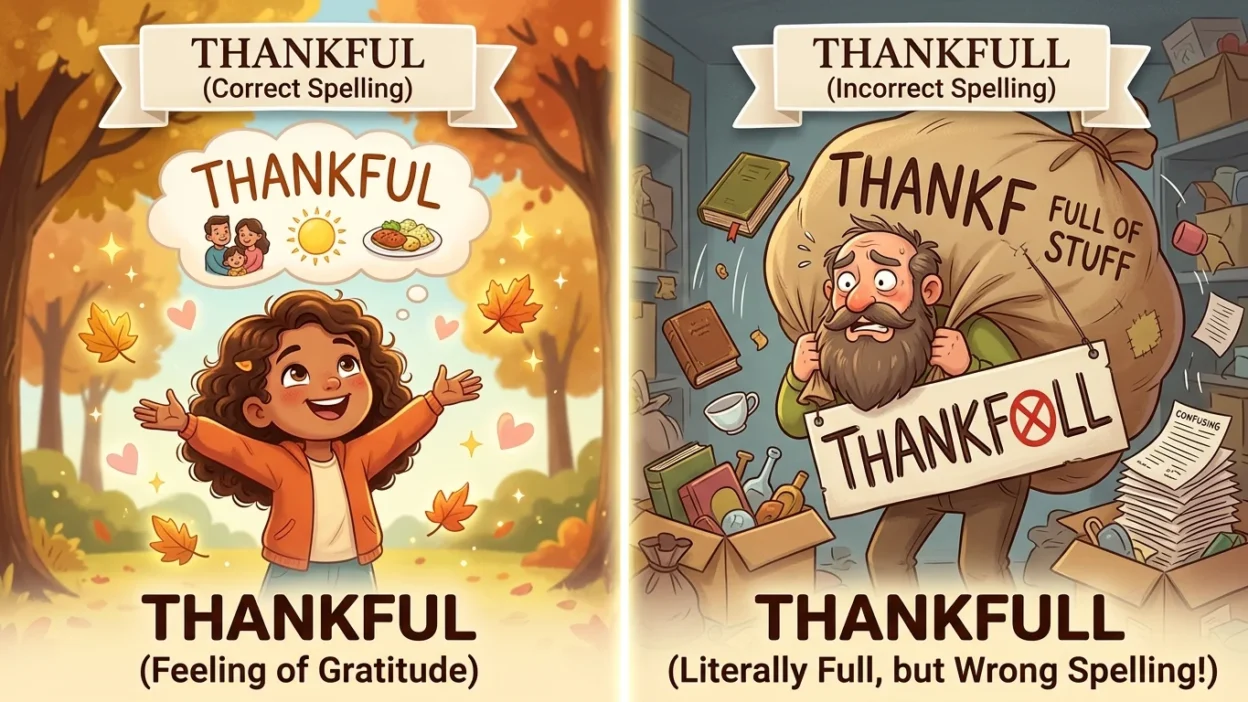
Many English learners get confused between thankful and thankfull because the two words look almost the same. The only difference is one extra “l” at the end. Because of this, people often make spelling mistakes when writing emails, messages, school work, or social media posts.
The good news is that the answer is very simple:
“Thankful” is correct.
“Thankfull” is incorrect.
In this article, you will learn the difference in very easy English with examples, tips, and simple explanations.
Quick Answer
Here is the short and simple answer:
- ✅ Thankful = correct spelling
- ❌ Thankfull = wrong spelling
Example:
- ✅ I am thankful for your help.
- ❌ I am thankfull for your help.
Use thankful in all writing situations.
Why Do People Get Confused?
People get confused because many English words end with -full, such as:
- beautiful
- careful
- helpful
- useful
Because of these words, some learners think thankful should also end with -full.
But English spelling is not always perfectly regular. Some words follow different patterns. The correct word is simply thankful, with only one “l” at the end.
Simple Background of the Word
The word thankful comes from the word thank.
- Thank = to show gratitude or appreciation
- Thankful = feeling happy and grateful because of something good
The ending -ful is used in many English adjectives.
Examples:
- careful
- hopeful
- peaceful
- thankful
The ending -ful usually means:
“full of” a feeling or quality
So:
- thankful = full of thanks or gratitude
Even though it sounds like “full,” the spelling in adjectives is usually just -ful with one l.
The Difference Between Thankful and Thankfull
Thankful
Thankful is the correct English word.
It means:
- feeling grateful
- appreciating kindness, help, or good things
Examples:
- I am thankful for my family.
- She felt thankful after receiving help.
- We are thankful for your support.
Thankfull
Thankfull is not a standard English word.
It is only a spelling mistake.
People sometimes accidentally add an extra “l” because they are thinking about the word full.
Incorrect Examples:
- ❌ I am thankfull for everything.
- ❌ She was very thankfull.
These should always be written as:
- ✅ I am thankful for everything.
- ✅ She was very thankful.
Easy Comparison Table
| Word | Correct or Incorrect? | Meaning | Should You Use It? |
| thankful | ✅ Correct | Feeling grateful | Yes |
| thankfull | ❌ Incorrect | No real English word | No |
Which One Should You Use?
You should always use thankful.
There is no situation where thankfull is the preferred spelling in modern English.
Use “thankful” in:
- school writing
- essays
- emails
- text messages
- social media
- business writing
- daily conversation
Examples:
- I am thankful for this opportunity.
- We are thankful for your kindness.
- He felt thankful after the good news.
Common Mistakes People Make
Here are some common mistakes learners make with this word.
1. Adding an Extra “L”
This is the biggest mistake.
❌ thankfull
✅ thankful
Remember:
The ending is -ful, not -full.
2. Confusing “Thankful” and “Grateful”
These words are similar, but not exactly the same.
- Thankful often focuses on appreciation for something specific.
- Grateful is a deeper feeling of appreciation.
In everyday English, both are often used in similar ways.
Examples:
- I am thankful for your help.
- I am grateful for your help.
Both are correct.
3. Using the Wrong Spelling in Professional Writing
Some people accidentally write:
- ❌ “Thankfull for your time”
This can look careless in:
- job applications
- business emails
- school assignments
Always double-check the spelling.
Simple Trick to Remember the Correct Spelling
Here is an easy memory trick:
Think of these words:
- helpful
- careful
- useful
- peaceful
They all end with:
-ful
So:
thankful → one “l”
Everyday Real-Life Examples
Seeing real examples helps learners remember better.
In Emails
- Thankful for your quick reply.
- I am thankful for your support.
- We are thankful for your cooperation.
In Daily Conversation
- I’m thankful to have good friends.
- She was thankful for the advice.
- They felt thankful after the storm ended safely.
On Social Media
- Feeling thankful today.
- So thankful for everyone who helped me.
- Thankful for another beautiful day.
In News or Public Speaking
- The family said they were thankful for community support.
- The player was thankful for the fans.
- Citizens were thankful for emergency workers.
In School Writing
- I am thankful for my teachers.
- The character felt thankful after learning a lesson.
- We should be thankful for what we have.
Thankful vs Grateful
Many learners also ask about this difference.
Here is a simple explanation.
| Word | Meaning |
| thankful | happy and appreciative for something |
| grateful | deeply appreciative and emotionally thankful |
In many situations, people use them almost the same way.
Examples:
- I am thankful for your help.
- I am grateful for your help.
Both sound natural.
Learning Section for Students and Beginners
Here are some easy learning tips.
Rule to Remember
✅ thankful
❌ thankfull
Spelling Pattern
Many adjectives use:
root word + ful
Examples:
- hope → hopeful
- care → careful
- peace → peaceful
- thank → thankful
Notice:
only one “l”
Practice Sentences
Fill in the blank with the correct word.
- I am _______ for your kindness.
- She felt _______ after the doctor helped her.
- We are _______ for this opportunity.
Answers:
- thankful
- thankful
- thankful
Beginner Tip
When writing quickly, your brain may try to type:
thank + full
But the correct adjective form is:
thankful
FAQ Section
1. Is “thankfull” a real English word?
No. “Thankfull” is considered a spelling mistake.
2. Which spelling is correct: thankful or thankfull?
The correct spelling is:
thankful
3. Why does “thankful” have only one “l”?
Because the adjective ending is usually written as -ful, not -full.
4. Can I use “thankfull” in informal writing?
No. Even in casual messages, “thankfull” is still incorrect.
5. Is “thankful” used in American and British English?
Yes. Both American and British English use:
thankful
6. What does “thankful” mean?
It means feeling grateful or appreciative.
7. What is an example sentence with “thankful”?
Example:
I am thankful for my family and friends.
8. Is “thankful” the same as “grateful”?
They are very similar, but “grateful” can sometimes sound deeper or more emotional.
Quick Review
Before finishing, here is a fast review:
| Correct Word | Wrong Word |
| thankful | thankfull |
Remember:
- thankful = correct
- thankfull = incorrect
- use thankful in all situations
Conclusion
The difference between thankful and thankfull is very simple once you understand the spelling rule.
- ✅ Thankful is the correct English word.
- ❌ Thankfull is a spelling mistake.
People often get confused because many English words seem connected to the word “full.” However, adjectives like thankful, helpful, and careful normally end with -ful, using only one “l.”
If you remember this small rule, you can avoid the mistake easily in emails, school work, social media posts, and everyday writing.

Justin Larry is a talented language writer and content creator at WordHuts.com. She specializes in explaining word differences, grammar tips, and common English mistakes in a clear, practical style. Her engaging content helps readers improve vocabulary, writing skills, and everyday communication, making language learning simple and effective.