Many people feel confused about commas and semicolons. Both marks help connect ideas in a sentence, but they are not used in the same way. Some writers use commas where a semicolon should be used, while others avoid semicolons completely because they seem difficult.
The good news is that the difference is actually simple.
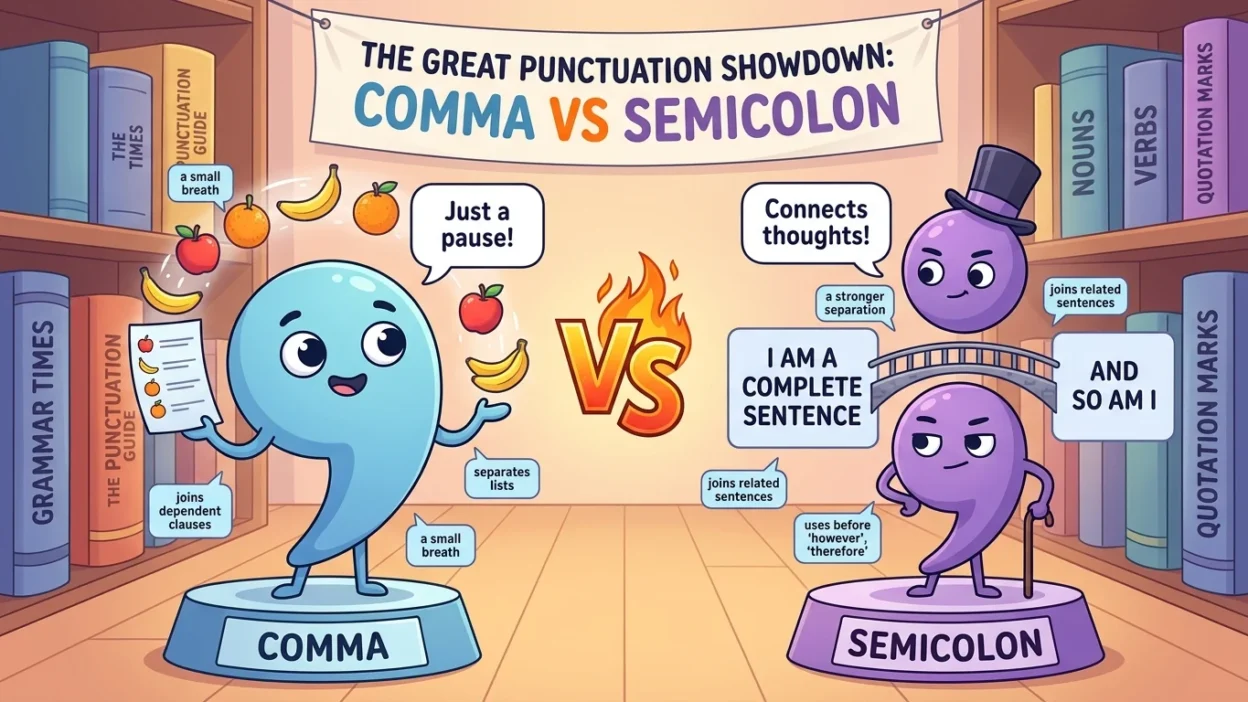
A comma is used for short pauses and to separate parts of a sentence. A semicolon is stronger than a comma and is often used to connect two closely related complete sentences.
Once you understand this basic idea, choosing the correct punctuation mark becomes much easier.
Quick Answer
Here is the simplest way to remember the difference:
Use a Comma When:
- You need a short pause.
- You separate items in a list.
- You separate introductory words or phrases.
- You join two complete sentences with a connecting word such as and, but, or so.
Example:
- I wanted to go outside, but it started raining.
Use a Semicolon When:
- You connect two complete sentences that are closely related.
- You want a stronger break than a comma but a weaker break than a period.
- You separate complicated list items.
Example:
- I wanted to go outside; it started raining.
A Simple Background Explanation
Punctuation helps readers understand where to pause and how ideas connect.
The comma has been used for hundreds of years to create short breaks in sentences. It helps make writing easier to read.
The semicolon appeared later and was created to connect ideas that belong together. It sits between a comma and a period in strength.
Think of punctuation like traffic signals:
- Comma = slow down
- Semicolon = longer pause
- Period = stop
This simple comparison helps many learners remember how each mark works.
The Difference Between a Comma and a Semicolon
The main difference is the strength of the break.
A comma creates a small pause.
A semicolon creates a larger pause and often joins two complete thoughts.
Comma Example
- Sarah went to the store, and she bought milk.
The comma works because the word and joins the two ideas.
Semicolon Example
- Sarah went to the store; she bought milk.
The semicolon connects the same ideas without using and.
Both sentences are correct, but the punctuation changes the structure.
Think About It This Way
If the two parts could stand alone as separate sentences, a semicolon may work.
Example:
- The movie was long.
- Everyone stayed until the end.
These can become:
- The movie was long; everyone stayed until the end.
Both sides are complete sentences.
Comma vs Semicolon Comparison Table
| Feature | Comma (,) | Semicolon (;) |
| Creates a pause | Yes | Yes |
| Strength of pause | Short | Stronger |
| Used in lists | Yes | Sometimes |
| Connects related ideas | Sometimes | Yes |
| Can join two complete sentences alone | No | Yes |
| Common in everyday writing | Very common | Less common |
| Easy for beginners | Usually | Takes more practice |
| Looks formal | Not usually | Often |
Which One Should You Use and When?
Use a Comma When Listing Items
Examples:
- I bought apples, oranges, bananas, and grapes.
- We need paper, pens, notebooks, and folders.
The comma separates each item clearly.
Use a Comma After an Introduction
Examples:
- After dinner, we watched a movie.
- In the morning, I go for a walk.
The comma helps readers move smoothly into the main sentence.
Use a Comma Before Certain Connecting Words
Examples:
- I was tired, but I finished my work.
- She studied hard, so she passed the test.
- He wanted coffee, yet he ordered tea.
Common connecting words include:
- and
- but
- so
- yet
- for
- nor
Use a Semicolon Between Related Sentences
Examples:
- The weather was beautiful; everyone went outside.
- The meeting ended late; people were ready to go home.
Each side could be a complete sentence by itself.
Use a Semicolon in Complex Lists
Sometimes list items already contain commas. A semicolon helps separate the larger parts.
Example:
- We visited Lahore, Pakistan; Dubai, UAE; and Kuala Lumpur, Malaysia.
Without semicolons, the sentence may become confusing.
Common Mistakes People Make
Mistake 1: Using a Comma Instead of a Semicolon
Incorrect:
- I love reading, my brother loves sports.
This is called a comma splice.
Correct:
- I love reading; my brother loves sports.
Or:
- I love reading. My brother loves sports.
Mistake 2: Using a Semicolon Before an Incomplete Thought
Incorrect:
- She went home; because she was tired.
Correct:
- She went home because she was tired.
Or:
- She was tired; she went home.
A semicolon should usually connect complete sentences.
Mistake 3: Using Too Many Semicolons
Incorrect:
- I woke up; I brushed my teeth; I ate breakfast; I left for work.
While technically possible, this style can feel heavy.
Better:
- I woke up, brushed my teeth, ate breakfast, and left for work.
Mistake 4: Forgetting the Comma in a List
Incorrect:
- We bought milk bread eggs and cheese.
Correct:
- We bought milk, bread, eggs, and cheese.
Everyday Real-Life Examples
In Emails
Comma:
- Thank you for your message, and I will reply soon.
Semicolon:
- Thank you for your message; I will reply soon.
In News Writing
Comma:
- The mayor spoke today, and residents attended the event.
Semicolon:
- The mayor spoke today; residents attended the event in large numbers.
On Social Media
Comma:
- I finished my homework, and now I’m relaxing.
Semicolon:
- I finished my homework; now I’m relaxing.
Many social media users prefer commas because they are simpler and faster.
In School Assignments
Comma:
- The experiment was successful, but more testing is needed.
Semicolon:
- The experiment was successful; more testing is needed.
In Everyday Conversation Writing
Comma:
- I called him, but he didn’t answer.
Semicolon:
- I called him; he didn’t answer.
Both can be correct depending on sentence structure.
Learning Tips for Students and Beginners
If you are still unsure, follow these easy rules:
Rule 1
Use a comma for lists.
Example:
- Red, blue, green, and yellow.
Rule 2
Use a comma before words like and, but, and so when joining complete ideas.
Example:
- I was hungry, so I made a sandwich.
Rule 3
Use a semicolon when two complete sentences are strongly connected.
Example:
- The test was difficult; everyone studied hard.
Rule 4
If you can replace the semicolon with a period and the sentence still makes sense, the semicolon is probably correct.
Example:
- She loves music; she plays guitar daily.
Can become:
- She loves music. She plays guitar daily.
Both work.
Frequently Asked Questions
1. Is a semicolon the same as a comma?
No. A semicolon creates a stronger pause and can connect complete sentences. A comma creates a shorter pause.
2. Can I replace every semicolon with a comma?
No. Doing this can create grammar mistakes, especially when joining complete sentences.
3. Can a semicolon replace a period?
Sometimes. If two complete sentences are closely related, a semicolon can connect them.
Example:
- It was late; everyone went home.
4. Which punctuation mark is used more often?
The comma is used much more often in everyday writing.
5. Are semicolons necessary?
Yes, but not always. Good writing can exist without many semicolons. However, they can make connections between ideas clearer.
6. Can I use a semicolon in a list?
Yes. It is useful when list items already contain commas.
Example:
- We traveled to Paris, France; Rome, Italy; and Madrid, Spain.
7. What is a comma splice?
A comma splice happens when a comma incorrectly joins two complete sentences.
Incorrect:
- I was tired, I went to bed.
Correct:
- I was tired; I went to bed.
8. Which one is easier for beginners?
Most beginners find commas easier because they are used more frequently and follow simpler rules.
Conclusion
The difference between a comma and a semicolon is easier than many people think.
A comma creates a short pause and helps separate items, phrases, and ideas within a sentence. A semicolon creates a stronger pause and connects closely related complete sentences without using words like and or but.
A simple way to remember it is:
- Comma = small pause
- Semicolon = stronger pause
- Period = full stop
When writing, use commas for everyday separation and semicolons when two complete thoughts belong closely together. With a little practice, you will quickly learn when each punctuation mark fits naturally and confidently in your writing.

Gregory Alexander is a skilled writer and language researcher at WordHuts.com. He focuses on clarifying confusing word pairs, grammar rules, and common usage mistakes. With a passion for precise communication, Gregory creates simple, easy-to-understand content that helps readers strengthen vocabulary, writing accuracy, and everyday English skills.