Many people become confused when they see both GOOG and GOOGL in stock market information. At first glance, they look almost identical. Both are connected to the same company, and their prices are often very close.
This causes many beginners to ask questions such as:
- Is GOOG a different company from GOOGL?
- Which one should I buy?
- Why are there two stock symbols?
- Do they represent different businesses?
The good news is that the difference is actually simple once you understand how company shares can be organized. This guide explains everything in clear, easy English.
Quick Answer
Here is the short answer:
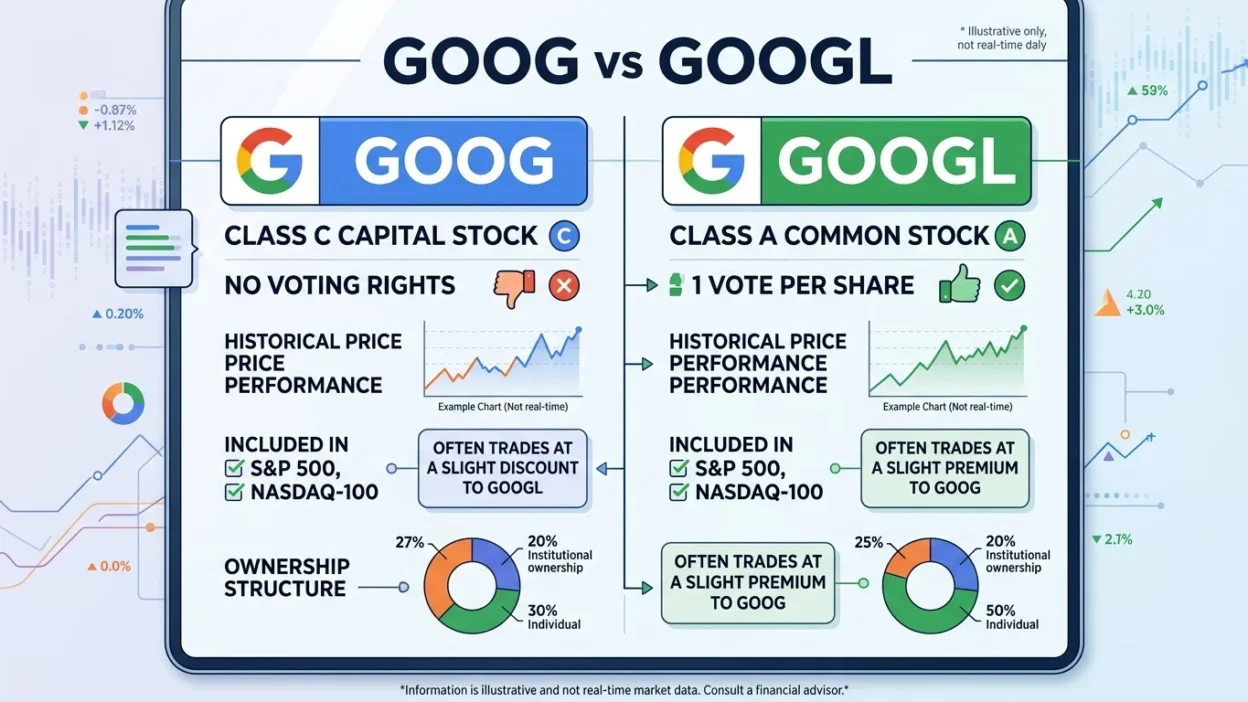
- GOOG and GOOGL are both shares of the same company.
- GOOGL shares come with voting rights.
- GOOG shares do not come with voting rights.
- Both shares represent ownership in the same business.
- Their prices are usually very similar.
- Most everyday investors see very little difference in daily performance.
The biggest difference is voting power, not ownership of a different company.
Background: Why Are There Two Stock Symbols?
To understand the difference, it helps to know a little history.
Many large companies want to raise money by selling shares to the public while still allowing founders to keep control over important company decisions.
One way to do this is by creating different classes of shares.
Instead of offering only one type of stock, a company may create:
- Shares with voting rights
- Shares with limited voting rights
- Shares with no voting rights
This system allows founders and early leaders to keep stronger control over company decisions while still letting public investors own part of the business.
That is why both GOOG and GOOGL exist.
What Does GOOGL Mean?
GOOGL is the stock symbol for the company’s Class A shares.
These shares include voting rights.
If shareholders vote on certain company matters, owners of GOOGL shares generally have the right to participate in those votes.
Examples of matters that may involve voting include:
- Electing board members
- Approving certain company actions
- Other shareholder decisions
Because of these voting rights, some investors prefer GOOGL.
What Does GOOG Mean?
GOOG is the stock symbol for the company’s Class C shares.
These shares do not provide voting rights.
People who own GOOG shares still own part of the company and can benefit if the company’s value grows.
However, they usually cannot vote on shareholder matters in the same way that GOOGL shareholders can.
For many investors, this difference may not matter much because they are focused mainly on investment returns rather than voting power.
The Main Difference Explained Simply
Imagine a school club.
Two students each receive a membership card.
Both students can:
- Attend activities
- Enjoy club benefits
- Be part of the club
But only one membership card allows voting in club elections.
That is similar to the relationship between GOOGL and GOOG.
Both represent ownership in the same company.
The difference is that:
- GOOGL = ownership + voting rights
- GOOG = ownership without voting rights
GOOG vs GOOGL Comparison Table
| Feature | GOOG | GOOGL |
| Company | Same company | Same company |
| Share class | Class C | Class A |
| Voting rights | No | Yes |
| Ownership in company | Yes | Yes |
| Can benefit from company growth | Yes | Yes |
| Dividend rights | Usually treated similarly | Usually treated similarly |
| Stock price | Often very close | Often very close |
| Popular with investors | Yes | Yes |
Which One Should You Use and When?
The answer depends on what matters to you as an investor.
Choose GOOGL if:
- You want voting rights.
- You like having a voice in shareholder decisions.
- You prefer owning shares that include voting power.
Choose GOOG if:
- Voting rights are not important to you.
- You simply want exposure to the company’s performance.
- You find GOOG trading at a more attractive price.
For many small investors, the practical difference is often very small because they own only a limited number of shares and may never take part in shareholder voting.
Why Are Their Prices Different?
Many beginners assume the prices should always be exactly the same.
In reality, stock prices are influenced by buyers and sellers in the market.
Since GOOG and GOOGL are different share classes, demand can vary slightly.
For example:
- Some investors value voting rights.
- Some investors do not care about voting rights.
- Institutional investors may prefer one share class over the other.
As a result, small price differences can appear.
However, because both shares represent ownership in the same company, their prices usually move in similar directions.
Common Mistakes People Make
Mistake 1: Thinking They Are Different Companies
This is the most common misunderstanding.
GOOG and GOOGL are not separate businesses.
They represent different share classes of the same company.
Mistake 2: Assuming One Is Always Better
Neither share class is automatically better.
The right choice depends on your goals.
Mistake 3: Ignoring Voting Rights
Some investors buy shares without understanding the voting difference.
It is always helpful to know what rights come with the shares you own.
Mistake 4: Expecting Huge Performance Differences
Because both share classes represent the same business, their long-term performance is often very similar.
Mistake 5: Thinking Voting Rights Guarantee Higher Returns
Voting rights give shareholders a voice, but they do not guarantee greater profits or better stock performance.
Everyday Real-Life Examples
Here are examples of how people may use the terms GOOG and GOOGL in daily conversations.
In a News Article
The company’s shares rose after strong earnings results.
The article may mention either GOOG or GOOGL depending on which share class is being discussed.
On Social Media
I bought GOOG today.
This usually means the person purchased the non-voting share class.
Another person might write:
I prefer GOOGL because it includes voting rights.
In a Classroom
Student:
Are GOOG and GOOGL different companies?
Teacher:
No. They are different share classes of the same company.
In an Investment Discussion
Friend 1:
Which one do you own?
Friend 2:
GOOGL. I like having voting rights.
In Personal Finance Conversations
Many investors compare:
- GOOG price
- GOOGL price
- Voting rights
- Long-term goals
before deciding which share class fits their needs.
Learning Section for Students and Beginners
A simple way to remember the difference is:
Remember This Formula
GOOGL = Voting Rights
GOOG = No Voting Rights
That is the key idea.
Both shares:
- Belong to the same company
- Reflect the same business performance
- Usually move similarly in value
The voting feature is what separates them.
Easy Memory Trick
Notice that GOOGL has an extra letter “L.”
Some beginners remember it like this:
L = Leadership Vote
This is not an official rule, but it can help you remember that GOOGL includes voting rights.
Frequently Asked Questions
1. Are GOOG and GOOGL the same company?
Yes. They are different share classes of the same company.
2. What is the biggest difference between them?
The biggest difference is voting rights.
GOOGL has voting rights, while GOOG generally does not.
3. Which stock is more expensive?
The answer changes over time. Their prices are usually very close but not always identical.
4. Do both shares benefit when the company grows?
Yes.
If the company performs well, both share classes can benefit because they represent ownership in the same business.
5. Why would someone choose GOOG?
Many investors focus mainly on investment performance and do not care about voting rights.
6. Why would someone choose GOOGL?
Some investors prefer having voting power, even if they own only a small number of shares.
7. Do GOOG and GOOGL move together?
Most of the time, yes.
Because both represent the same company, their prices often move in similar ways.
8. Is one always better than the other?
No.
The better choice depends on whether voting rights matter to you.
Conclusion
The confusion between GOOG and GOOGL comes from the fact that both stock symbols represent ownership in the same company. Many people assume they are different businesses, but that is not true.
The key difference is simple:
- GOOGL shares include voting rights.
- GOOG shares do not include voting rights.
Aside from that, both share classes are connected to the same company and often perform very similarly. For most beginners, understanding the voting-rights difference is enough to remove almost all confusion.
If you remember one thing from this guide, remember this:
GOOGL = ownership with voting rights.
GOOG = ownership without voting rights.
That single idea explains the difference clearly and simply.

Justin Larry is a talented language writer and content creator at WordHuts.com. She specializes in explaining word differences, grammar tips, and common English mistakes in a clear, practical style. Her engaging content helps readers improve vocabulary, writing skills, and everyday communication, making language learning simple and effective.