
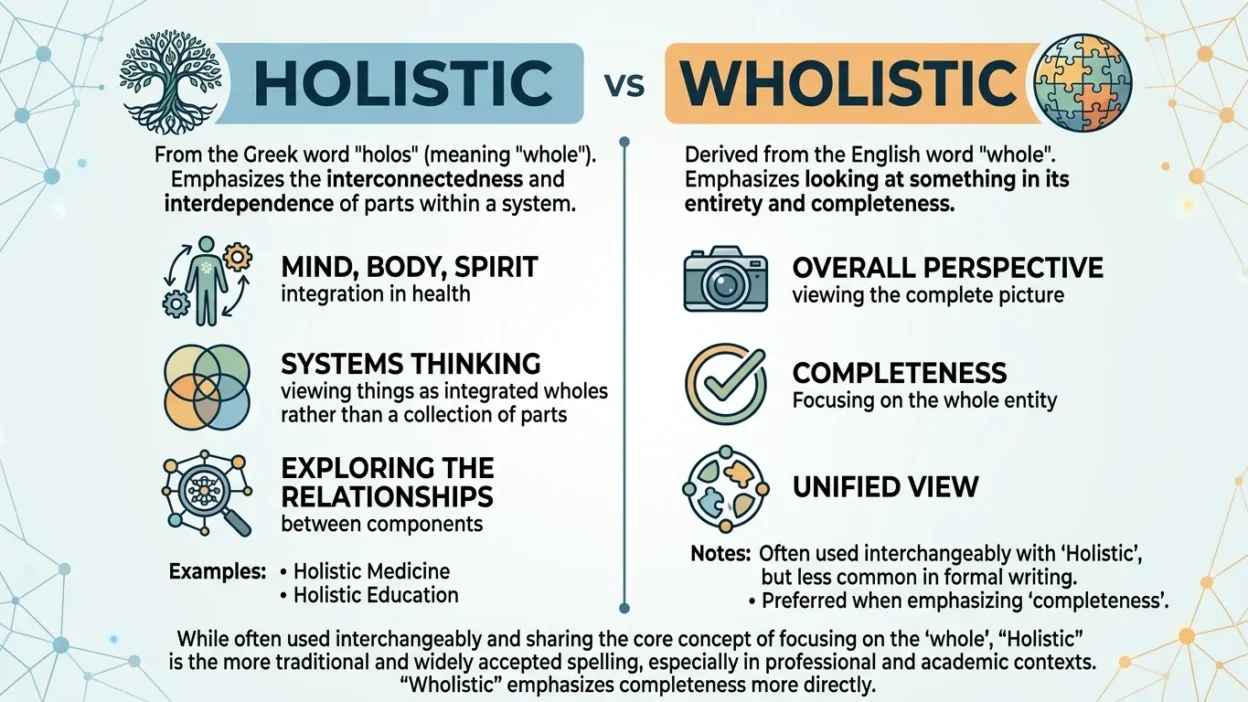
Many people see the words holistic and wholistic and wonder if they mean different things. They look similar, sound almost the same, and are often used in health, education, business, and personal growth discussions.
This creates confusion, especially for students, English learners, and beginners. Some people believe one word is more correct than the other. Others think they have different meanings.
The good news is that the difference is much simpler than it seems.
In most situations, holistic and wholistic mean the same thing. The main difference is how people choose to spell the word and the feeling they want to give when using it.
This guide explains everything in clear and simple English.
Quick Answer
Here is the short answer:
- Holistic is the standard and most commonly used spelling.
- Wholistic is an alternative spelling.
- Both words usually mean looking at the whole person or whole system, not just one part.
- Most dictionaries and professional writing prefer holistic.
- Some people use wholistic to emphasize the idea of “whole.”
- In everyday English, the meanings are generally the same.
Simple Example
- Holistic approach to health
- Wholistic approach to health
Both sentences mean considering the entire person rather than focusing on only one symptom or problem.
Where Do These Words Come From?
To understand the difference, it helps to know a little background.
The word holistic comes from the word whole. The idea behind it is that everything should be viewed as a complete system.
For example:
- A doctor may look at a person’s body, mind, and lifestyle together.
- A teacher may consider a student’s learning, emotions, and environment.
- A company may study all parts of a project instead of only one area.
Over time, some writers began using wholistic because it visibly contains the word whole. They felt this spelling made the meaning easier to understand.
Even though both spellings exist, holistic became the more common form in English.
Understanding the Difference
What Does Holistic Mean?
Holistic means considering the entire picture instead of focusing on only one piece.
It encourages people to look at how different parts work together.
Examples:
- Holistic healthcare
- Holistic education
- Holistic planning
- Holistic development
In each case, the focus is on the complete situation.
What Does Wholistic Mean?
Wholistic carries the same basic meaning.
People who choose this spelling often want to highlight the idea of “wholeness.”
Examples:
- Wholistic wellness
- Wholistic healing
- Wholistic lifestyle
The meaning is still about viewing something as a complete whole.
Is There a Meaning Difference?
Usually, no.
Most English speakers and writers treat the words as synonyms.
The difference is mainly:
- Holistic = standard spelling
- Wholistic = alternative spelling
Holistic vs Wholistic Comparison Table
| Feature | Holistic | Wholistic |
| Meaning | Looking at the whole picture | Looking at the whole picture |
| Pronunciation | Almost the same | Almost the same |
| Commonness | Very common | Less common |
| Dictionary preference | Usually preferred | Usually listed as a variant |
| Professional writing | More common | Less common |
| Focus | Complete system | Complete system |
| Everyday use | Frequently seen | Occasionally seen |
Which One Should You Use?
Use “Holistic” Most of the Time
For school, work, reports, articles, and professional communication, holistic is usually the safest choice.
Examples:
- A holistic education plan
- A holistic business strategy
- A holistic healthcare program
Most readers immediately recognize this spelling.
Use “Wholistic” When Emphasizing Wholeness
Some people prefer wholistic because it clearly shows the word whole.
You may see it in:
- Wellness communities
- Personal development discussions
- Alternative health conversations
- Spiritual or lifestyle writing
Examples:
- A wholistic healing journey
- A wholistic wellness approach
These uses are not wrong. They are simply less common.
Simple Rule
If you are unsure, choose holistic.
Common Mistakes People Make
Mistake 1: Thinking One Word Is Wrong
Many people assume wholistic is incorrect.
This is not true.
It is an accepted alternative spelling, although it is less common.
Mistake 2: Believing the Meanings Are Completely Different
Some people think:
- Holistic = physical
- Wholistic = spiritual
This is not a general rule.
Both words can be used in many of the same situations.
Mistake 3: Mixing Spellings in One Document
Choose one spelling and stay consistent.
Correct:
- Holistic approach
- Holistic care
- Holistic planning
Also correct:
- Wholistic approach
- Wholistic care
- Wholistic planning
Less ideal:
- Holistic approach and wholistic planning in the same document
Mistake 4: Assuming Wholistic Is More Modern
Neither spelling automatically makes writing more modern or advanced.
The choice is usually a style preference.
Everyday Examples
In Emails
Holistic
“We need a holistic solution that addresses all parts of the problem.”
Wholistic
“Our team supports a wholistic approach to employee wellness.”
Both sentences sound natural.
In News Reports
Holistic
“The organization introduced a holistic education program.”
This spelling is more likely to appear in news writing.
On Social Media
Holistic
“I am learning about holistic health.”
Wholistic
“I am starting a wholistic wellness journey.”
Both are commonly understood.
In Daily Conversations
Person A: “What does holistic mean?”
Person B: “It means looking at the whole situation, not just one part.”
This explanation would also work for wholistic.
In Education
Holistic approach to learning
A teacher may consider:
- Grades
- Skills
- Confidence
- Participation
- Personal growth
Instead of focusing only on test scores.
In Healthcare
Holistic care
A healthcare provider may consider:
- Physical health
- Mental health
- Sleep
- Diet
- Stress levels
The goal is to understand the complete person.
Learning Tips for Students and Beginners
Remember these simple points:
Tip 1: Learn the Common Form First
Start with holistic because it is the spelling you will see most often.
Tip 2: Connect It to “Whole”
Both words are about seeing the complete picture.
Think:
whole picture = holistic thinking
Tip 3: Look for Context
When reading, ask:
“Is the writer talking about all parts together?”
If yes, holistic or wholistic probably fits.
Tip 4: Practice with Sentences
Examples:
- We need a holistic plan.
- The school uses a holistic teaching method.
- She follows a holistic lifestyle.
- They support a wholistic wellness program.
Reading and writing examples helps build confidence.
Frequently Asked Questions
1. Are holistic and wholistic the same thing?
Yes. In most situations, they have the same meaning and can be used interchangeably.
2. Which spelling is more common?
Holistic is much more common in everyday and professional English.
3. Is wholistic a real word?
Yes. It is a recognized alternative spelling of holistic.
4. Which spelling should students use?
Students should generally use holistic, especially in school assignments and formal writing.
5. Do the words sound different?
Not usually. Most speakers pronounce them very similarly.
6. Is wholistic more correct because it contains the word “whole”?
No. Both spellings are accepted, but holistic is the standard form.
7. Can I use wholistic in professional writing?
You can, but holistic is usually the preferred choice in professional settings.
8. How can I remember the meaning?
Think of the phrase:
“Look at the whole picture.”
That idea explains both holistic and wholistic.
Conclusion
The confusion between holistic and wholistic is common because the words look different but share nearly the same meaning.
Both words describe an approach that considers the whole person, whole system, or complete situation rather than focusing on a single part.
The key difference is spelling:
- Holistic is the standard and most widely used form.
- Wholistic is a less common alternative spelling that emphasizes the idea of wholeness.
For most school, work, and everyday writing, holistic is the best choice. However, if you see wholistic, remember that it usually carries the same meaning.
Once you understand that both words are about seeing the complete picture, the confusion disappears.

Justin Larry is a talented language writer and content creator at WordHuts.com. She specializes in explaining word differences, grammar tips, and common English mistakes in a clear, practical style. Her engaging content helps readers improve vocabulary, writing skills, and everyday communication, making language learning simple and effective.