
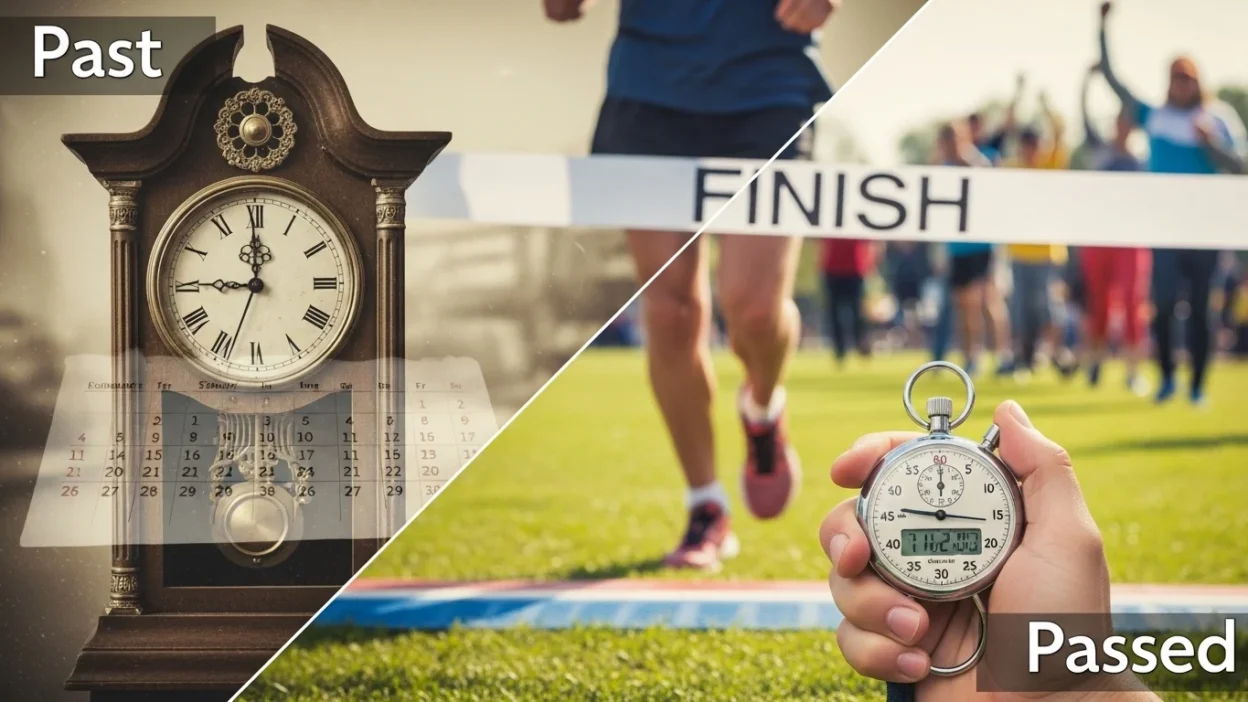
Many learners feel confused about past and passed because the two words sound the same. When you hear them, they are identical in speech. But when you write them, they have different meanings and uses.
This confusion is very common for students, ESL learners, and even native speakers. The good news is that once you understand one simple idea, the difference becomes very easy.
This guide will explain everything in a calm and simple way so you can use both words correctly every time.
Quick Answer (Simple and Fast)
- Past = time before now OR something finished
- Passed = the past form of the verb pass (an action)
👉 Easy trick:
- If you are talking about time, use past
- If you are talking about an action, use passed
Simple Background
Let’s look at where these words come from:
- Past is a word that talks about time. It shows something that already happened.
- Passed comes from the verb pass, which means:
- to move
- to go by
- to complete something
- to succeed in something (like a test)
So:
- Past = time or position
- Passed = action
Clear Explanation of the Difference
1. What is “Past”?
Past is not a verb. It is usually:
- a noun (the past)
- an adjective (past events)
- a preposition (walk past something)
It talks about time before now or something that is already finished.
Examples:
- I am thinking about the past.
- That was a past mistake.
- He walked past the shop.
👉 No action here. Just time or position.
2. What is “Passed”?
Passed is always a verb. It is the past tense of “pass.”
It shows an action already completed.
Examples:
- She passed the exam.
- The car passed me.
- Time passed quickly.
👉 There is always an action happening.
Comparison Table (Easy to Understand)
| Feature | Past | Passed |
| Type | Not a verb | Verb (action word) |
| Meaning | Time before now | Completed action |
| Use | Time, position, description | Movement, success, change |
| Example | In the past | He passed the test |
| Easy clue | Think “time” | Think “action” |
Which One to Use and When
Here is a simple way to choose the correct word:
Use “Past” when:
- You are talking about time
- You mean before now
- You describe something already finished
Examples:
- The past is important to learn from.
- In the past, people wrote letters.
- We walked past the park.
Use “Passed” when:
- There is an action
- Something happened or moved
- Someone completed or succeeded
Examples:
- He passed the ball.
- She passed her driving test.
- The train passed the station.
Common Mistakes People Make
Here are some common errors and how to fix them:
❌ Wrong:
- He past the exam.
✔ Correct: - He passed the exam.
👉 Reason: “passed” is needed because it is an action.
❌ Wrong:
- In the passed, life was slower.
✔ Correct: - In the past, life was slower.
👉 Reason: “past” is about time.
❌ Wrong:
- She walked passed me.
✔ Correct: - She walked past me.
👉 Reason: This shows position, not action.
Quick Reminder
- If you can replace the word with went, moved, or completed, use passed
- If you can replace it with before now, use past
Everyday Real-Life Examples
Let’s see how people use these words in daily life:
In Emails
- We discussed this in the past.
- I passed the message to the team.
In News
- The law was passed last year.
- In the past, this area was quiet.
On Social Media
- The weekend passed so fast!
- I miss the past sometimes.
In Daily Conversations
- He passed by my house.
- Let’s not talk about the past.
Short Learning Section (For Students and Beginners)
Here is a very simple learning method:
Step 1: Ask yourself
Is this about time or action?
Step 2: Choose the word
- Time → Past
- Action → Passed
Step 3: Practice with simple sentences
Try these:
- Yesterday passed quickly.
- In the past, people traveled less.
- She passed me in the race.
- That is all in the past now.
Memory Trick
👉 “Passed has ‘ed’ — like other past tense verbs”
Examples:
- walked
- played
- passed
So if it feels like a verb, use passed
FAQ Section
1. What is the main difference between past and passed?
Past talks about time before now.
Passed is an action (the past tense of “pass”).
2. Can “past” be a verb?
No, past is not a verb. It cannot show an action.
3. Is “passed” always a verb?
Yes, passed is always a verb and shows something that happened.
4. Which is correct: “passed away” or “past away”?
✔ Correct: passed away
It means someone died. It is an action.
5. Which is correct: “in the past” or “in the passed”?
✔ Correct: in the past
It talks about time.
6. How can I remember the difference easily?
Think:
- Past = time
- Passed = action
7. Is “walked past” correct?
Yes.
Example: She walked past me.
Here, “past” shows position, not action.
8. Why do people mix them up?
Because both words sound the same when spoken.
Conclusion
The difference between past and passed becomes simple once you focus on one idea:
- Past = time, no action
- Passed = action, something happened
Whenever you feel confused, just ask:
👉 “Is this about time or action?”
If it’s time, choose past.
If it’s an action, choose passed.
With a little practice, you will stop making mistakes and start using both words naturally and confidently.

Brandon Samuel is a dedicated writer and language enthusiast, serving as the lead author at WordHuts.com. He specializes in explaining word differences, grammar rules, and common language mistakes in simple terms. Brandon’s clear, practical writing style helps readers improve vocabulary, writing confidence, and everyday communication skills.