
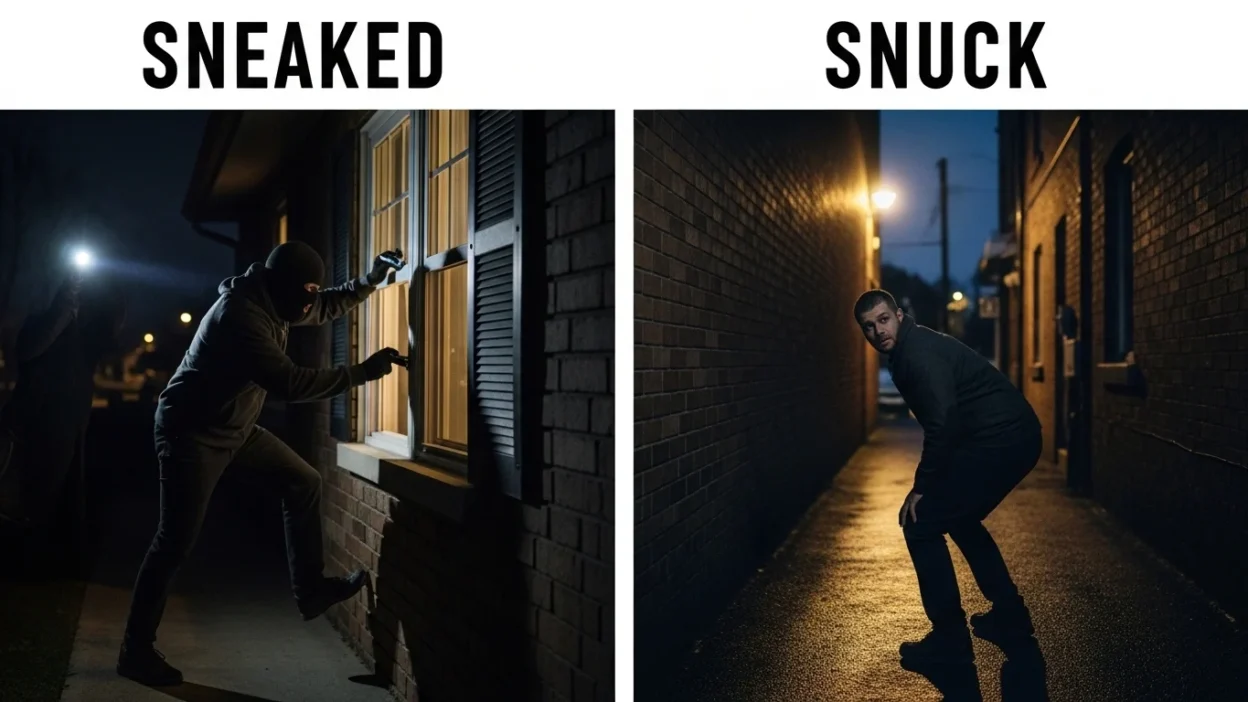
Many learners feel confused about “sneaked” and “snuck.” Both words sound correct, and you may hear both in movies, books, and daily conversations. So which one is right?
The simple answer is: both are correct—but they are used a little differently depending on place, tone, and situation. This article will explain everything in very easy English so you can understand it quickly and use the right word with confidence.
Quick Answer
- Both “sneaked” and “snuck” are past forms of “sneak.”
- “Sneaked” is the older and more traditional form.
- “Snuck” is newer but very common, especially in everyday speech.
- In formal writing, “sneaked” is usually safer.
- In casual speech, “snuck” sounds natural and friendly.
Simple Background
The verb “sneak” means to move quietly or secretly.
Example:
- He wants to sneak out of the house.
In the past, English speakers used “sneaked” as the past tense:
- He sneaked out last night.
Later, people began using “snuck.” It became popular because many English verbs change like this:
- stick → stuck
- strike → struck
- sneak → snuck
Even though “snuck” started as informal, it is now widely accepted in modern English.
Clear Explanation of the Difference
There is no difference in meaning between “sneaked” and “snuck.” Both mean the same thing: moving quietly or secretly in the past.
The difference is mainly about style and usage:
“Sneaked”
- More traditional
- Sounds more formal
- Often used in writing, school work, or exams
“Snuck”
- More modern
- Sounds casual and natural
- Common in speech and everyday writing
So, the choice is not about meaning—it is about tone and context.
Comparison Table
| Feature | Sneaked | Snuck |
| Meaning | Same as “snuck” | Same as “sneaked” |
| Style | Formal / traditional | Informal / modern |
| Usage | Writing, school, formal use | Speech, casual writing |
| Popularity | Older form | Very common today |
| Correct? | Yes | Yes |
Which One Should You Use and When?
Use “sneaked” when:
- Writing essays or exams
- Writing formal emails
- You want to sound more careful or traditional
Example:
- She sneaked into the room quietly.
Use “snuck” when:
- Speaking with friends
- Writing casual messages
- Telling stories or jokes
Example:
- He snuck out to meet his friends.
Easy Tip:
If you are not sure, use “sneaked”—it is always safe.
If you want to sound natural in conversation, “snuck” is fine too.
Common Mistakes People Make
1. Thinking one is wrong
Some people think “snuck” is incorrect. This is not true.
Both are correct in modern English.
2. Mixing tense forms incorrectly
Wrong:
- He has sneak yesterday.
Correct:
- He sneaked yesterday.
- He snuck yesterday.
3. Using both in one sentence
Wrong:
- He sneaked and snuck into the room.
Use only one:
- He sneaked into the room.
- He snuck into the room.
4. Worrying too much
Learners often stress about choosing the “perfect” word.
In this case, both choices are acceptable, so don’t worry too much.
Everyday Real-Life Examples
In Emails
- Someone sneaked into the office after hours.
- Someone snuck into the office last night.
(Both are correct; the first is more formal.)
In News
- The thief sneaked into the building.
- The thief snuck past security.
On Social Media
- I snuck out for ice cream!
- I sneaked out to watch a movie.
In Daily Conversation
- He snuck into the kitchen at midnight.
- She sneaked away without saying goodbye.
In Stories
- The cat sneaked through the window.
- The boy snuck into the haunted house.
Learning Section for Students and Beginners
Here is a simple way to remember:
Step 1: Learn the base verb
- sneak = move quietly
Step 2: Learn both past forms
- sneaked (formal)
- snuck (informal)
Step 3: Practice with simple sentences
- I sneaked out early.
- I snuck out early.
Both sentences are correct.
Step 4: Choose based on situation
- School → sneaked
- Talking → snuck
Practice Exercise
Fill in the blank:
- He ______ into the room quietly.
- She ______ out of the house at night.
Answers:
- sneaked OR snuck (both correct)
FAQ Section
1. Is “snuck” a real word?
Yes, “snuck” is a real and correct word in modern English.
2. Which is more correct: sneaked or snuck?
Both are correct. “Sneaked” is more formal, and “snuck” is more casual.
3. Which one should students use in exams?
It is safer to use “sneaked” in exams and formal writing.
4. Do native speakers use “snuck”?
Yes, many native speakers use “snuck” in daily conversation.
5. Is there any difference in meaning?
No, there is no difference in meaning. Both mean the same thing.
6. Can I use “snuck” in writing?
Yes, but it is better for informal writing. For formal writing, use “sneaked.”
7. Why does “snuck” sound more natural?
Because many English verbs change like this (stick → stuck), so “snuck” feels natural to many speakers.
8. Will people understand both words?
Yes, everyone will understand both “sneaked” and “snuck.”
Conclusion
The confusion between “sneaked” and “snuck” is very common, but the good news is simple: both are correct and mean the same thing.
The only real difference is style:
- Use “sneaked” for formal situations
- Use “snuck” for casual speech
If you remember this one idea, you will never feel confused again. Keep practicing with simple sentences, and soon both words will feel natural to you.

Brandon Samuel is a dedicated writer and language enthusiast, serving as the lead author at WordHuts.com. He specializes in explaining word differences, grammar rules, and common language mistakes in simple terms. Brandon’s clear, practical writing style helps readers improve vocabulary, writing confidence, and everyday communication skills.