
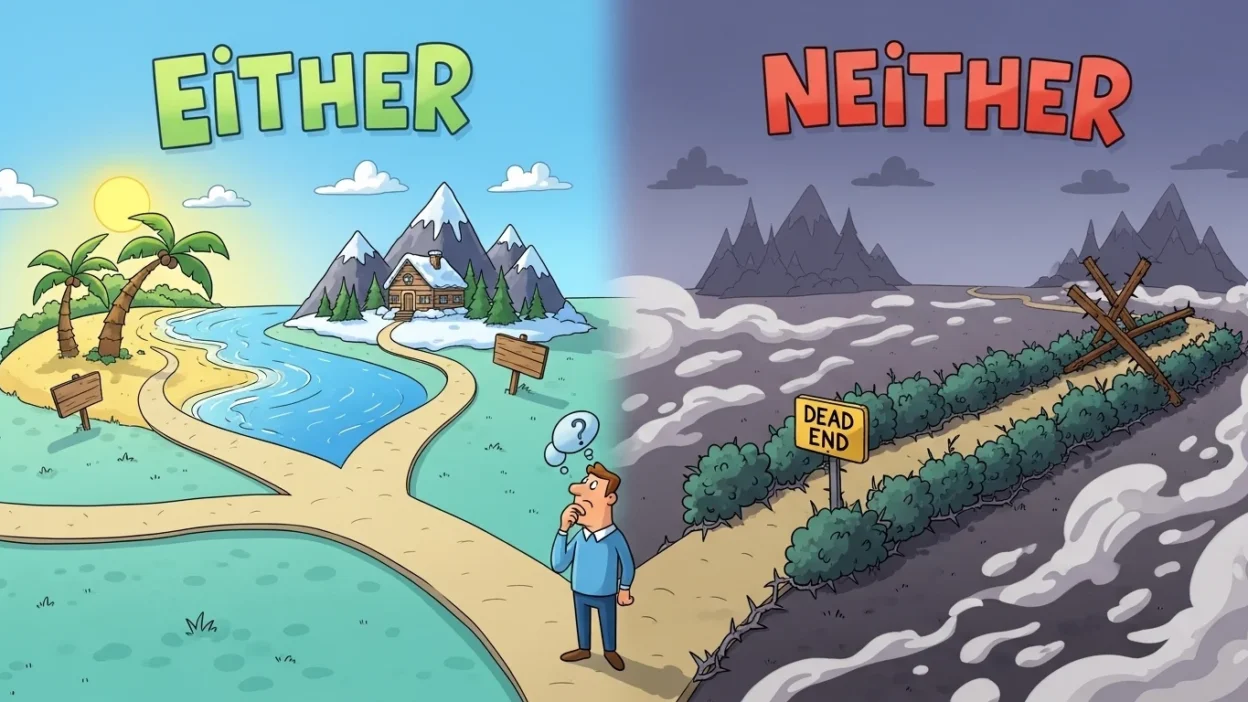
Many English learners feel confused when they see the words either and neither. These two words look similar, sound similar, and are often used in the same types of sentences. Because of this, people sometimes mix them up.
For example, someone may say:
- “Either of them are correct.”
- “Me either.”
- “Neither of the answers are right.”
Some of these sentences are correct, and some are not. The confusion usually happens because either and neither both talk about two choices, but they do different jobs.
The good news is that the difference is actually simple. Once you understand the basic idea, using these words becomes much easier.
This guide explains everything in clear and simple English, with examples you will see in everyday life.
Quick Answer
Here is the short and simple difference:
Either
- Means one or the other
- Used when both choices are possible
- Often shows a choice between two things
Neither
- Means not one and not the other
- Used when both choices are not true
- Shows a negative idea
Quick examples
- Either option is fine.
(One of them is okay.) - Neither option is good.
(Both are bad.)
A simple way to remember:
- Either = one
- Neither = none
Simple Background of the Words
Understanding where the words come from can also help.
Long ago in English:
- Either came from words that meant “one of two.”
- Neither came from words that meant “not either.”
So the meaning stayed almost the same over time.
That is why:
- Either talks about two possible choices
- Neither means both choices are not true
These meanings are still used in modern English today.
The Clear Difference Between Either and Neither
The biggest difference is positive vs negative meaning.
Either = one of two choices
We use either when both options are possible, but we choose one.
Example:
- You can sit either here or there.
Both places are possible.
Another example:
- Either answer is acceptable.
One of the answers is correct.
Neither = not one and not the other
We use neither when both options are not true.
Example:
- Neither answer is correct.
Both answers are wrong.
Another example:
- Neither restaurant is open.
Both restaurants are closed.
Easy Comparison Table
| Feature | Either | Neither |
| Basic meaning | one or the other | not one and not the other |
| Type of idea | positive choice | negative idea |
| Number of choices | two | two |
| Example sentence | Either road will take you home | Neither road is safe |
| Simple meaning | one option works | no option works |
Which One to Use and When
Let’s look at the most common situations where people use these words.
1. Talking About Two Choices
Use either when one choice is possible.
Example:
- You can choose either coffee or tea.
- We can meet either Monday or Tuesday.
- You can call either number.
Use neither when both choices are not possible.
Example:
- Neither coffee nor tea is available.
- Neither Monday nor Tuesday works for me.
- Neither number is correct.
2. In Short Responses
These are very common in conversation.
Either
Used after a negative sentence.
Example:
Person A:
“I don’t like spicy food.”
Person B:
“Me either.”
Meaning: I also do not like it.
Neither
Used to agree with a negative statement.
Example:
Person A:
“I didn’t watch the movie.”
Person B:
“Neither did I.”
Meaning: I also did not watch it.
3. With “or” and “nor”
These pairs often appear together.
Either + or
Example:
- You can either call or text me.
- We will travel either by bus or by train.
Neither + nor
Example:
- Neither John nor Anna is here.
- Neither the phone nor the laptop is working.
Common Mistakes People Make
Learning about common mistakes can help you avoid them.
Mistake 1: Using Either Instead of Neither
Wrong:
- Either answer is wrong.
Correct:
- Neither answer is correct.
Why? Because both answers are wrong.
Mistake 2: Using Double Negatives
Wrong:
- I don’t want neither option.
Correct:
- I want neither option.
or
- I don’t want either option.
English usually avoids double negatives.
Mistake 3: Saying “Me Neither” in Formal Writing
In casual conversation:
- “Me neither” is common.
But in formal writing:
- Neither do I is better.
Example:
Casual:
“Me neither.”
Formal:
“Neither do I.”
Mistake 4: Using Plural Verbs Incorrectly
Sometimes people write:
- Neither of the answers are correct.
Many teachers prefer:
- Neither of the answers is correct.
Because neither usually acts like a singular subject.
Everyday Real-Life Examples
Here are examples you might see in daily life.
In Emails
- You can contact me at either email address.
- Neither time works for my schedule.
- You can send the file either today or tomorrow.
In News
- Neither candidate won the debate clearly.
- The storm damaged neither city seriously.
On Social Media
- I like either photo!
- Neither movie was good.
- I didn’t understand the ending.
Me either.
In Daily Conversation
Friend 1:
“Do you want pizza or burgers?”
Friend 2:
“Either one is fine.”
Parent:
“Do you want milk or juice?”
Child:
“Neither. I want water.”
Coworker:
“I didn’t finish the report.”
Response:
“Neither did I.”
Learning Section for Students and Beginners
If you are learning English, here is a simple method to remember the difference.
Step 1: Think about two choices
Both words usually talk about two things.
Example:
- tea
- coffee
Step 2: Ask yourself a question
Is one option possible?
If yes → use either
Example:
- You can drink either tea or coffee.
Step 3: Ask another question
Are both options not possible?
If yes → use neither
Example:
- Neither tea nor coffee is available.
Memory Trick
Remember this simple idea:
Either = one
Neither = none
This small trick helps many students.
Frequently Asked Questions (FAQ)
1. What is the main difference between either and neither?
Either means one of two choices.
Neither means not one and not the other.
2. Can either be used with “or”?
Yes. This is very common.
Example:
- You can either stay here or leave now.
3. Can neither be used with “nor”?
Yes.
Example:
- Neither the teacher nor the students understood the problem.
4. Is “me either” correct?
It is common in informal conversation.
But in formal English, people prefer:
- Neither do I.
5. Does neither always mean two things?
Usually yes. It normally refers to two choices or two people.
Example:
- Neither answer is correct.
6. Can either mean both?
No. Either does not mean both.
It means one or the other.
Example:
- Either road will take you there.
(One road is enough.)
7. Is neither positive or negative?
Neither is negative because it means not one and not the other.
Example:
- Neither plan worked.
8. Can either start a sentence?
Yes.
Examples:
- Either option is acceptable.
- Either student can answer the question.
Conclusion
The difference between either and neither is simple once you understand the basic idea.
- Either means one of two choices is possible.
- Neither means both choices are not true.
Think of it like this:
- Either = one works
- Neither = none works
These words appear often in daily English, from conversations and emails to news and social media. By remembering the simple rules and practicing with real examples, students and beginners can use them correctly and confidently.

Gregory Alexander is a skilled writer and language researcher at WordHuts.com. He focuses on clarifying confusing word pairs, grammar rules, and common usage mistakes. With a passion for precise communication, Gregory creates simple, easy-to-understand content that helps readers strengthen vocabulary, writing accuracy, and everyday English skills.