Many English learners feel confused when they see “leaped” and “leapt.” Both words look different, but they seem to mean the same thing. This makes people wonder:
- Which one is correct?
- Is one better than the other?
- Do they change the meaning?
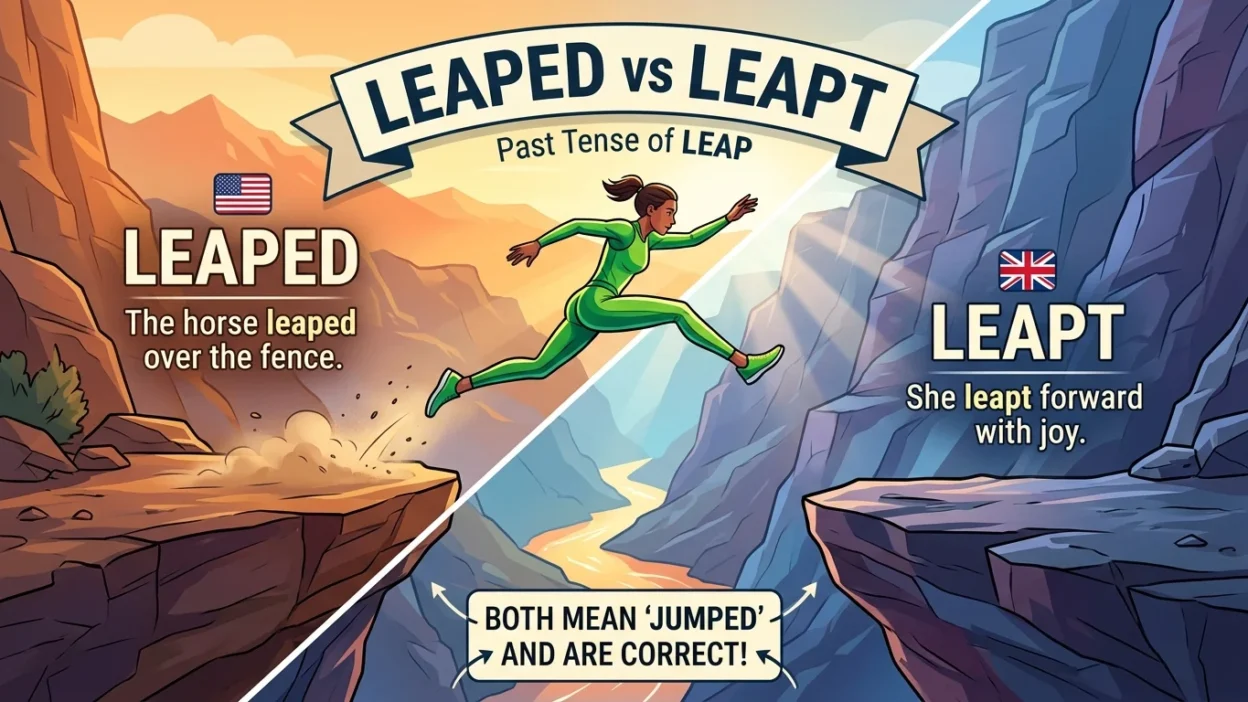
The good news is simple: both words are correct. The confusion comes from different styles of English, not from meaning.
This guide will explain everything in very easy English so you can understand it clearly the first time.
Quick Answer
- Leaped and leapt are both past forms of the verb “leap.”
- They both mean: jumped or moved quickly into the air.
- There is no difference in meaning.
- The only difference is style and usage:
- Leaped → more common in American English
- Leapt → more common in British English
- You can use either one, but it’s best to stay consistent.
Simple Background: Where These Words Come From
The verb “leap” is an old English word. Over time, English developed two past forms:
- Leaped (regular form: verb + “-ed”)
- Leapt (irregular form: similar to “kept” or “slept”)
English often keeps both forms. For example:
- Dreamed / Dreamt
- Learned / Learnt
- Burned / Burnt
So, leaped vs leapt is part of this pattern. Both forms stayed in use, especially in different parts of the world.
Clear Explanation of the Difference
Let’s make it very simple:
Meaning
There is no difference in meaning.
- Leaped = leapt = jumped
Example:
- The cat leaped onto the table.
- The cat leapt onto the table.
Both sentences mean the same thing.
Style and Region
This is where the real difference is:
- Leaped
- More common in American English
- Sounds more modern and regular
- Leapt
- More common in British English
- Sounds a little more traditional
Tone (Very Small Difference)
Sometimes, people feel a tiny difference in tone:
- Leapt may sound:
- Slightly more dramatic
- More formal or literary
- Leaped may sound:
- More natural in everyday speech
- Simpler and more direct
But this is not a strict rule. Both are widely accepted.
Comparison Table
| Feature | Leaped | Leapt |
| Meaning | Jumped | Jumped |
| Verb Type | Regular (adds -ed) | Irregular form |
| Usage Region | More common in American English | More common in British English |
| Tone | Simple, modern | Slightly formal or classic |
| Correctness | 100% correct | 100% correct |
| Example | He leaped over the fence | He leapt over the fence |
Which One Should You Use?
Use “leaped” if:
- You are learning American English
- You want a simple and safe choice
- You are writing emails, school work, or daily messages
Example:
- She leaped out of the car quickly.
Use “leapt” if:
- You are learning British English
- You like a slightly classic or storytelling style
- You are writing stories or creative work
Example:
- The hero leapt across the river.
Best Tip
👉 Choose one style and stay consistent.
Don’t mix both in the same piece of writing.
Common Mistakes People Make
Here are some mistakes to avoid:
1. Thinking One Is Wrong
❌ Incorrect idea:
- “Leapt is wrong.”
✅ Truth:
- Both are correct.
2. Mixing Both Forms in One Text
❌ Example:
- He leaped over the wall and then leapt again.
✅ Better:
- He leaped over the wall and then leaped again.
OR - He leapt over the wall and then leapt again.
3. Using the Wrong Tense
❌ Example:
- He leap over the fence yesterday.
✅ Correct:
- He leaped over the fence yesterday.
- He leapt over the fence yesterday.
4. Confusing with Present Form
Remember:
- Present: leap
- Past: leaped / leapt
Everyday Real-Life Examples
Let’s see how people use these words in daily life.
In Emails
- I leaped at the chance to join your team.
- She leapt into action when she heard the news.
In News
- The player leaped high to catch the ball.
- The tiger leapt across the river.
On Social Media
- I literally leaped out of bed when I heard that song!
- My heart leapt with joy when I saw the message.
In Daily Conversation
- The dog leaped onto me when I came home.
- He leapt over the puddle to stay dry.
In Stories
- The knight leapt onto his horse and rode away.
- The child leaped with excitement.
Learning Section for Students and Beginners
Here’s a very easy way to remember:
Step 1: Learn the Base Verb
- Leap = to jump
Step 2: Learn Both Past Forms
- Leaped (easy, regular)
- Leapt (short, classic)
Step 3: Practice Simple Sentences
- I leaped over the rock.
- I leapt over the rock.
Say both out loud. Notice they feel the same.
Step 4: Pick One Style
If you are unsure, choose:
👉 Leaped (it is easier and more common for learners)
Quick Memory Trick
- Leaped → longer word → easier rule (-ed)
- Leapt → shorter word → special form
FAQ (Frequently Asked Questions)
1. Are “leaped” and “leapt” the same?
Yes. They have the same meaning. Both mean “jumped.”
2. Which one is more correct?
Both are 100% correct. There is no wrong choice.
3. Which one is more common?
- Leaped → more common in American English
- Leapt → more common in British English
4. Can I use them in the same sentence?
No. It’s better to choose one and stay consistent.
5. Is “leapt” old-fashioned?
Not really. It is still used today, but it may sound a bit more formal or literary.
6. Which one should students use?
Students can safely use “leaped.” It is easier and more widely used.
7. What is the past participle?
Both forms work:
- He has leaped over the wall.
- He has leapt over the wall.
8. Do native speakers use both?
Yes. Native speakers use both, depending on region and style.
Conclusion
The difference between leaped and leapt is actually very simple:
- They mean the same thing
- They are both correct past forms of “leap”
- The only real difference is style and region
If you want a simple rule:
👉 Use “leaped” for everyday writing
👉 Use “leapt” for a slightly classic or British style
Don’t worry too much about choosing the “perfect” one. What matters most is that your sentence is clear and easy to understand.
With practice, both words will feel natural to you.

Gregory Alexander is a skilled writer and language researcher at WordHuts.com. He focuses on clarifying confusing word pairs, grammar rules, and common usage mistakes. With a passion for precise communication, Gregory creates simple, easy-to-understand content that helps readers strengthen vocabulary, writing accuracy, and everyday English skills.