
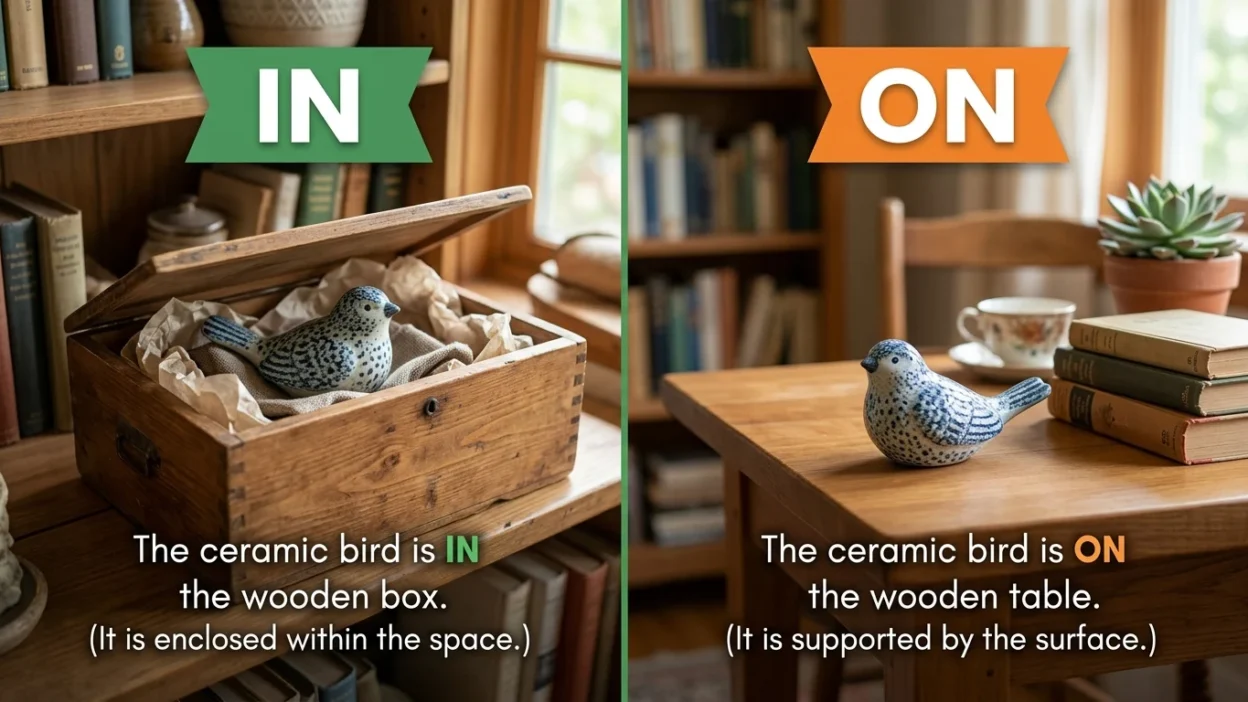
Many English learners get confused about in and on because both words are very common and often talk about place, time, or position.
For example:
- I am in the room.
- The book is on the table.
Both sentences are correct, but why do we use in in one sentence and on in the other?
The confusion happens because these small words can have many uses. The good news is that the difference is usually simple once you understand the basic idea.
This guide explains in vs on in clear and easy English with examples from everyday life.
Quick Answer
Use in when something is:
- Inside a space, area, or container
- Part of a larger area
- Talking about months, years, or long periods of time
Examples:
- The keys are in my bag.
- She lives in Canada.
- We met in 2025.
Use on when something is:
- Touching a surface
- Positioned above and supported by something
- Talking about specific days and dates
Examples:
- The phone is on the desk.
- The picture is on the wall.
- We will meet on Monday.
A Simple Background Explanation
Both in and on are prepositions. A preposition is a small word that shows the relationship between people, things, places, or time.
Over many years, English speakers began using:
- In for things that are inside something
- On for things that rest on a surface
These basic ideas are still the easiest way to remember the difference today.
Think of it like this:
- In = inside
- On = touching a surface
This simple rule helps in most situations.
The Main Difference Between In and On
The easiest way to understand the difference is to focus on position.
In = Inside Something
Use in when something is surrounded by a space, area, or container.
Examples:
- The milk is in the fridge.
- The toys are in the box.
- She is in the classroom.
- We live in a city.
In these examples, the object or person is inside something.
On = On a Surface
Use on when something touches the top of a surface.
Examples:
- The cup is on the table.
- The laptop is on the desk.
- The cat is on the sofa.
- There is dust on the shelf.
In these examples, the object is resting on a surface.
Comparison Table
| Situation | In | On |
| Inside a container | ✓ | ✗ |
| Touching a surface | ✗ | ✓ |
| Months and years | ✓ | ✗ |
| Days and dates | ✗ | ✓ |
| Inside a room | ✓ | ✗ |
| On a table | ✗ | ✓ |
| Inside a country | ✓ | ✗ |
| On a wall | ✗ | ✓ |
Examples
| In | On |
| In the box | On the box |
| In the room | On the floor |
| In July | On Monday |
| In 2026 | On June 15 |
| In Pakistan | On the map |
Which One to Use and When
Using In for Place
Use in when talking about something inside an area.
Examples:
- She is in the kitchen.
- The money is in my wallet.
- They live in Australia.
- The students are in class.
Think: inside.
Using On for Place
Use on when something is on a surface.
Examples:
- The keys are on the table.
- There is a stain on my shirt.
- The clock is on the wall.
- The notebook is on the chair.
Think: touching a surface.
Using In for Time
Use in for longer periods.
Examples:
- In January
- In summer
- In 2026
- In the morning
Sentences:
- School starts in September.
- I was born in 2008.
- We travel more in summer.
Using On for Time
Use on for specific days and dates.
Examples:
- On Monday
- On Friday
- On my birthday
- On July 10
Sentences:
- The meeting is on Tuesday.
- We arrived on June 5.
- The exam is on Friday.
Using In for Transportation
Use in when talking about being inside a car or taxi.
Examples:
- She is in the car.
- We sat in a taxi.
Using On for Transportation
Use on with public transportation.
Examples:
- On the bus
- On the train
- On the plane
- On the ship
Sentences:
- I met him on the train.
- She slept on the plane.
Common Mistakes People Make
Mistake 1
❌ The keys are in the table.
✅ The keys are on the table.
Reason: A table is a surface.
Mistake 2
❌ I will see you in Monday.
✅ I will see you on Monday.
Reason: Monday is a specific day.
Mistake 3
❌ My phone is on my bag.
✅ My phone is in my bag.
Reason: The phone is inside the bag.
Mistake 4
❌ I was born on 2010.
✅ I was born in 2010.
Reason: Years use in.
Mistake 5
❌ She is in the wall.
✅ She is on the wall.
Reason: Pictures, posters, and decorations are usually attached to a surface.
Everyday Real-Life Examples
In Emails
- I have attached the file in this email.
- The details are in the document.
On Social Media
- I saw the news on social media.
- She posted a photo on Instagram.
In Daily Conversations
- My wallet is in my pocket.
- Your glasses are on the table.
- We live in a small town.
- The menu is on the screen.
In News Reports
- Heavy rain is expected in the region.
- The story appeared on television.
- The event happened on Sunday.
At School
- The answers are in the book.
- Write your name on the paper.
- The students are in the classroom.
- The homework is on page 15.
Learning Tips for Students and Beginners
Here are some easy ways to remember the difference.
Remember This Rule
In = inside
Examples:
- In a room
- In a box
- In a country
On = surface
Examples:
- On a desk
- On a wall
- On a shelf
Use the Question Method
Ask yourself:
Is it inside something?
If yes, use in.
Example:
- The pencil is inside the bag.
- The pencil is in the bag.
Is it touching a surface?
If yes, use on.
Example:
- The pencil is touching the desk.
- The pencil is on the desk.
Practice with Simple Sentences
- The apple is ___ the bowl.
- The book is ___ the table.
- We met ___ 2026.
- The meeting is ___ Monday.
Answers:
- In
- On
- In
- On
Frequently Asked Questions (FAQ)
1. What is the basic difference between in and on?
In means inside something. On means touching a surface.
2. Do I use in or on with years?
Use in.
Example:
- I graduated in 2026.
3. Do I use in or on with days?
Use on.
Example:
- The class starts on Wednesday.
4. Is it in the car or on the car?
Usually, it is in the car because you are inside it.
Example:
- She is waiting in the car.
5. Is it in the picture or on the picture?
Usually:
- In the picture = inside the image.
- On the picture = on the surface of the photo.
Examples:
- There are three people in the picture.
- Someone wrote a note on the picture.
6. Why do we say on the bus but in the car?
English traditionally uses on for larger public transportation and in for smaller personal vehicles.
Examples:
- On the bus
- On the train
- In the car
- In the taxi
7. Is it in the morning or on the morning?
Usually say in the morning.
Example:
- I exercise in the morning.
8. Can in and on ever both be correct?
Sometimes, yes, but the meaning changes.
Example:
- The toy is in the box. (inside)
- The toy is on the box. (on top)
Conclusion
The difference between in and on becomes much easier when you remember one simple idea:
- In means inside something.
- On means touching a surface.
For time expressions:
- Use in with months, years, seasons, and longer periods.
- Use on with specific days and dates.
Examples:
- In the room
- In 2026
- On the table
- On Monday
With regular practice, choosing between in and on will start to feel natural, and you will make fewer mistakes in speaking and writing English.

Justin Larry is a talented language writer and content creator at WordHuts.com. She specializes in explaining word differences, grammar tips, and common English mistakes in a clear, practical style. Her engaging content helps readers improve vocabulary, writing skills, and everyday communication, making language learning simple and effective.