
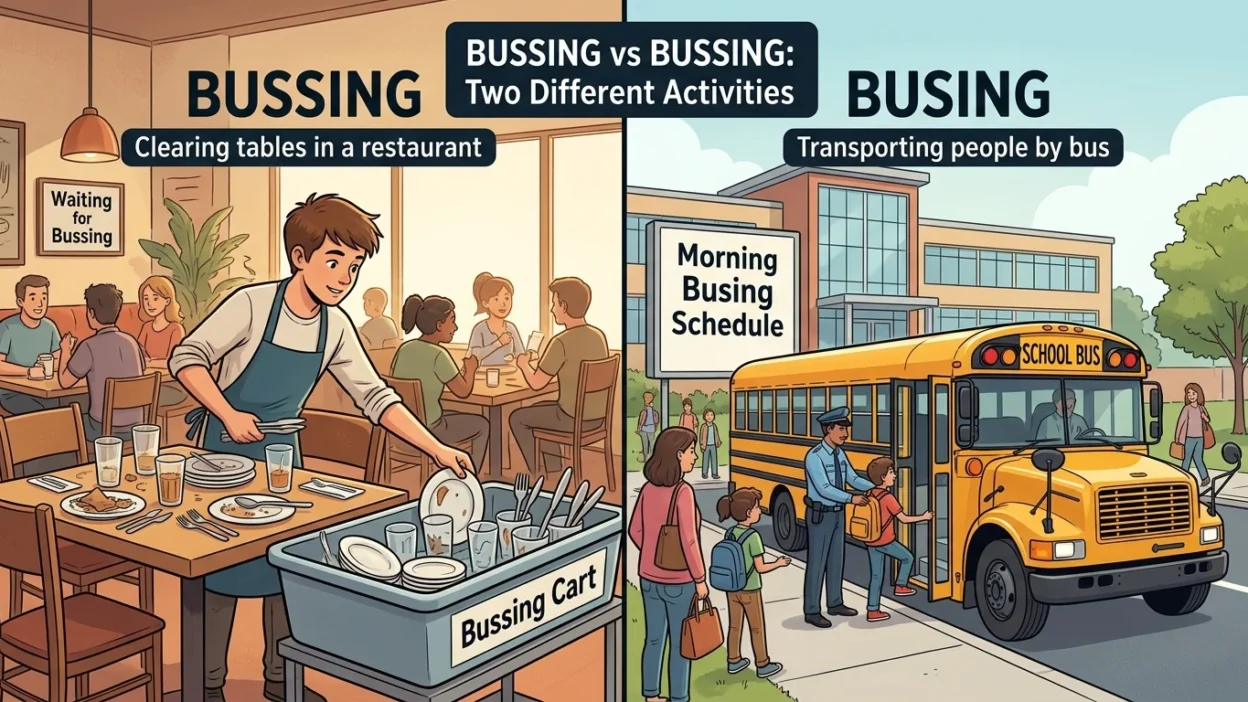
Many English learners and native speakers get confused by bussing and busing because both spellings appear in books, newspapers, schools, workplaces, and online writing.
At first glance, they look almost the same. The only difference is one extra s. However, people often wonder whether one spelling is correct and the other is wrong.
The good news is that both words can be correct. The right choice depends on the meaning and the style of English being used.
In this guide, you will learn the difference between bussing and busing in very simple English, along with examples, common mistakes, and helpful tips for remembering which spelling to use.
Quick Answer
- Busing is the more common spelling today.
- Busing usually means transporting people by bus.
- Bussing is often used when talking about clearing tables in restaurants.
- Some writers also use bussing for transportation, but this is less common.
- Modern dictionaries generally accept both spellings, but usage depends on context.
Quick Examples
✅ The school is busing students to the event.
✅ The restaurant worker is bussing tables.
✅ The city is busing passengers during the rail shutdown.
Simple Origin and Background
The word bus began as a noun. It refers to a large vehicle that carries passengers.
Later, English speakers turned bus into a verb.
For example:
- We can bus students to school.
- The city can bus people to another location.
When verbs ending in certain letters receive -ing, spelling questions often appear.
This is where busing and bussing developed.
Over time:
- Many writers preferred busing for transportation.
- Restaurant workers often used bussing when talking about clearing tables.
Today, both spellings can be found, but many style guides prefer busing for transportation because it is easier to distinguish from restaurant-related usage.
Clear Explanation of the Difference
What Does “Busing” Mean?
Busing usually refers to transporting people by bus.
It is commonly used in:
- Schools
- Public transportation
- Government programs
- News reports
- Travel discussions
Examples:
- The district is busing students from nearby towns.
- The company is busing employees to the office.
- Emergency crews are busing residents to safer areas.
In modern writing, this is the spelling most readers expect when transportation is being discussed.
What Does “Bussing” Mean?
Bussing is very common in restaurants.
It refers to:
- Removing dirty dishes
- Clearing tables
- Cleaning dining areas after customers leave
Examples:
- She spent the evening bussing tables.
- The restaurant hired two workers for bussing duties.
- He was bussing tables during the lunch rush.
Because restaurant workers frequently use this spelling, many readers immediately connect bussing with restaurant work.
Can “Bussing” Also Mean Transporting by Bus?
Yes.
Some dictionaries accept bussing as another spelling of the transportation verb.
Example:
- The school is bussing students across town.
However, many writers avoid this spelling because it may cause confusion with restaurant work.
For clarity, busing is usually preferred when transportation is the meaning.
Comparison Table
| Feature | Bussing | Busing |
| Common meaning | Clearing restaurant tables | Transporting people by bus |
| Used in restaurants | Very common | Rare |
| Used in transportation | Sometimes | Very common |
| Common in news writing | Less common | More common |
| Easy for readers to understand | Depends on context | Usually yes |
| Preferred for school transportation | Usually no | Yes |
Which One Should You Use and When?
Use “Busing” When Talking About Transportation
Examples:
- The school is busing students.
- The city is busing passengers.
- The company is busing workers to the factory.
This spelling is the safest choice when discussing buses and transportation.
Use “Bussing” When Talking About Restaurant Work
Examples:
- She is bussing tables.
- He worked as a bussing assistant.
- The employee spent the evening bussing tables after customers left.
This spelling clearly shows that the topic is restaurant work.
If You Are Unsure
A simple rule is:
- Transportation → busing
- Restaurant tables → bussing
This rule works in most situations.
Common Mistakes People Make
Mistake 1: Using “Bussing” in Every Situation
❌ The district is bussing students to school.
While not always wrong, many readers expect:
✅ The district is busing students to school.
Mistake 2: Using “Busing” for Restaurant Tables
❌ She spent the evening busing tables.
Many readers may understand it, but:
✅ She spent the evening bussing tables.
is usually clearer.
Mistake 3: Thinking One Spelling Is Completely Wrong
Some people believe only one spelling is correct.
That is not true.
Both spellings exist in English. The important thing is choosing the one that fits the meaning.
Mistake 4: Mixing Spellings in the Same Piece of Writing
Choose one style and stay consistent.
Example:
❌ The school is busing students while the report later says bussing students.
✅ The school is busing students throughout the report.
Consistency helps readers.
Everyday Real-Life Examples
In Emails
Transportation
- We will be busing employees from the hotel to the conference center.
Restaurant Work
- John will be bussing tables during the evening shift.
In News Writing
- The city is busing passengers during service disruptions.
- The district is busing students to neighboring schools.
On Social Media
- Our school is busing everyone to the tournament tomorrow.
- First day at the restaurant and I’m already bussing tables!
At Work
- The company is busing workers from nearby towns.
- She started her career by bussing tables in a local restaurant.
In Daily Conversation
- Are they busing students to the museum?
- Who is bussing tables tonight?
Short Learning Section for Students and Beginners
Here is a simple memory trick.
Think About the Meaning
Ask yourself:
Are people riding a bus?
If yes:
➡ Use busing
Example:
- The school is busing students.
Are restaurant tables being cleaned?
If yes:
➡ Use bussing
Example:
- He is bussing tables.
Easy Memory Tip
The extra s in bussing can remind you of:
Serving tables
Both words contain an extra s sound.
- Serving tables → bussing
- Transportation → busing
This is not a grammar rule, but many learners find it helpful.
Frequently Asked Questions
1. Is bussing a real word?
Yes. It is a real English word and is commonly used in restaurants to describe clearing tables.
2. Is busing a real word?
Yes. It is the standard spelling used for transporting people by bus.
3. Which spelling is more common today?
Busing is generally more common in transportation-related writing.
4. Can bussing mean transporting people by bus?
Yes. Some dictionaries accept this usage, but many writers prefer busing to avoid confusion.
5. Which spelling should students use in school assignments?
For transportation, use busing. It is usually the clearest and most widely accepted choice.
6. Why do restaurants use “bussing”?
Restaurant workers often use bussing to describe clearing dishes and cleaning tables after customers leave.
7. Is “bussing tables” correct?
Yes. This is a very common expression in restaurant work.
Example:
- She spent the summer bussing tables.
8. Are both spellings accepted in English?
Yes. Both spellings are accepted, but they are often used for different purposes to make meanings clearer.
Conclusion
The difference between bussing and busing is mostly about meaning and clarity.
- Busing usually means transporting people by bus.
- Bussing usually means clearing tables in a restaurant.
- Both spellings are accepted in English.
- Modern writers often choose busing for transportation because readers immediately understand the meaning.
- Bussing remains the common choice in restaurant settings.
If you remember one simple rule, make it this:
People riding a bus = busing
Restaurant tables being cleared = bussing
Following this guideline will help you use both words correctly and confidently in everyday English.

Gregory Alexander is a skilled writer and language researcher at WordHuts.com. He focuses on clarifying confusing word pairs, grammar rules, and common usage mistakes. With a passion for precise communication, Gregory creates simple, easy-to-understand content that helps readers strengthen vocabulary, writing accuracy, and everyday English skills.