Many people get confused between foregoing and forgoing because the words look almost the same. They sound similar, and both are used in formal writing, school work, emails, and news articles.
But these two words have very different meanings.
One word talks about something mentioned earlier. The other means giving something up or choosing not to have it.
Even native English speakers mix them up sometimes. The good news is that the difference is actually simple once you see clear examples.
This guide explains everything in very easy English so students, ESL learners, and beginners can understand it quickly and confidently.
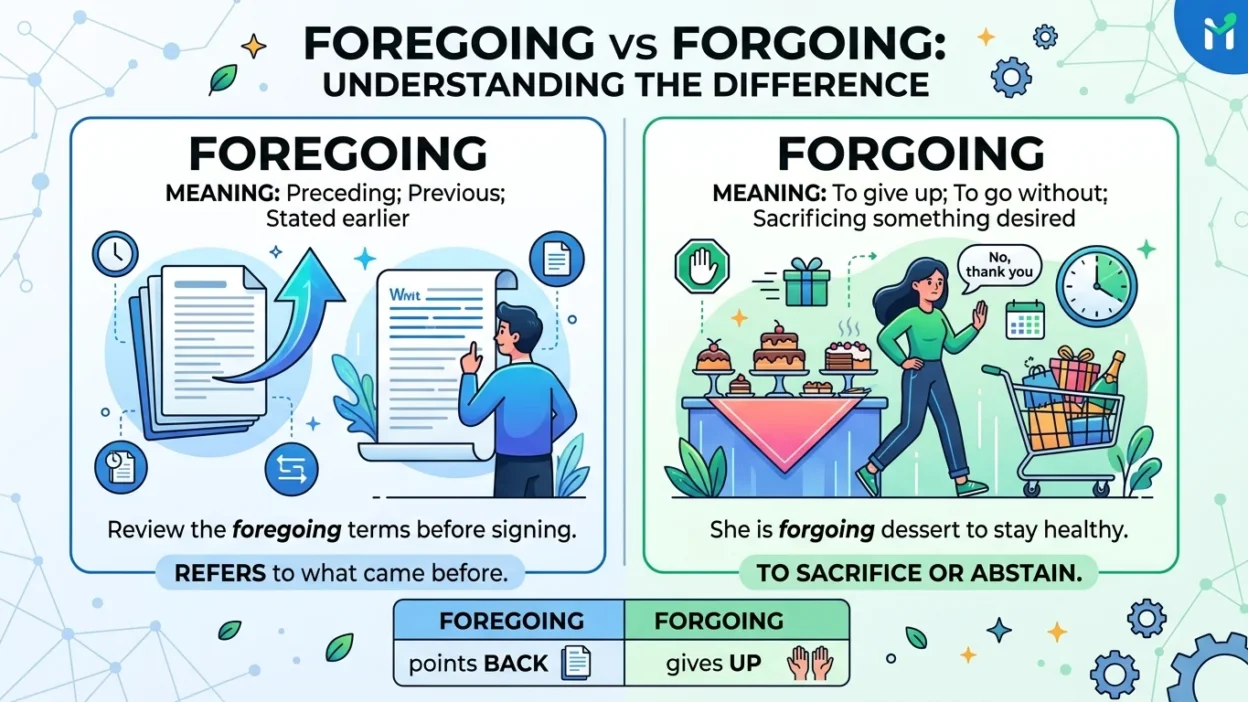
Quick Answer
Foregoing
- Means mentioned earlier
- Refers to something that came before
- Often used in formal writing
Example:
- Please read the foregoing paragraph.
Forgoing
- Means giving up something
- Choosing not to have or do something
Example:
- She is forgoing dessert to eat healthier.
Simple Origin and Background
Understanding where the words come from can make them easier to remember.
Foregoing
The word foregoing comes from:
- fore = before
- going = coming or appearing
So, foregoing means:
- something that came before
- something already mentioned
It is connected to the idea of “earlier.”
Forgoing
The word forgoing comes from the verb forgo.
Forgo means:
- to give up
- to do without
- to choose not to take something
So, forgoing means:
- giving something up
- not taking something you could have had
The Main Difference
The difference is easier than it looks.
Foregoing = Earlier
Use foregoing when talking about:
- something already written
- something already said
- something mentioned before
Think:
“the earlier thing”
Example:
- The foregoing information explains the problem.
This means:
- the information mentioned earlier explains the problem.
Forgoing = Giving Up
Use forgoing when talking about:
- sacrifice
- choosing not to do something
- giving something up
Think:
“going without”
Example:
- He is forgoing coffee this month.
This means:
- he is choosing not to drink coffee.
Easy Comparison Table
| Word | Meaning | Used For | Simple Memory Trick | Example |
| Foregoing | Mentioned earlier | Previous information | “Fore” = before | The foregoing chapter explains this. |
| Forgoing | Giving something up | Sacrifice or choice | “Forgo” = go without | She is forgoing sugar. |
Which One Should You Use?
Use “Foregoing” When Talking About Earlier Information
Choose foregoing if you mean:
- previous
- earlier
- already mentioned
Common situations:
- essays
- reports
- business writing
- legal documents
Examples:
- The foregoing statement is important.
- The foregoing examples show the difference.
- Please review the foregoing notes.
Use “Forgoing” When Talking About Sacrifice or Choice
Choose forgoing if someone:
- gives something up
- refuses something
- decides not to have something
Common situations:
- health goals
- money decisions
- personal choices
Examples:
- They are forgoing vacations to save money.
- He is forgoing snacks after dinner.
- Many students are forgoing part-time jobs during exams.
Common Mistakes People Make
Mistake 1: Using “Foregoing” Instead of “Forgoing”
❌ She is foregoing sweets this week.
This is wrong because sweets are being given up.
✅ She is forgoing sweets this week.
Mistake 2: Using “Forgoing” for Earlier Information
❌ The forgoing paragraph explains the answer.
This is wrong because the paragraph was mentioned earlier.
✅ The foregoing paragraph explains the answer.
Mistake 3: Thinking Both Words Mean the Same Thing
They do not mean the same thing at all.
- Foregoing = earlier
- Forgoing = giving up
Mistake 4: Forgetting the “e”
Many learners accidentally remove the “e” from foregoing.
Remember:
- foregoing has fore
- “fore” helps remind you of “before”
Everyday Real-Life Examples
Seeing the words in real situations helps a lot.
In Emails
Foregoing
- Please review the foregoing comments before the meeting.
Forgoing
- I am forgoing lunch today because I have too much work.
In School Writing
Foregoing
- The foregoing section explained the causes of pollution.
Forgoing
- Some students are forgoing social media during exams.
In News Articles
Foregoing
- The foregoing report included important economic data.
Forgoing
- Many people are forgoing travel due to high prices.
On Social Media
Foregoing
- As mentioned in the foregoing post, the event starts at 7.
Forgoing
- I’m forgoing coffee for 30 days.
In Daily Conversation
Foregoing
This word is less common in casual speaking.
People usually say:
- “earlier”
- “previous”
- “before”
Instead of:
- the foregoing message
Forgoing
This word appears more often in everyday life.
Examples:
- She’s forgoing dessert.
- He’s forgoing video games this week.
- We are forgoing unnecessary spending.
Simple Memory Tricks
Trick for “Foregoing”
Think:
FORE = BEFORE
So:
- foregoing = mentioned before
Easy sentence:
- The foregoing paragraph came before this one.
Trick for “Forgoing”
Think:
Forgo = Go without
So:
- forgoing = giving something up
Easy sentence:
- She is forgoing soda this month.
Short Learning Section for Students and Beginners
Step 1: Ask Yourself a Question
Is the sentence talking about something earlier?
Use:
✅ foregoing
Is the sentence talking about giving something up?
Use:
✅ forgoing
Step 2: Replace the Word
Try replacing the word.
If “earlier” works:
Use foregoing
Example:
- The foregoing chapter
- → The earlier chapter
- Correct!
If “giving up” works:
Use forgoing
Example:
- Forgoing fast food
- → Giving up fast food
- Correct!
Step 3: Practice Small Sentences
Foregoing
- The foregoing explanation was clear.
- The foregoing points are important.
Forgoing
- He is forgoing snacks.
- They are forgoing luxury items.
Practice helps your brain remember the difference naturally.
FAQ Section
1. Are “foregoing” and “forgoing” pronounced the same?
They sound very similar, which is why people confuse them. However, their meanings are completely different.
2. What does “foregoing” mean in simple English?
It means:
- mentioned earlier
- previous
- already discussed
3. What does “forgoing” mean in simple English?
It means:
- giving something up
- choosing not to have something
4. Is “foregoing” formal?
Yes. It is mostly used in:
- formal writing
- business documents
- legal writing
- reports
In everyday conversation, people usually say “earlier” or “previous.”
5. Is “forgoing” common in daily English?
Yes. People often use it when talking about:
- diets
- saving money
- personal choices
- sacrifice
6. Can I use “foregoing” instead of “previous”?
Usually yes.
Example:
- the foregoing discussion
- the previous discussion
Both can work.
7. Why do people confuse these words?
People confuse them because:
- they look almost identical
- they sound similar
- both appear in formal writing
8. Which word is more common?
Forgoing is more common in daily life.
Foregoing is more common in formal or professional writing.
Conclusion
The difference between foregoing and forgoing becomes simple once you connect each word to its meaning.
Remember:
Foregoing
= something mentioned earlier
Think:
before
Forgoing
= giving something up
Think:
going without
A quick memory trick can help:
- Foregoing → “before”
- Forgoing → “give up”
With a little practice, you will start recognizing the correct word naturally in writing, reading, emails, school work, and everyday English.

Brandon Samuel is a dedicated writer and language enthusiast, serving as the lead author at WordHuts.com. He specializes in explaining word differences, grammar rules, and common language mistakes in simple terms. Brandon’s clear, practical writing style helps readers improve vocabulary, writing confidence, and everyday communication skills.