Many English learners get confused by moulds and molds because both words look almost the same and have the same meaning in many situations. You may see one spelling in a British book and another spelling in an American movie. That can make people wonder which one is correct.
The good news is simple: both spellings are correct. The difference mainly depends on the type of English being used.
This article explains everything in very easy English so you can understand the difference clearly and use the correct spelling with confidence.
Quick Answer
- Moulds = British English spelling
- Molds = American English spelling
- Both words usually mean:
- a type of fungus
- a hollow shape used to form something
- a form or pattern
Simple examples
- British English: “The bread has moulds on it.”
- American English: “The bread has molds on it.”
Both sentences mean the same thing.
Simple Background and Origin
The word came from old forms of English used many hundreds of years ago. Over time, spelling changed in different countries.
In Britain, many words kept the extra “u” in spelling:
- colour
- favour
- mould
In America, spellings became shorter:
- color
- favor
- mold
That is why:
- moulds is common in the UK, Australia, and some other countries.
- molds is common in the United States.
The meaning did not really change. Only the spelling changed.
What Does “Moulds” or “Molds” Mean?
The words can have several meanings depending on the situation.
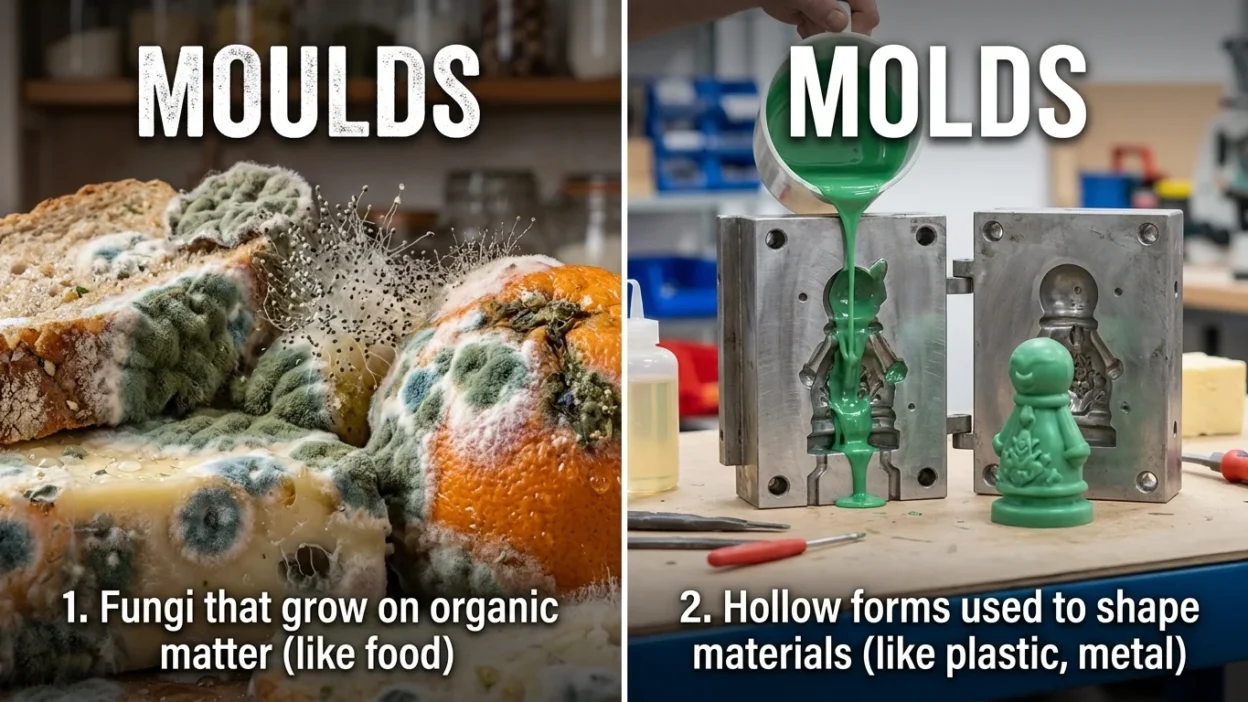
1. Fungus Growing on Food or Walls
This is the most common meaning.
Examples
- There are moulds on the cheese.
- Black molds appeared on the bathroom wall.
These words describe small fungi that grow in wet places.
2. A Shape Used to Form Something
A mold or mould can also be a container or shape used to make objects.
Examples
- Chocolate is poured into molds.
- The artist made clay figures using moulds.
3. A Person or Thing That Shapes Something
Sometimes the word means something that influences or forms character, ideas, or behavior.
Examples
- Teachers help mould young minds.
- Hard experiences can mold a person.
The Main Difference Between Moulds and Molds
The biggest difference is simply regional spelling.
“Moulds”
Used mostly in:
- the United Kingdom
- Australia
- New Zealand
- some other Commonwealth countries
“Molds”
Used mostly in:
- the United States
The pronunciation is almost the same.
Easy Comparison Table
| Feature | Moulds | Molds |
| Type of English | British English | American English |
| Meaning | Same meaning | Same meaning |
| Correct spelling? | Yes | Yes |
| Used in UK? | Very common | Less common |
| Used in USA? | Rare | Very common |
| Pronunciation | Same | Same |
| Example | “Bread has moulds.” | “Bread has molds.” |
Which One Should You Use?
Use “moulds” if:
- You are writing in British English.
- Your school follows UK spelling rules.
- You live in countries that use British spelling.
Example
- “The old house had moulds on the walls.”
Use “molds” if:
- You are writing in American English.
- Your audience is mainly American.
- Your school or workplace uses US spelling.
Example
- “The basement had dangerous molds.”
Important Tip
Do not mix both spellings in the same piece of writing.
For example:
❌ “The molds in the kitchen were caused by moulds on the wall.”
Choose one style and stay consistent.
Different Uses of the Word
As a Noun
The word can name a thing.
Examples
- The molds spread quickly.
- The baker used cake moulds.
As a Verb
The word can also describe shaping something.
Examples
- The artist molds clay carefully.
- Parents help mould children’s habits.
Again:
- British English prefers mould
- American English prefers mold
Common Mistakes People Make
1. Thinking One Spelling Is Wrong
Many learners think only one spelling is correct.
That is not true.
Both are correct in different forms of English.
2. Mixing British and American English
Some people write:
- colour
- favorite
- mould
- center
all in the same article.
This creates inconsistency.
Try to follow one style only.
3. Confusing the Word With “Mold” Meaning Shape
Sometimes learners think:
- mold = shape
- mould = fungus
But actually both spellings can mean both things.
Example
- cake mold
- cake mould
Both are correct depending on region.
4. Wrong Plural Forms
The singular forms are:
- mould
- mold
The plural forms are:
- moulds
- molds
Correct examples
- Several moulds grew on the fruit.
- Different molds were used in the factory.
Everyday Real-Life Examples
In Emails
British English
- “Please clean the moulds in the storage room.”
American English
- “Please remove the molds from the ceiling.”
On Social Media
British English
- “This bread is covered in moulds!”
American English
- “I found strange molds in the fridge.”
In News Reports
British English
- “Experts warned about toxic moulds in old buildings.”
American English
- “Health officials inspected homes for harmful molds.”
In Daily Conversation
British English
- “These ice cube moulds are useful.”
American English
- “I bought new chocolate molds.”
Mould vs Mold in Other Word Forms
Here are some related forms:
| British English | American English |
| mould | mold |
| moulds | molds |
| moulding | molding |
| moulded | molded |
Example Sentences
- British: “The statue was moulded by hand.”
- American: “The statue was molded by hand.”
Short Learning Section for Students and Beginners
Here is an easy way to remember the difference.
Simple Memory Trick
“U” for UK
- mould = UK spelling
No “u” for American spelling:
- mold = US spelling
Easy Practice Sentences
Choose British or American spelling and complete the sentence.
- The bread has green ______.
- The factory uses metal ______.
- The artist carefully ______ the clay.
Possible answers:
- moulds / molds
- moulds / molds
- moulds / molds
Both styles work if used consistently.
Beginner Tip
When reading English:
- British books may use “moulds.”
- American books may use “molds.”
Do not worry. The meaning is usually the same.
FAQ Section
1. Is “moulds” correct English?
Yes. “Moulds” is correct in British English.
2. Is “molds” correct English?
Yes. “Molds” is correct in American English.
3. Do “moulds” and “molds” mean the same thing?
Yes. They usually have the same meaning.
4. Which spelling is more common worldwide?
“Molds” is very common because American English is widely used online and in media. However, “moulds” is still widely used in many countries.
5. How do I know which spelling to use?
Use the spelling style required by:
- your school
- your workplace
- your audience
- your country’s English style
6. Are they pronounced differently?
No. They are pronounced almost the same way.
7. Can both words describe fungus and shaping tools?
Yes. Both spellings can describe:
- fungus
- shaping containers
- forming or shaping something
8. Is “mould” older than “mold”?
The British spelling with “u” reflects older spelling traditions, while American English later simplified many spellings.
Final Conclusion
The difference between moulds and molds is mainly a difference between British English and American English.
- Moulds is the British spelling.
- Molds is the American spelling.
Both are correct, both sound nearly the same, and both carry the same meanings in most situations.
The most important thing is consistency. If you choose British English, use British spellings throughout your writing. If you choose American English, stay with American spellings.
Once you remember that:
- “u” = UK
- no “u” = US
the confusion becomes much easier to understand.

Justin Larry is a talented language writer and content creator at WordHuts.com. She specializes in explaining word differences, grammar tips, and common English mistakes in a clear, practical style. Her engaging content helps readers improve vocabulary, writing skills, and everyday communication, making language learning simple and effective.