Many English learners get confused between presenters and presentors because both words look very similar. They also sound almost the same when spoken quickly. People often see one version online and wonder if both are correct.
The confusion becomes even bigger because English has many words ending in -er and -or, such as:
- teacher
- actor
- creator
- editor
So learners naturally ask:
- Should it be presenter or presentor?
- Which spelling is correct?
- Are both acceptable?
- Which one sounds more natural in modern English?
The good news is that the answer is actually simple once you understand how the words are used.
This article will explain everything in very easy English.
Quick Answer
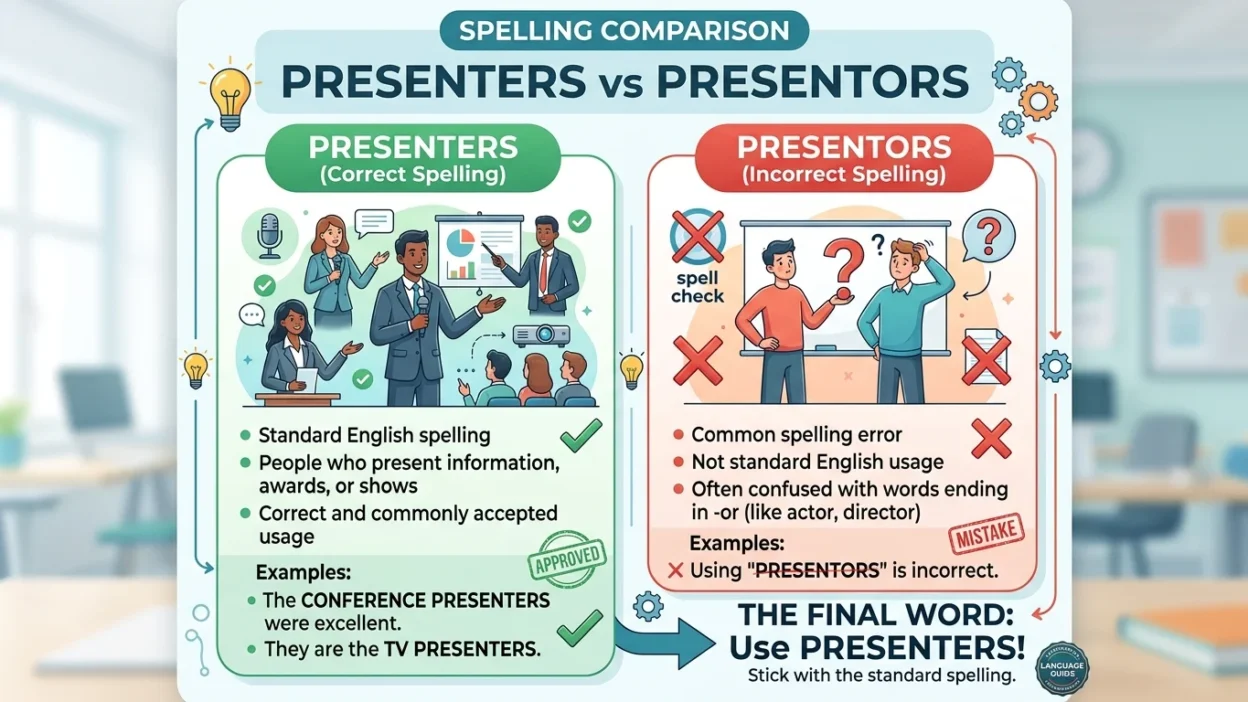
The correct and common word is presenters
Use presenters when talking about:
- TV hosts
- people giving presentations
- award presenters
- speakers
- radio hosts
Example:
- The conference presenters were very professional.
- The TV presenters announced the winners.
“Presentors” is usually considered incorrect or very uncommon
Most modern English dictionaries and style guides prefer:
- presenter (singular)
- presenters (plural)
Simple Background Explanation
The word presenter comes from the verb present.
The ending -er is very common in English for a person who does an action.
Examples:
- teach → teacher
- write → writer
- sing → singer
- present → presenter
This pattern is normal and natural in English.
The spelling presentor appeared sometimes in older or less common usage, but it never became the standard form in everyday English.
Today, most native English speakers use:
- presenter
- presenters
That is why you see it in:
- schools
- business meetings
- television
- news programs
- conferences
What Is the Difference Between Presenters and Presentors?
Presenters
“Presenters” is the standard plural form of presenter.
It means:
people who present something
This could include:
- giving information
- hosting a show
- speaking at an event
- introducing someone
Examples
- The presenters explained the topic clearly.
- The award presenters came onto the stage.
- Morning show presenters usually speak live.
This is the form you should use in almost all situations.
Presentors
“Presentors” is a very rare spelling.
Some people use it by mistake because they think words ending in -or sound more formal or professional.
However, in modern English:
- it is uncommon
- it may look incorrect
- many readers think it is a spelling mistake
Example
- The presentors spoke at the event.
Most teachers and editors would change this to:
- The presenters spoke at the event.
Comparison Table
| Feature | Presenters | Presentors |
| Common in modern English | Yes | No |
| Preferred spelling | Yes | No |
| Used in schools and business | Yes | Rarely |
| Found in dictionaries | Yes | Sometimes, but uncommon |
| Sounds natural to native speakers | Yes | Usually no |
| Recommended for writing | Yes | No |
Which One Should You Use?
Use “presenters” almost every time
This is the safest and most natural choice.
Good situations for “presenters”
- school presentations
- TV programs
- business meetings
- online videos
- award ceremonies
- conferences
- news reports
Examples
- The presenters answered audience questions.
- All presenters must arrive early.
- The sports presenters discussed the match.
Avoid “presentors” in normal writing
Even if some people use it, it is not the standard modern spelling.
Using “presentors” can:
- confuse readers
- look unprofessional
- appear as a spelling error
For students and beginners, it is best to remember only:
- presenter
- presenters
Why Do People Make This Mistake?
There are several reasons.
1. Confusion with words ending in -or
English has many words ending in -or:
- actor
- creator
- director
So learners sometimes expect:
- presentor
But English spelling is not always perfectly regular.
2. Sound confusion
When spoken quickly:
- presenter
- presentor
can sound similar.
This causes spelling mistakes.
3. Internet spelling errors
Sometimes people copy incorrect spellings online without checking.
After seeing “presentors” many times, learners may think it is correct.
Common Mistakes People Make
Mistake 1: Using “presentors” in formal writing
Incorrect:
- The presentors gave excellent speeches.
Correct:
- The presenters gave excellent speeches.
Mistake 2: Mixing both spellings together
Incorrect:
- The presenters and presentors attended the meeting.
Correct:
- The presenters attended the meeting.
Mistake 3: Thinking “presentor” sounds more professional
Some learners believe:
- “-or” endings sound smarter
But native English speakers usually prefer:
- presenter
Simple and correct English is always better.
Everyday Real-Life Examples
In Emails
Correct
- The presenters will join the meeting at 10 AM.
Incorrect
- The presentors will join the meeting at 10 AM.
In School
Correct
- Student presenters should prepare slides.
Incorrect
- Student presentors should prepare slides.
On Television
Correct
- The news presenters discussed the election.
Incorrect
- The news presentors discussed the election.
On Social Media
Correct
- The event presenters were amazing tonight.
Incorrect
- The event presentors were amazing tonight.
In Business Meetings
Correct
- All presenters must submit their reports early.
Incorrect
- All presentors must submit their reports early.
Easy Grammar Tip
A simple way to remember the correct spelling is this:
Most action people words use “-er”
Examples:
- teach → teacher
- read → reader
- work → worker
- present → presenter
So:
- present → presenter
This pattern helps many learners remember the correct form.
Short Learning Section for Students and Beginners
Easy Rule
Correct:
- presenter
- presenters
Avoid:
- presentor
- presentors
Memory Trick
Think about:
- “Someone who presents is a presenter.”
Just like:
- “Someone who teaches is a teacher.”
Both use -er.
Practice Sentences
Fill in the blank:
- The TV __________ announced the winner.
- The conference __________ spoke clearly.
- Our class __________ prepared slides.
Answers
- presenters
- presenters
- presenters
Frequently Asked Questions (FAQ)
1. Is “presentors” a real word?
It exists in very rare usage, but it is not the standard modern spelling.
Most people use:
- presenters
2. Which spelling is correct in modern English?
The correct and preferred spelling is:
- presenters
3. Do native English speakers say “presentors”?
Usually no.
Most native speakers say:
- presenter
- presenters
4. Can I use “presentors” in school writing?
It is better not to.
Teachers will usually expect:
- presenters
5. Why do some people write “presentors”?
Mostly because:
- they hear the sound differently
- they confuse it with other “-or” words
6. Is “presenter” used in business English?
Yes, very often.
Examples:
- conference presenter
- TV presenter
- guest presenter
7. What is the singular form?
The singular form is:
- presenter
Example:
- The presenter introduced the speaker.
8. What is the plural form?
The plural form is:
- presenters
Example:
- The presenters answered questions.
Simple Summary
Correct Forms
- presenter
- presenters
Avoid
- presentor
- presentors
Conclusion
The difference between presenters and presentors is simple once you know the standard modern spelling.
In today’s English, presenters is the correct and widely accepted form. It is used in:
- schools
- business
- television
- conferences
- everyday communication
The spelling presentors is very uncommon and may look incorrect to many readers.
If you want your English to sound natural, clear, and professional, always choose:
- presenter
- presenters
This small spelling choice can make your writing cleaner and easier for everyone to understand.

Justin Larry is a talented language writer and content creator at WordHuts.com. She specializes in explaining word differences, grammar tips, and common English mistakes in a clear, practical style. Her engaging content helps readers improve vocabulary, writing skills, and everyday communication, making language learning simple and effective.