Many English learners get confused by publicly and publically because both words look similar and both seem connected to the word public. When people write quickly, they often wonder which spelling is correct.
The good news is that the difference is actually very simple.
One spelling is the standard and correct form used in modern English, while the other is usually considered a spelling mistake or a less accepted variation.
In this guide, you will learn:
- Which spelling is correct
- Why people get confused
- How to use the word correctly in sentences
- Common mistakes to avoid
- Easy examples from daily life
By the end, the difference will feel clear and easy.
Quick Answer
Publicly vs Publically
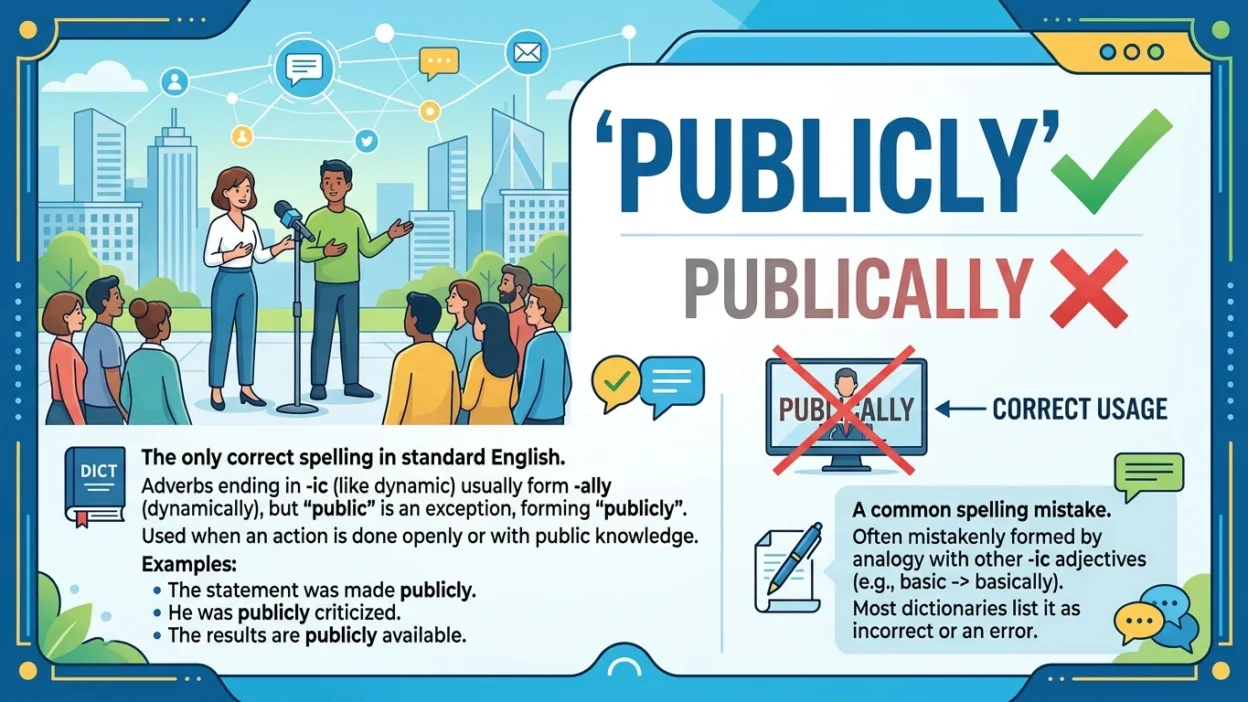
- Publicly = correct and standard spelling
- Publically = usually considered incorrect in modern English
- Use publicly in school writing, emails, news writing, and daily English
- Most dictionaries and grammar guides accept publicly
- Native speakers almost always use publicly
Correct Example
- She publicly apologized for the mistake.
Incorrect or Uncommon Example
- She publically apologized for the mistake.
Simple Background Explanation
The confusion comes from the word public.
Usually, when English words end in -ic, they change before adding -ly.
For example:
- basic → basically
- dramatic → dramatically
- automatic → automatically
Because of this pattern, many people think:
- public → publically
That seems logical.
However, English does not always follow perfect rules. In this case, the accepted spelling became:
- public → publicly
Over time, publicly became the normal and correct form in standard English.
What Does “Publicly” Mean?
The word publicly means:
- openly
- in front of people
- where others can see or hear
- not private
It describes actions that happen in public or are known by many people.
Examples
- The company publicly shared the news.
- He publicly thanked his teacher.
- The singer publicly announced her new album.
In all these examples, the action is open and visible to others.
Why “Publically” Looks Correct
Many learners write publically because they follow common spelling patterns in English.
For example:
| Word | Adverb Form |
| automatic | automatically |
| tragic | tragically |
| basic | basically |
So people naturally expect:
| Word | Expected Form |
| public | publically |
But English developed differently in this case.
The accepted form is still:
- publicly
This is why many spell-check tools mark publically as incorrect.
Clear Explanation of the Difference
Publicly
Meaning
Openly or in front of other people.
Status
Correct and standard spelling.
Used In
- Schools
- Books
- News articles
- Emails
- Business writing
- Social media
- Everyday English
Example
- The actor publicly supported the charity.
Publically
Meaning
Usually intended to mean the same thing as “publicly.”
Status
Nonstandard or incorrect in most modern English writing.
Used In
Sometimes seen:
- in typing mistakes
- older writing
- informal online posts
Example
- The actor publically supported the charity. ❌
Most teachers and editors would change this to publicly.
Comparison Table
| Feature | Publicly | Publically |
| Correct modern spelling | Yes | Usually no |
| Common in books and news | Yes | Rare |
| Accepted in school writing | Yes | Usually no |
| Used by native speakers | Very common | Very uncommon |
| Safe for formal writing | Yes | No |
| Recommended spelling | Yes | No |
Which One Should You Use?
Always Use “Publicly”
If you are writing:
- homework
- essays
- emails
- reports
- business messages
- news content
- online posts
then use:
✅ Publicly
This is the safest and most accepted spelling.
When You May See “Publically”
You might still notice publically online sometimes.
This can happen because:
- someone made a spelling mistake
- autocorrect missed it
- the writer followed a spelling pattern by mistake
- older texts used it
Even if you see it, it is still better to use publicly in your own writing.
Common Mistakes People Make
1. Adding an Extra “al”
Incorrect
- The company publically responded.
Correct
- The company publicly responded.
Many people accidentally add “al” because of words like “basically” or “automatically.”
2. Thinking Both Spellings Are Equally Correct
Some learners believe both versions are standard.
But in modern English, publicly is strongly preferred.
3. Using “Publicly” in the Wrong Situation
Remember that publicly means openly or in front of others.
Correct
- She publicly shared the news.
Not Natural
- She publicly whispered to him.
Whispering is private, so “publicly” sounds strange there.
Everyday Real-Life Examples
In Emails
- The manager publicly thanked the team.
- The school publicly announced the holiday.
In News Writing
- The athlete publicly denied the claim.
- The government publicly released the report.
On Social Media
- She publicly shared her opinion online.
- The actor publicly apologized to fans.
In Daily Conversation
- He publicly supported his friend.
- They publicly celebrated their success.
Easy Sentence Practice
Read these examples carefully.
Correct Sentences
- The teacher publicly praised the student.
- The company publicly admitted the error.
- She publicly spoke about the problem.
- The mayor publicly announced the plan.
- He publicly thanked his parents.
Incorrect Sentences
- The teacher publically praised the student.
- The company publically admitted the error.
Small Learning Tip for Students
A simple trick can help you remember the correct spelling.
Memory Trick
Think:
public + ly = publicly
Do not add:
- “al”
Even though some English words change differently, this one stays simple.
Another easy reminder:
If you are unsure, choose “publicly.”
That choice will almost always be correct.
Publicly in Formal and Informal English
Formal English
Use publicly in:
- academic writing
- reports
- professional emails
- applications
Example
- The company publicly confirmed the information.
Informal English
People also use publicly in:
- texting
- social media
- casual conversation
Example
- He publicly posted the photo online.
The spelling stays the same in both formal and informal situations.
Why Correct Spelling Matters
Using the correct spelling helps your writing look:
- clearer
- more professional
- easier to trust
Incorrect spelling can confuse readers or make writing seem careless.
For students and English learners, learning small spelling differences like this improves overall writing skills.
FAQ Section
1. Which spelling is correct: publicly or publically?
Publicly is the correct and standard spelling in modern English.
2. Is “publically” a real word?
Some people use it, but most dictionaries and grammar experts prefer publicly.
3. Why do people write “publically”?
People often follow common English spelling patterns and accidentally add “al.”
4. Can I use “publically” in school writing?
It is better not to. Teachers usually expect publicly.
5. What does “publicly” mean?
It means openly or in front of other people.
6. Is “publicly” formal or informal?
It works in both formal and informal English.
7. Do native English speakers use “publicly”?
Yes. It is the normal spelling used by native speakers.
8. How can I remember the correct spelling?
Remember this simple form:
- public + ly = publicly
Do not add “al.”
Final Conclusion
The difference between publicly and publically is simple once you understand it clearly.
- Publicly is the correct and accepted spelling.
- Publically is usually considered incorrect or nonstandard.
Even though “publically” may look logical because of other English spelling patterns, modern English strongly prefers publicly in almost every situation.
Whenever you write essays, emails, news reports, or social media posts, choosing publicly will help your English look more natural and correct.
If you remember one thing from this guide, remember this:

Brandon Samuel is a dedicated writer and language enthusiast, serving as the lead author at WordHuts.com. He specializes in explaining word differences, grammar rules, and common language mistakes in simple terms. Brandon’s clear, practical writing style helps readers improve vocabulary, writing confidence, and everyday communication skills.