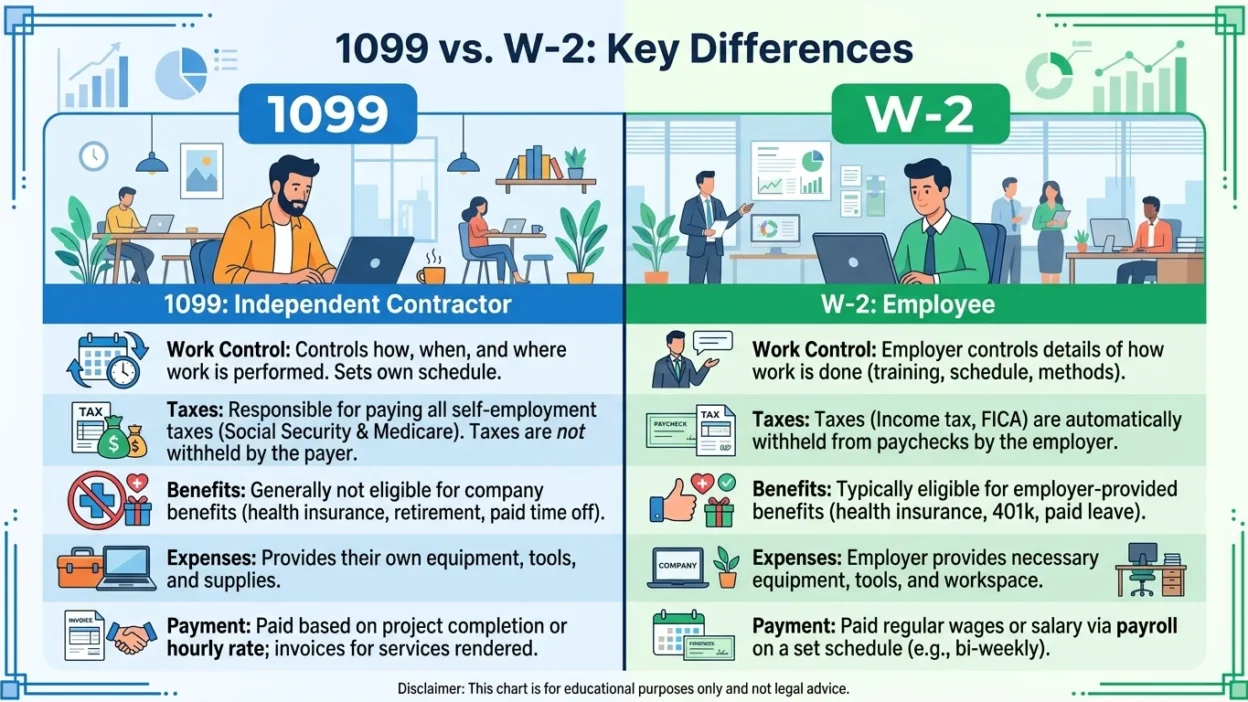
Many people get confused about 1099 vs W-2 because both are tax forms connected to jobs and income. If you are starting your first job, doing freelance work, or learning about taxes for the first time, the names can sound difficult and confusing.
The good news is that the difference is actually simple once you break it down into everyday language.
In basic terms:
- A W-2 worker is usually an employee.
- A 1099 worker is usually an independent contractor or freelancer.
This article explains everything in very simple English so students, beginners, and ESL learners can understand it easily.
Quick Answer: 1099 vs W-2
W-2
- You are an employee of a company
- The company takes taxes out of your paycheck
- You may get benefits like health insurance or paid vacation
- The company controls your work schedule more closely
- You receive a W-2 form at tax time
1099
- You work for yourself or as an independent contractor
- You usually pay your own taxes later
- You normally do not get employee benefits
- You often have more freedom over your schedule
- You receive a 1099 form at tax time
Simple Background Explanation
The names “W-2” and “1099” come from tax forms used in the United States.
These forms tell the government how much money a person earned during the year.
What Is a W-2 Form?
A W-2 form is used for employees. Employers send this form to workers every year. It shows:
- Total pay
- Taxes already taken out
- Social Security taxes
- Medicare taxes
What Is a 1099 Form?
A 1099 form is mostly used for independent workers. It shows how much money someone earned from freelance or contract work.
Taxes are usually not removed before payment.
That is why many freelancers must save money for taxes themselves.
Main Difference Between 1099 and W-2
The biggest difference is this:
W-2 = Employee
A company hires you as part of the business.
1099 = Independent Contractor
You work for yourself and provide services to clients or companies.
Easy Explanation of W-2 Employees
A W-2 employee usually works under company rules.
The employer may decide:
- Your work hours
- Your schedule
- Your duties
- Your workplace
The company also handles part of your taxes automatically.
Common W-2 Jobs
- Teacher
- Office worker
- Nurse
- Store employee
- Hotel worker
- Factory worker
Benefits of W-2 Jobs
Many W-2 employees receive:
- Paid vacation
- Sick leave
- Health insurance
- Retirement plans
- Stable paychecks
Downsides of W-2 Jobs
- Less freedom
- Fixed schedule
- More company control
Easy Explanation of 1099 Workers
A 1099 worker is usually self-employed.
This person may work for different clients instead of one employer.
They often choose:
- When to work
- Where to work
- How to complete the work
Common 1099 Jobs
- Freelance writer
- Graphic designer
- Delivery driver
- Photographer
- Consultant
- Online creator
Benefits of 1099 Work
- More freedom
- Flexible hours
- Ability to work for many clients
- Sometimes higher pay
Downsides of 1099 Work
- Must pay own taxes
- Usually no employee benefits
- Income may change month to month
1099 vs W-2 Comparison Table
| Feature | W-2 | 1099 |
| Worker Type | Employee | Independent contractor |
| Taxes Taken Out Automatically | Yes | Usually no |
| Work Schedule | Controlled by employer | More flexible |
| Benefits | Often included | Usually not included |
| Job Stability | More stable | Can change often |
| Works for One Employer | Usually yes | Often many clients |
| Tax Form Received | W-2 | 1099 |
| Freedom Level | Lower | Higher |
| Responsible for Own Taxes | Partly | Mostly yes |
Which One Should You Choose?
The best choice depends on your lifestyle and goals.
Choose W-2 If You Want:
- Stable income
- Regular work hours
- Employee benefits
- Less tax responsibility
- Long-term job security
W-2 jobs are often good for beginners and people who like routine.
Choose 1099 If You Want:
- Flexible schedules
- Freedom to choose projects
- Remote work opportunities
- Multiple income sources
- Independence
1099 work can be good for creative people or those who enjoy working for themselves.
Common Mistakes People Make
1. Thinking 1099 Means “No Taxes”
This is false.
1099 workers still pay taxes. In fact, they often must handle taxes themselves.
If they do not save money during the year, tax season can become stressful.
2. Believing W-2 Workers Never Do Extra Taxes
Most W-2 workers already have taxes removed from paychecks, but sometimes they still owe additional taxes depending on their situation.
3. Thinking 1099 Workers Are Employees
Some people work full-time for one company but are still labeled as 1099 workers.
This can create confusion because true independent contractors usually control their own work more freely.
4. Forgetting About Benefits
Many beginners only compare salary numbers.
For example:
- A W-2 job may pay less money but include health insurance.
- A 1099 job may pay more but offer no benefits.
Benefits can make a big difference.
5. Not Saving Receipts and Records
1099 workers especially need to track income and expenses carefully.
Good records help during tax filing.
Everyday Real-Life Examples
Example 1: Office Job
Sara works at a bank from 9 AM to 5 PM.
The bank sets her schedule and removes taxes from every paycheck.
She is a W-2 employee.
Example 2: Freelance Designer
Ali designs logos for different companies online.
He chooses his own hours and sends invoices to clients.
He is a 1099 contractor.
Example 3: Social Media Conversation
Someone posts:
“I switched from W-2 to 1099 because I wanted more freedom.”
This means they left traditional employment and started independent work.
Example 4: Family Discussion
A parent might say:
“A W-2 job gives steady income and benefits.”
This usually means a regular employee position.
Example 5: News or Business Talk
You may hear:
“More workers are joining the freelance economy.”
This often refers to people doing 1099-style work.
Simple Learning Section for Students and Beginners
Here is an easy way to remember the difference:
W-2 = Worker With a Boss
Think about:
- Regular schedule
- Company rules
- Taxes removed automatically
1099 = Independent Worker
Think about:
- Freelance jobs
- Flexible schedule
- Self-managed taxes
Quick Memory Trick
W-2
“Works for company”
1099
“Works for self”
This is not perfectly exact in every case, but it helps beginners remember the basic idea.
FAQs
1. Is a 1099 worker self-employed?
Usually yes. Most 1099 workers are independent contractors or freelancers.
2. Do W-2 workers pay taxes?
Yes. Taxes are normally removed automatically from their paychecks.
3. Which pays more: 1099 or W-2?
Sometimes 1099 jobs pay more money upfront, but workers must often pay their own taxes and benefits.
4. Can one person have both W-2 and 1099 income?
Yes. Someone can work a regular job and also do freelance work on the side.
5. Is freelance work always 1099?
Most freelance work uses 1099 forms, but situations can differ depending on the job and payment amount.
6. Which is better for beginners?
Many beginners prefer W-2 jobs because taxes and benefits are simpler.
7. Do 1099 workers get vacation pay?
Usually no. Independent contractors normally do not receive paid vacation from clients.
8. Why do companies hire 1099 workers?
Companies may hire independent contractors for flexibility, short projects, or special skills.
Conclusion
Understanding 1099 vs W-2 becomes much easier when you focus on one main idea:
- W-2 workers are employees
- 1099 workers are independent contractors
A W-2 job usually offers stability, benefits, and automatic tax withholding.
A 1099 job usually offers flexibility, independence, and more control over your schedule.
Neither option is always better for everyone. The right choice depends on your goals, lifestyle, and work preferences.
Once you understand who controls the work, who handles the taxes, and whether benefits are included, the difference becomes much clearer.

Gregory Alexander is a skilled writer and language researcher at WordHuts.com. He focuses on clarifying confusing word pairs, grammar rules, and common usage mistakes. With a passion for precise communication, Gregory creates simple, easy-to-understand content that helps readers strengthen vocabulary, writing accuracy, and everyday English skills.