Many people become confused when they hear the terms bridge and implant while talking about replacing missing teeth. Both are common dental solutions, and both can help improve your smile, chewing ability, and confidence.
Because they are used for a similar purpose, some people think they are the same thing. However, a bridge and an implant work in very different ways.
This guide explains the difference between a bridge and an implant in very simple English. By the end, you will know what each one is, how it works, and when it may be used.
Quick Answer
If you want a fast explanation, here it is:
- A bridge replaces a missing tooth by using nearby teeth for support.
- An implant replaces a missing tooth by placing an artificial root into the jawbone.
- A bridge usually does not require surgery.
- An implant usually requires a surgical procedure.
- Implants often last longer than bridges.
- Bridges are usually completed faster than implants.
- Both can improve appearance and chewing ability.
Simple Background Explanation
People have looked for ways to replace missing teeth for hundreds of years.
When a tooth is lost because of injury, decay, or disease, a gap remains. This gap can make eating difficult and may affect a person’s smile.
Over time, dentists developed different methods to replace missing teeth. Two of the most common modern options are:
- Dental bridges
- Dental implants
Both are designed to fill the empty space left by a missing tooth, but they do it differently.
What Is a Dental Bridge?
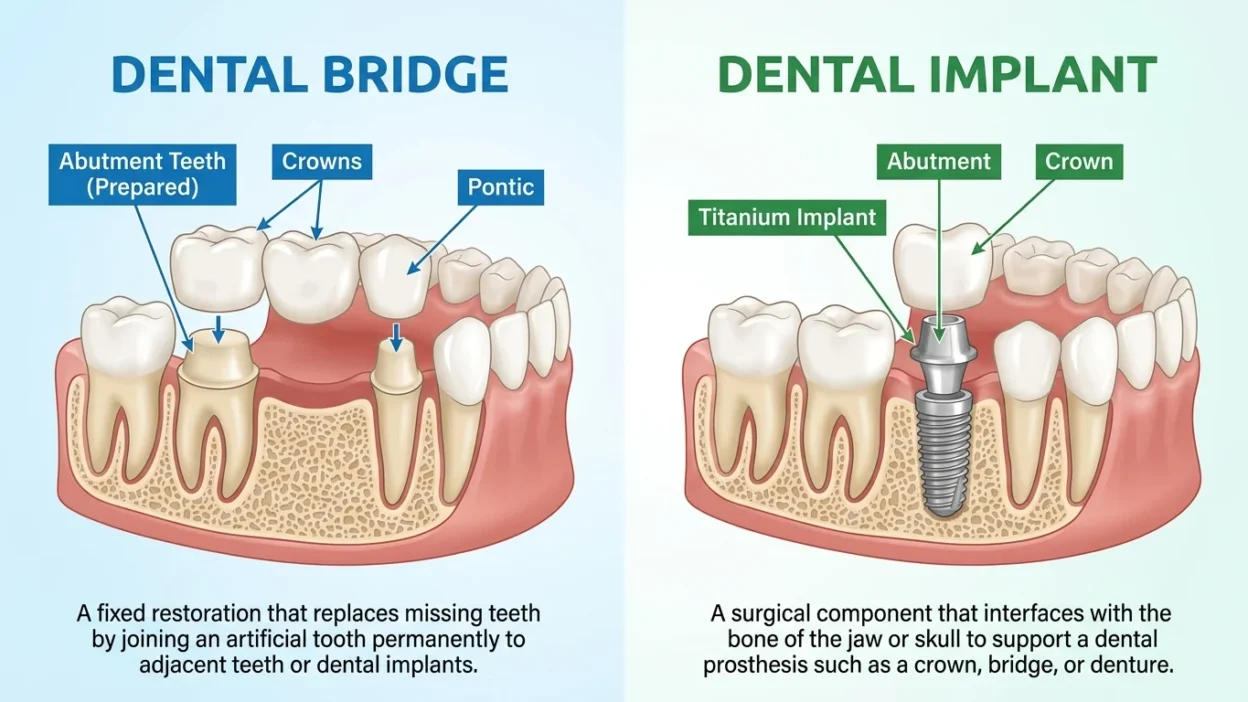
A dental bridge is a false tooth that fills the space where a tooth is missing.
The bridge is supported by the teeth on either side of the gap. These supporting teeth help hold the replacement tooth in place.
Imagine a small bridge crossing a river. The ends of the bridge are supported by land on both sides. A dental bridge works in a similar way.
Main Features of a Bridge
- Replaces one or more missing teeth
- Uses nearby teeth for support
- Usually does not involve placing a root into the jawbone
- Can improve appearance and function
Example
If you lose a tooth between two healthy teeth, a dentist may place a bridge that connects to those neighboring teeth.
What Is a Dental Implant?
A dental implant is a replacement tooth system that includes an artificial root.
The implant is placed into the jawbone. After healing, a replacement tooth is attached to it.
Because the implant is connected to the bone, it works more like a natural tooth.
Main Features of an Implant
- Replaces a missing tooth
- Includes an artificial root
- Is placed into the jawbone
- Usually requires surgery
- Functions similarly to a natural tooth
Example
If you lose a tooth, a dentist may place a metal post into your jawbone. Once it heals, a new tooth is attached to that post.
The Main Difference Between Bridge and Implant
The biggest difference is how the replacement tooth is supported.
A bridge depends on nearby teeth.
An implant depends on the jawbone.
Bridge
- Supported by neighboring teeth
- Does not replace the tooth root
- Usually completed more quickly
Implant
- Supported by the jawbone
- Replaces the tooth root
- Usually takes longer because healing is needed
Think of it this way:
- A bridge is supported by other teeth.
- An implant stands on its own.
Bridge vs Implant Comparison Table
| Feature | Bridge | Implant |
| Purpose | Replace missing teeth | Replace missing teeth |
| Support | Nearby teeth | Jawbone |
| Replaces root | No | Yes |
| Surgery needed | Usually no | Usually yes |
| Treatment time | Often shorter | Often longer |
| Healing period | Usually shorter | Usually longer |
| Works independently | No | Yes |
| Long-term durability | Good | Often very good |
| Effect on nearby teeth | Uses neighboring teeth | Usually does not rely on neighboring teeth |
| Appearance | Natural-looking | Natural-looking |
Which One Should You Use and When?
There is no single answer that fits everyone.
The best choice depends on several factors.
A Bridge May Be Used When:
- A person wants a faster solution
- Nearby teeth can support the bridge
- Surgery is not preferred
- The dental situation makes a bridge suitable
An Implant May Be Used When:
- A person wants a tooth replacement that stands alone
- The jawbone can support an implant
- A longer treatment process is acceptable
- Long-term stability is important
A dentist examines the teeth, gums, and jawbone before recommending the most suitable option.
Common Mistakes People Make
1. Thinking They Are the Same Thing
Many people use the words interchangeably.
A bridge and an implant both replace missing teeth, but they are different treatments.
2. Assuming Implants Are Always Better
Implants have advantages, but they are not automatically the best choice for every person.
Each case is different.
3. Believing Bridges Are Old-Fashioned
Bridges are still widely used today and can be effective for many patients.
4. Ignoring Treatment Time
Some people are surprised that implant treatment can take several months because healing is often required.
5. Focusing Only on Appearance
Both options can look natural. The decision should also consider comfort, health, treatment time, and dental needs.
Everyday Real-Life Examples
Seeing the words in context can make them easier to understand.
In a Dental Office
Patient: “I lost a tooth last year.”
Dentist: “We can discuss whether a bridge or an implant would work best for you.”
In an Email
“I have an appointment next week to learn more about getting a dental implant.”
In a News Article
“A local clinic reported increased interest in dental implants among adults with missing teeth.”
On Social Media
“My bridge helped fill the gap in my smile.”
In Daily Conversation
“My dentist said an implant may be a good option for replacing my missing tooth.”
Learning Section for Students and Beginners
A simple memory trick can help.
Remember This:
Bridge = Supported by other teeth
Think of a bridge crossing from one side to another.
The replacement tooth is held by teeth around it.
Implant = Inserted into the jawbone
Think of planting a post into the ground.
The implant is placed into the bone and supports the new tooth.
Quick Practice
Which option uses nearby teeth for support?
Answer: Bridge
Which option includes an artificial root in the jawbone?
Answer: Implant
Which option usually requires surgery?
Answer: Implant
Frequently Asked Questions (FAQ)
1. What is the main difference between a bridge and an implant?
A bridge uses neighboring teeth for support, while an implant is supported by the jawbone.
2. Which looks more natural?
Both can look very natural when properly made and fitted.
3. Does an implant replace the tooth root?
Yes. An implant replaces the missing root as well as supporting the replacement tooth.
4. Does a bridge replace the tooth root?
No. A bridge fills the gap but does not replace the root inside the jawbone.
5. Is surgery required for a bridge?
Usually, a bridge does not require implant surgery.
6. Is surgery required for an implant?
Yes. An implant is generally placed through a surgical procedure.
7. Which treatment takes longer?
Implants usually take longer because healing time is often needed before the final tooth is attached.
8. Can both replace a missing tooth?
Yes. Both bridges and implants are common ways to replace missing teeth.
Conclusion
The difference between a bridge and an implant comes down to how the replacement tooth is supported.
A bridge uses nearby teeth to hold the replacement tooth in place. An implant uses an artificial root placed in the jawbone and functions more independently.
Both options can restore a smile, improve chewing, and replace missing teeth. The right choice depends on a person’s dental condition, treatment goals, and professional dental advice.
If you remember one simple rule, remember this:
A bridge is supported by other teeth, while an implant is supported by the jawbone. This single idea makes the difference much easier to understand.

Gregory Alexander is a skilled writer and language researcher at WordHuts.com. He focuses on clarifying confusing word pairs, grammar rules, and common usage mistakes. With a passion for precise communication, Gregory creates simple, easy-to-understand content that helps readers strengthen vocabulary, writing accuracy, and everyday English skills.