
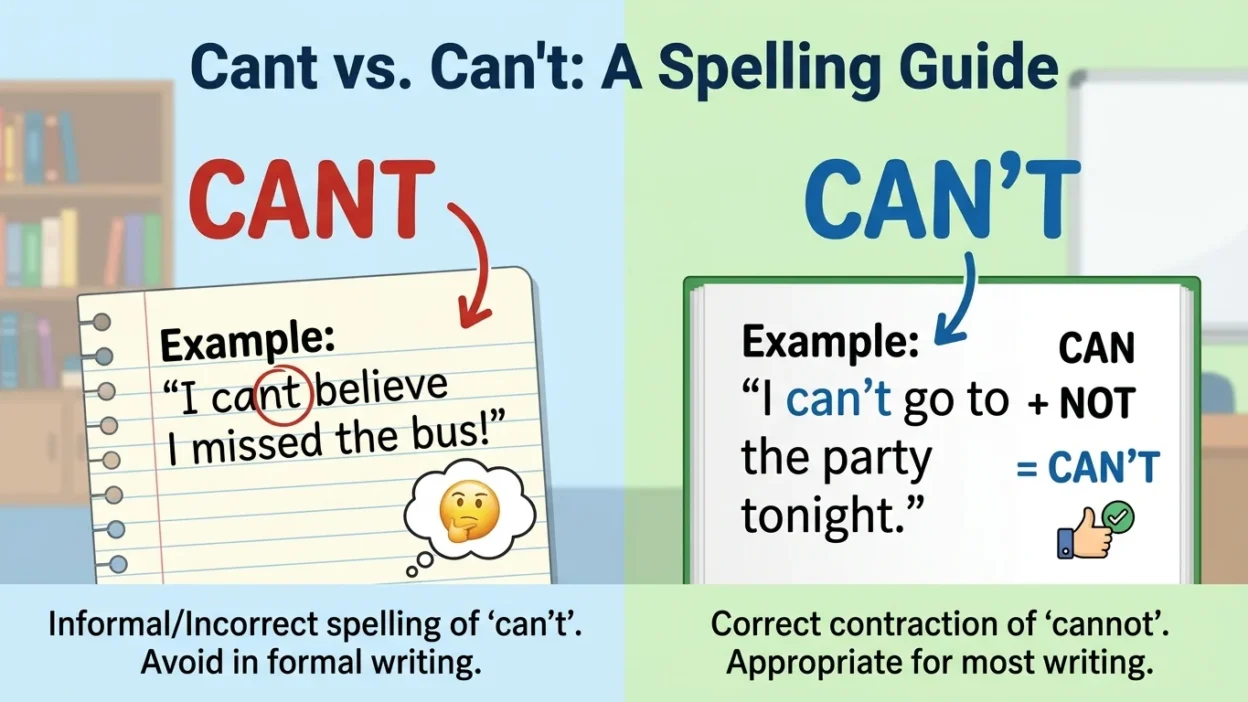
Many people get confused by cant and can’t because they look almost the same. The only visible difference is the apostrophe (‘). Because of this, students, ESL learners, and even native English speakers sometimes wonder if they mean the same thing.
The truth is that can’t is a very common English word, while cant is a completely different word with a different meaning. In most everyday situations, people actually mean can’t when they write.
This guide explains the difference in simple English so you can use both words correctly and avoid common mistakes.
Quick Answer
- Can’t = short form of cannot.
- Cant = a less common word with special meanings.
- In everyday English, can’t is used much more often.
- If you mean “unable to do something,” use can’t.
- If you accidentally leave out the apostrophe, you may change the meaning of the sentence.
Examples
✅ I can’t swim.
✅ She can’t come today.
✅ We can’t find the keys.
❌ I cant swim. (Incorrect in normal writing)
Simple Background Explanation
The word can’t comes from combining two words:
- can
- not
When these words are joined together, the apostrophe replaces missing letters:
- cannot → can’t
This is called a contraction.
The word cant, without an apostrophe, has existed in English for hundreds of years. It developed separately and does not mean “cannot.”
Because can’t is extremely common and cant is uncommon, people often assume they are the same word. They are not.
What Does “Can’t” Mean?
Can’t means:
- cannot
- not able to
- not allowed to
Examples
- I can’t drive.
- She can’t speak Spanish.
- We can’t enter this room.
- They can’t finish the project today.
In all these examples, can’t means that something is impossible, not allowed, or not able to happen.
More Examples
- You can’t park here.
- He can’t hear you.
- The dog can’t open the door.
- I can’t remember her name.
This is the meaning most learners need.
What Does “Cant” Mean?
Cant is a real English word, but it is not common in everyday conversation.
It can have several meanings depending on the situation.
Meaning 1: Special Language Used by a Group
Sometimes cant means special words or expressions used by a certain group of people.
Example:
- The group spoke in a secret cant.
Meaning 2: Insincere or Repeated Speech
It can also mean speech that sounds false, empty, or repeated without real feeling.
Example:
- He was tired of hearing political cant.
Meaning 3: A Slope or Tilt
In some technical situations, cant can mean a slant, angle, or tilt.
Example:
- The road has a slight cant.
These meanings are much less common than the everyday meaning of can’t.
The Difference Between Cant and Can’t
The easiest way to remember the difference is this:
Can’t
Means:
- cannot
- unable to
- not permitted
Example:
- I can’t help today.
Cant
Means:
- special language
- empty speech
- a tilt or angle
Example:
- The track has a slight cant.
These meanings are completely different.
Comparison Table
| Word | Meaning | Common? | Example |
| Can’t | Cannot; not able to | Very common | I can’t go. |
| Cant | Special language, empty speech, or a tilt | Uncommon | The road has a cant. |
| Can’t | Negative form of can | Very common | She can’t swim. |
| Cant | Separate noun with special meanings | Rare | He disliked the cant. |
Which One Should You Use and When?
Use “Can’t” When:
You mean:
- cannot
- unable to
- not allowed
Examples:
- I can’t find my phone.
- She can’t attend the meeting.
- We can’t stay longer.
- You can’t enter without a ticket.
Use “Cant” When:
You are talking about:
- special group language
- empty or insincere speech
- a slope or tilt
Examples:
- The engineer measured the cant of the track.
- The article criticized political cant.
Easy Rule
If you can replace the word with cannot, then use can’t.
Example:
- I can’t go.
- I cannot go.
Both work.
But:
- I cant go.
This is incorrect because “cant” does not mean “cannot.”
Common Mistakes People Make
Mistake 1: Forgetting the Apostrophe
❌ I cant come today.
✅ I can’t come today.
The apostrophe is important because it shows that the word is a contraction.
Mistake 2: Typing Too Fast
Many people accidentally write:
❌ She cant swim.
Instead of:
✅ She can’t swim.
This often happens in text messages or online comments.
Mistake 3: Thinking Both Words Mean the Same Thing
Some learners believe:
- cant = can’t
This is not correct.
The apostrophe changes the word and its meaning.
Mistake 4: Using “Cant” in Formal Writing by Accident
When proofreading, check carefully for missing apostrophes.
Example:
❌ We cant accept the offer.
✅ We can’t accept the offer.
Everyday Real-Life Examples
In Emails
✅ I can’t attend tomorrow’s meeting.
✅ We can’t process your request today.
On Social Media
✅ I can’t stop laughing at this video.
✅ I can’t believe it’s already Friday.
In News Reports
✅ Officials said they can’t confirm the information yet.
✅ Experts say the problem can’t be solved overnight.
At School
✅ I can’t understand this question.
✅ We can’t use calculators during the test.
At Home
✅ Dad can’t find his glasses.
✅ I can’t open this jar.
At Work
✅ She can’t finish the report today.
✅ We can’t change the schedule now.
Learning Section for Students and Beginners
Here is a simple way to remember the difference.
Step 1
Ask yourself:
Do I mean “cannot”?
If yes, write can’t.
Example:
- I can’t wait.
- We can’t leave.
Step 2
Try replacing it with “cannot.”
Example:
- I can’t swim.
- I cannot swim.
Both sentences work.
That means can’t is correct.
Step 3
If the sentence sounds strange after replacing it with “cannot,” you may need another word.
Example:
- The road has a cannot.
This makes no sense.
In this case, the correct word might be cant if you are discussing a slope or angle.
Memory Trick
Think of the apostrophe as a reminder that letters are missing.
- can + not = can’t
No apostrophe?
Then it is the separate word cant.
Frequently Asked Questions
1. Is “cant” a real word?
Yes. It is a real English word, but it has different meanings and is much less common than can’t.
2. Is “can’t” the same as “cannot”?
Yes. Can’t is the short form of cannot.
Example:
- I can’t go.
- I cannot go.
Both mean the same thing.
3. Which word is more common?
Can’t is far more common in everyday English.
4. Can I write “cant” instead of “can’t”?
No.
If you mean “cannot,” you should write can’t.
5. Why is the apostrophe important?
The apostrophe shows that letters have been removed from “cannot.”
Without it, you create a different word.
6. Is “can’t” formal or informal?
Can’t is usually considered less formal than cannot, but it is widely accepted in everyday writing and speech.
7. Do native English speakers make this mistake?
Yes. Many people accidentally type cant when they mean can’t, especially when writing quickly.
8. How can I remember the difference?
Remember this simple rule:
- Can’t = cannot
- Cant = different word with special meanings
If you mean “not able to,” always use can’t.
Conclusion
The difference between cant and can’t is simple once you know what each word means.
Can’t is the contraction of cannot and is one of the most common words in English. It means that something is not possible, not allowed, or cannot be done.
Cant, without an apostrophe, is a separate word with uncommon meanings such as special group language, empty speech, or a slope or tilt.
For most everyday writing, conversations, emails, social media posts, school assignments, and work messages, you will usually need can’t. Whenever you can replace the word with cannot, you know that can’t is the correct choice.
Remember:
- Can’t = cannot
- Cant = a different word
Keeping that small apostrophe in place will help you write clear and correct English every time.

Brandon Samuel is a dedicated writer and language enthusiast, serving as the lead author at WordHuts.com. He specializes in explaining word differences, grammar rules, and common language mistakes in simple terms. Brandon’s clear, practical writing style helps readers improve vocabulary, writing confidence, and everyday communication skills.